

Teeth whitening is one of the most popular cosmetic dental treatments. A whiter smile can instantly boost confidence, enhance appearance, and leave a lasting impression. But once you’ve achieved a brighter smile, how long will it actually stay that way?
The answer depends on a few key things: The whitening method you choose, your lifestyle habits (like diet and smoking), and how well you care for your teeth after whitening.
In this guide, we’ll break down what affects whitening longevity, which treatments last the longest, and what you can do to keep your results shining for as long as possible.
Key Takeaways
-
In-office whitening can last one to three years. At-home kits typically last three to six months, longer with regular touch-ups.
-
Research backs this up. A peer-reviewed study in the International Journal of Dentistry (PMC3124242) tracked 34 people using 10% carbamide peroxide at home and found significant whitening still held at six months, with relapse rates of 18 to 27% depending on the product.
-
A 2022 narrative review in ScienceDirect found that one study reported a 45% reduction in measurable color improvement at just six months post-whitening, and that Haywood documented regression in 26% of cases by 18 months.
-
Your daily habits have more impact on how long results last than the product itself does.
-
The 48 hours right after whitening are critical. What you eat and drink in that window can reverse results within days.
-
Touch-ups matter more than most people think. Without them, even professional results fade noticeably within months.
What Is Teeth Whitening?
Teeth whitening is a cosmetic dental procedure that lightens the natural color of your teeth by removing surface stains and discoloration. It’s one of the most accessible ways to improve the look of your smile, and it's incredibly popular for a reason.
In fact, teeth whitening is the top dental treatment in the U.S., accounting for 32% of all dental office visits. Why? Because 99.7% of people believe a smile is an important social asset. A bright smile often signals health, youth, and confidence.
The demand isn't just limited to cosmetic trends in the U.S., it’s global. According to a 2016 survey by a London dental clinic (reported by White Dental Beauty), 84% of people feel increased pressure to have a perfect smile, largely due to the growing visibility of adult braces, influencer culture, and celebrity dental makeovers.
Whether you’re prepping for a big event or simply want to feel more confident day-to-day, teeth whitening offers a fast, effective, and widely available solution for refreshing your smile.
How Long Each Whitening Method Actually Lasts
Let's get specific. Teeth whitening can last for different lengths of time depending on the method, not the optimistic version on most product pages.
There are different types of whitening methods, and here's a breakdown of what the research actually says about each one.
|
Whitening Method |
How Long It Lasts |
What Affects It Most |
|---|---|---|
|
In-office whitening |
1 to 3 years |
Diet, tobacco use, and how well you maintain things afterward |
|
At-home trays (dentist-supervised) |
6 months to 2 years |
Consistency of touch-ups and peroxide concentration used |
|
At-home LED kits (e.g., SNOW) |
3 to 6 months (longer with touch-ups) |
How often you use it, and what you eat and drink |
|
Over-the-counter whitening strips |
2 weeks to 6 months |
Usage frequency and staining habits |
|
Whitening toothpaste |
2 to 8 weeks |
Brushing consistency; surface stain management only |
In-Office Whitening: One to Three Years
This is the longest-lasting option, and the reason why is simple: In-office treatments use the highest hydrogen peroxide concentrations available, typically 25% to 40%, applied under professional supervision, usually in just one visit for noticeable results faster than at-home options and more long lasting effects.
In laser whitening, the laser activates the whitening agent for immediate results.
A 2024 double-blinded randomized controlled trial published in PMC confirmed significant whitening efficacy at six months across all hydrogen peroxide concentrations tested. With a clean diet and good maintenance, your results can genuinely hold for up to three years.
Without maintenance, though, the same results can fade within six to 12 months. The treatment is only part of the equation.
At-Home Trays (Dentist-Supervised): Six Months to Two Years
A study tracking 92 people using carbamide peroxide at home over two years, published on ResearchGate, found that tooth shade was still significantly lighter than baseline at the two-year mark.
With custom trays, the gel is applied directly against the teeth for even contact, and the trays are usually worn for small periods each day during the whitening cycle.
The caveat: More than 66% of participants reported mild to moderate relapse, which tracked directly with their staining food and drink consumption.
This is the pattern you'll see across the research. Results are real and they hold, but only if you keep up with touch-ups every three to six months.
At-Home LED Kits: Three to Six Months (Longer With Touch-Ups)
At-home LED kits like SNOW® use controlled concentrations of hydrogen peroxide and carbamide peroxide activated by LED light. The peroxide levels are lower than in-office treatments, which means consistent maintenance is what separates three months of results from six.
A 2023 study in Medicina (DOI: 10.3390/medicina59061130) found that at-home whitening results showed only minor reduction at six months when maintenance sessions were followed.
Two to three short sessions per week after your initial cycle is usually enough to keep your shade where you want it.
Whitening Strips: Two Weeks to Six Months
Whitening strips are accessible and easy to use, and they’re also among the most effective over-the-counter tooth whiteners for home use, but they sit at the lower end of the duration range. Lower peroxide concentration and shorter contact time mean your results fade faster than with tray-based systems.
According to Aspen Dental, citing Colgate-Palmolive (2024), strips can last up to six months after a full treatment cycle. That's the ceiling, not the average. Without lifestyle adjustments and consistent oral hygiene, results often start to fade within a few months, and most people see noticeable fade much sooner.
Whitening Toothpaste: Two to Eight Weeks
Whitening toothpaste works through mild abrasive action on surface deposits. It doesn't contain peroxide at concentrations that penetrate enamel meaningfully, so results are modest and limited to surface brightening. Think of it as a maintenance tool between whitening cycles, not a standalone treatment for significant staining.
What Actually Makes Teeth Whitening Fade Faster
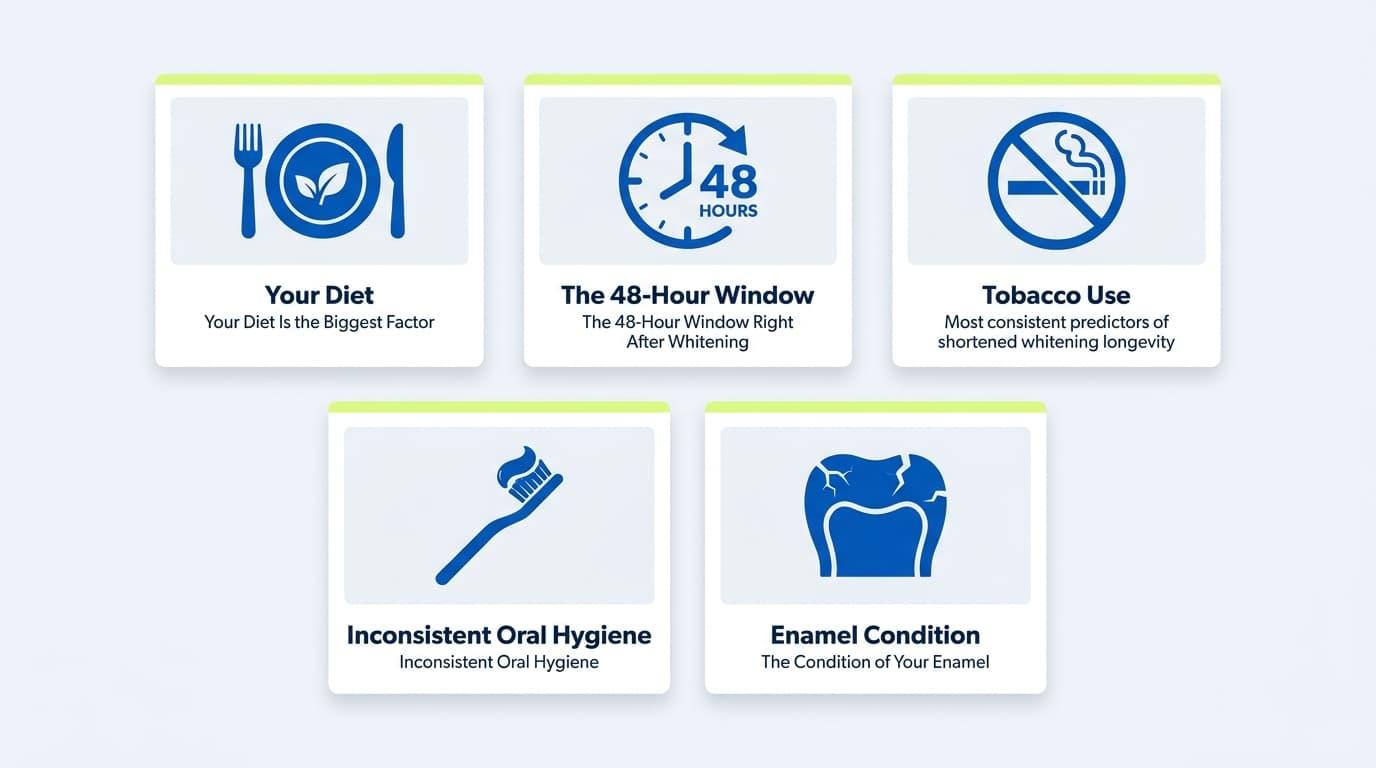
This is the section most people skip, and it's usually why their results don't last as long as expected.
Your results don't just disappear on their own. They fade in response to specific habits.
Your Diet Is the Biggest Factor
The issue isn't a single cup of coffee or one glass of red wine at dinner. It's the daily, repeated exposure to certain foods and drinks that builds up over weeks and months.
Each staining episode alone is minor. When you're consuming pigment-heavy foods and drinks every day, though, the cumulative effect accelerates and fades faster than you'd expect. Your enamel absorbs those pigments gradually, and the brightness you worked for starts dulling sooner than it should.
Here's a quick breakdown of staining risk by food and drink. Use this as a reference when planning what to eat or avoid right after whitening:
|
High Staining Risk |
Medium Staining Risk |
Low Staining Risk |
|---|---|---|
|
Coffee (especially dark roast) |
Green tea |
White wine |
|
Red wine |
Blueberries and dark berries |
Sparkling water |
|
Black tea |
Tomato-based sauces |
White or light-colored foods |
|
Soy sauce and balsamic vinegar |
Dark fruit juices |
Milk and dairy |
|
Tobacco (smoking or chewing) |
Curry and turmeric |
Chicken and fish |
A quick tip: Drink water with meals and rinse immediately after consuming high-staining foods or drinks. It doesn't eliminate the effect, but it reduces how long those pigments stay in contact with your teeth.
The 48-Hour Window Right After Whitening
This is the window that can seriously undermine your results if you ignore it.
Whitening temporarily opens enamel tubules, the tiny channels running through tooth structure. For about 48 hours after a session, those channels are more permeable than usual, meaning pigment from food and drink can enter faster and bind more readily than at any other time.
What you eat and drink in the first 48 hours after whitening has a disproportionate impact on how long your results hold.
Stick to light-colored foods and plain water right after treatment. Re-staining during this window can reverse results within days, not weeks.
Tobacco Use
Tobacco is in its own category. Cigarettes and chewing tobacco introduce tar and nicotine directly onto tooth surfaces, and these compounds don't just sit on the enamel; they penetrate it.
That means staining that goes deeper than typical food and drink stains. Whitening agents work best on surface and near-surface discoloration. When staining has penetrated deeper layers, results fade faster and are harder to maintain between sessions.
A 2022 narrative review in ScienceDirect identifies tobacco use as one of the most consistent predictors of shortened whitening longevity, alongside daily dietary pigment consumption and oral hygiene level.
Inconsistent Oral Hygiene
This one seems obvious, but it's easy to underestimate how much it actually matters.
When oral hygiene habits like brushing and flossing are inconsistent, surface stains from food, drink, and daily exposure accumulate on the enamel without interruption.
Regular brushing removes early-stage deposits before they have time to set; flossing clears buildup from between your teeth, where discoloration often starts and spreads.
The cleaner your teeth stay between whitening sessions, the longer your results tend to hold. It's one of the simplest, most reliable things you can do to extend your results, especially if strong oral hygiene habits stay in place.
The Condition of Your Enamel
This one gets overlooked a lot, but it matters more than most people realize.
Thinner or compromised enamel is more porous, which means it reabsorbs staining pigments more readily after treatment. The whitening reaction may also be less consistent on compromised enamel, leading to results that are uneven or shorter-lived.
If your enamel is already in rough shape, your whitening results won't hold as well as they would on healthy enamel. Addressing tooth condition before starting a whitening routine helps.
Extrinsic vs. Intrinsic Stains: Why the Difference Matters for Whitening
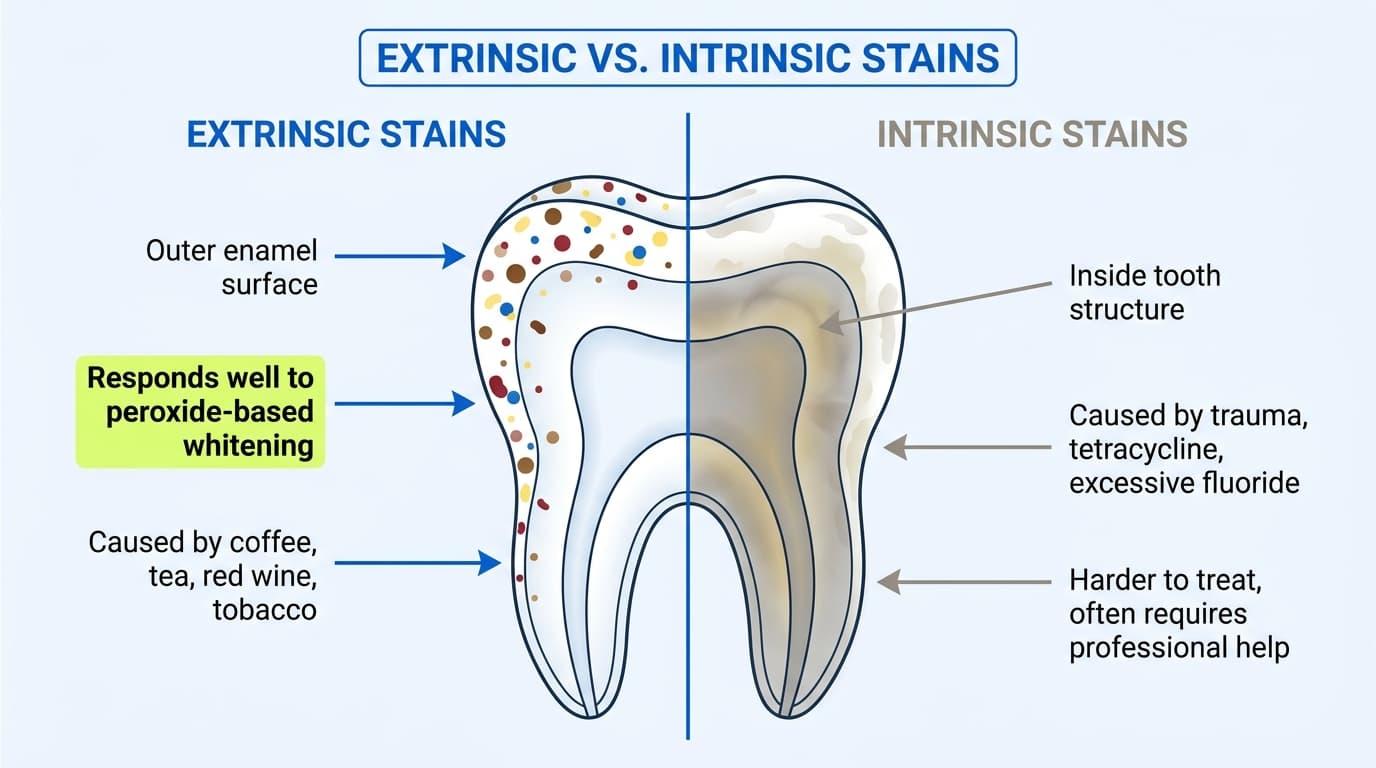
Not all tooth discoloration responds to whitening the same way. Knowing which type you're dealing with saves a lot of frustration and sets you up for realistic expectations.
Extrinsic Stains
These live on the outer surface of your enamel. Coffee, tea, red wine, and tobacco are the main culprits.
Because they're on or just below the surface, they respond well to peroxide-based whitening and are generally easier to treat than deeper discoloration.
Hydrogen peroxide breaks apart the stain molecules through oxidation, which is why these stains lift noticeably with consistent treatment.
Results also tend to last longer when you manage the underlying habits.
Intrinsic Stains
These originate inside the tooth structure itself.
Intrinsic stains can develop inside the tooth from trauma or medications such as tetracycline, as well as from excessive fluoride exposure during development.
Because the staining is deeper than the enamel surface, whitening agents have a harder time reaching it.
Results are possible, but these stains are harder to treat than surface stains and often require professional help.
How Your Starting Shade Plays Into It
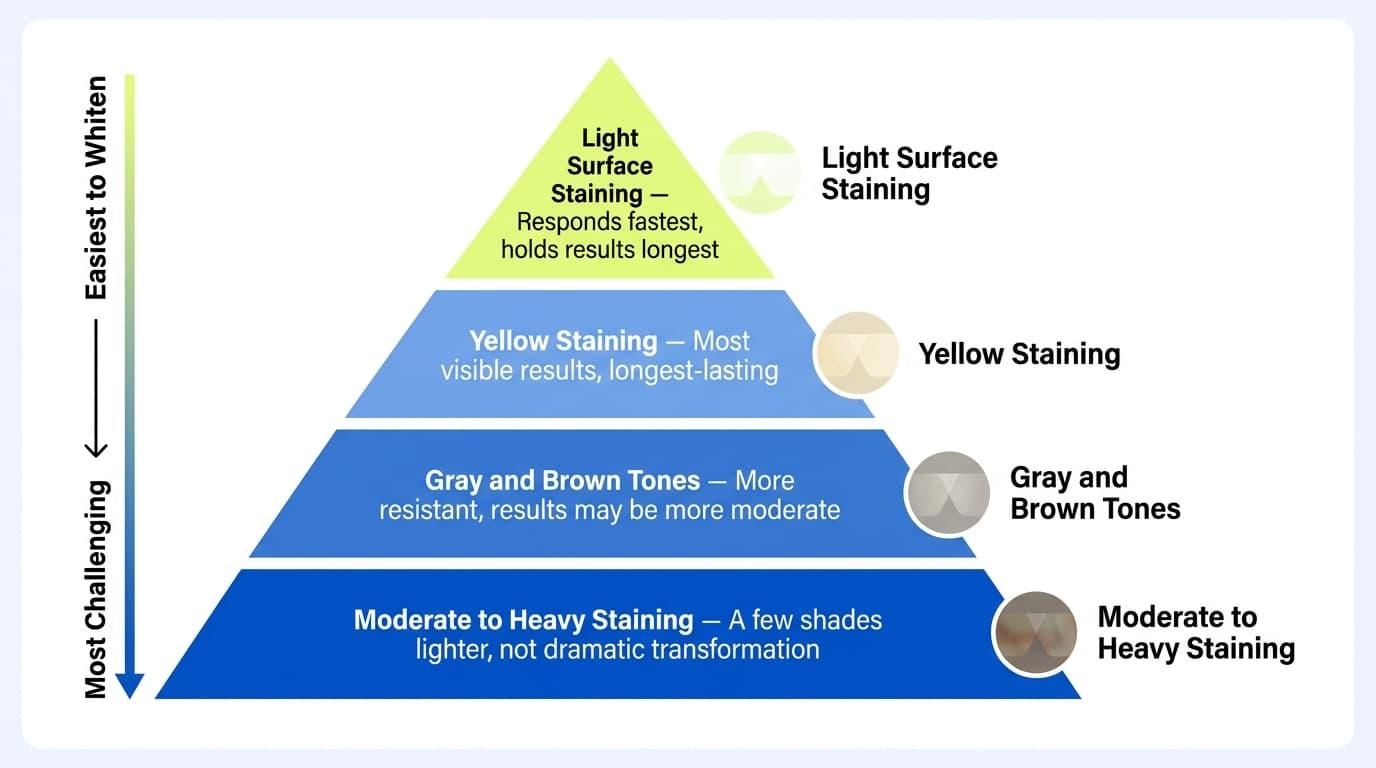
The type of staining and your starting shade both influence what you can realistically expect. Here's the honest breakdown:
-
Yellow staining: Generally the most responsive to peroxide-based whitening. Results tend to be the most visible and the longest-lasting.
-
Gray and brown tones: More resistant. More sessions may be needed, and results may be more moderate.
-
Light surface staining: Responds fastest and holds results longest.
-
Moderate to heavy staining: Can still improve, but expect a few shades lighter rather than a dramatic transformation.
Whitening lifts your natural shade. It doesn't produce an unnaturally bright result.
For most people with extrinsic staining, the outcome is a genuinely brighter, cleaner version of your own smile.
Have Crowns, Veneers, or Fillings? Read This Before You Start
This is one of the most common things that catches people off guard.
Dental restorations don't respond to whitening the way natural teeth do. Whitening works by triggering an oxidation reaction inside natural tooth enamel; that process only works on natural enamel. Restorations are synthetic, so they stay exactly the shade they were when placed.
The following will not change color with whitening, regardless of how many sessions you do:
-
Dental crowns
-
Porcelain veneers
-
Composite bonding
-
Tooth-colored fillings
In practice, this means whitening the natural teeth around a restoration can create a visible mismatch.
Your natural teeth get brighter; the restoration stays the same shade. That can stand out, especially in the front of your smile.
This isn't a reason to skip whitening. It's just worth knowing before you start so you can plan accordingly. If any restorations are in a visible area, a quick conversation with your dentist helps you understand what the result will realistically look like.
The ADA's guidance on whitening covers this directly and is worth reading if you have restorations and are weighing your options.
Tips to Prolong Teeth Whitening Results
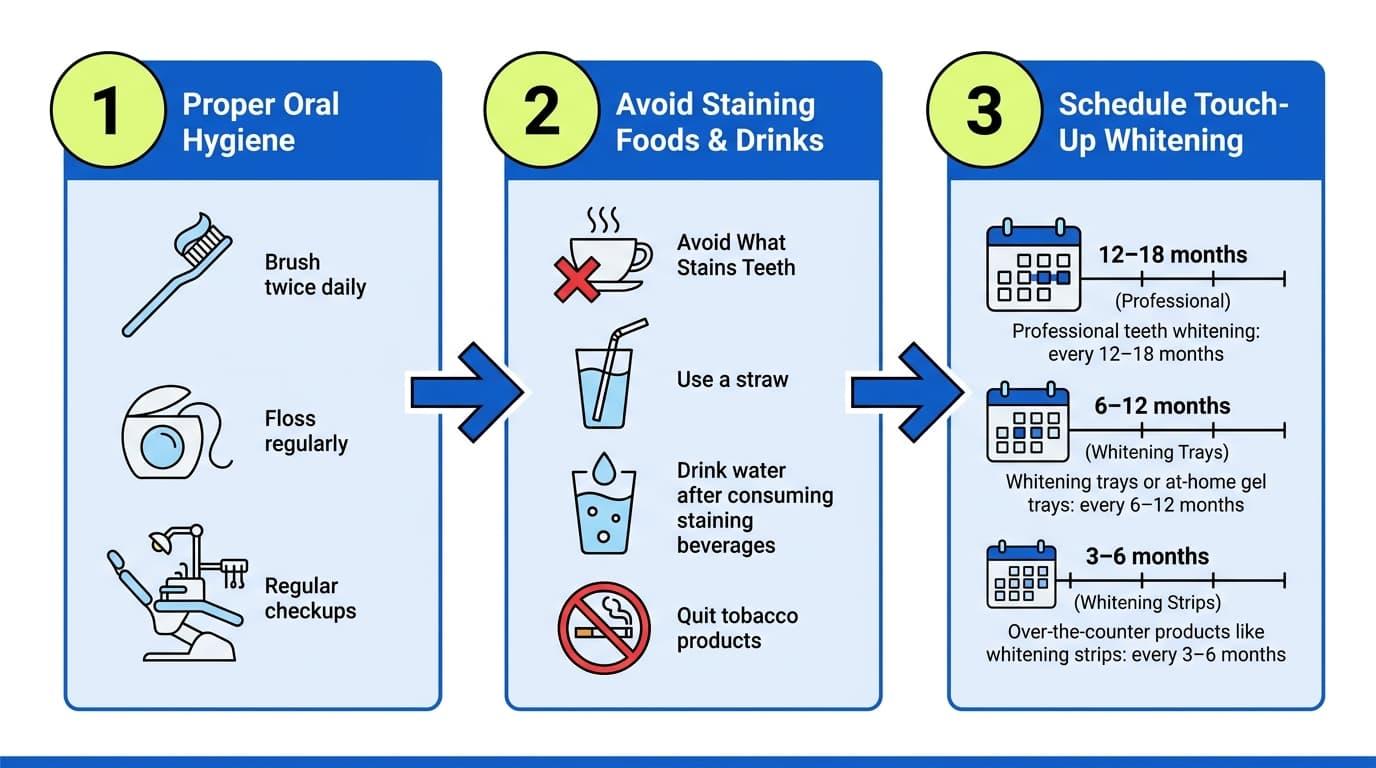
Achieving a whiter teeth smile is just the beginning; maintaining it requires ongoing effort and lifestyle adjustments. Whitening your teeth is just the start.
To keep your teeth whitening results looking fresh, follow these essential tips:
1. Stick to Proper Oral Hygiene
Maintaining proper oral hygiene is essential for keeping your teeth white and promoting oral health. Key practices include:
-
Brushing twice a day
-
Floss regularly to remove surface stains and prevent plaque buildup
-
Attending regular dental checkups for professional cleanings that remove tartar and other deposits contributing to staining, ensuring good oral hygiene.
Using whitening toothpaste can also be beneficial in maintaining your newly whitened teeth. These toothpastes contain mild abrasives that help remove surface stains and keep your smile bright.
2. Avoid What Stains Teeth
To prolong your teeth whitening results, it’s important to be mindful of what you eat and drink, especially certain foods and beverages that stain teeth.
Dark-colored beverages like coffee, tea, and red wine can quickly stain teeth. Drinking water after consuming staining beverages can help rinse away particles that cause discoloration during meals as well.
Using a straw when drinking these beverages can help minimize contact with your teeth and reduce staining.
Additionally, avoiding colorful or acidic foods like berries and tomato sauce can help maintain your bright smile.
Chewing sugar-free gum can help clean your mouth and stimulate saliva production, which keeps teeth bright. Quitting tobacco products is also advisable, as smoking can cause teeth to yellow prematurely.
3. Schedule Touch-Up Whitening
How long teeth whitening lasts depends on your habits, the method used, and whether you opt for touch-ups on schedule. As people age, they may experience increased yellowing of their teeth due to enamel thinning.
How often should you whiten your teeth?
-
Professional teeth whitening: Touch up every 12–18 months
-
Whitening trays or at home gel trays: Every 6–12 months
-
Over the counter products like whitening strips: Every 3–6 months, with results often needing refreshing within a few months
Use safe whitening gel with carbamide peroxide or hydrogen peroxide for touch-ups at home.
Additionally, consider in-chair bleaching and LED whitening methods for longer-lasting results. By making a few simple changes to your daily routine, touch-ups can help brighten your smile and lighten teeth again before stains fully return.
With proper care, your brighter smile can last longer — whether you use laser teeth whitening, in office treatment, or a home teeth whitening system.
Long-Term Risks of Teeth Whitening
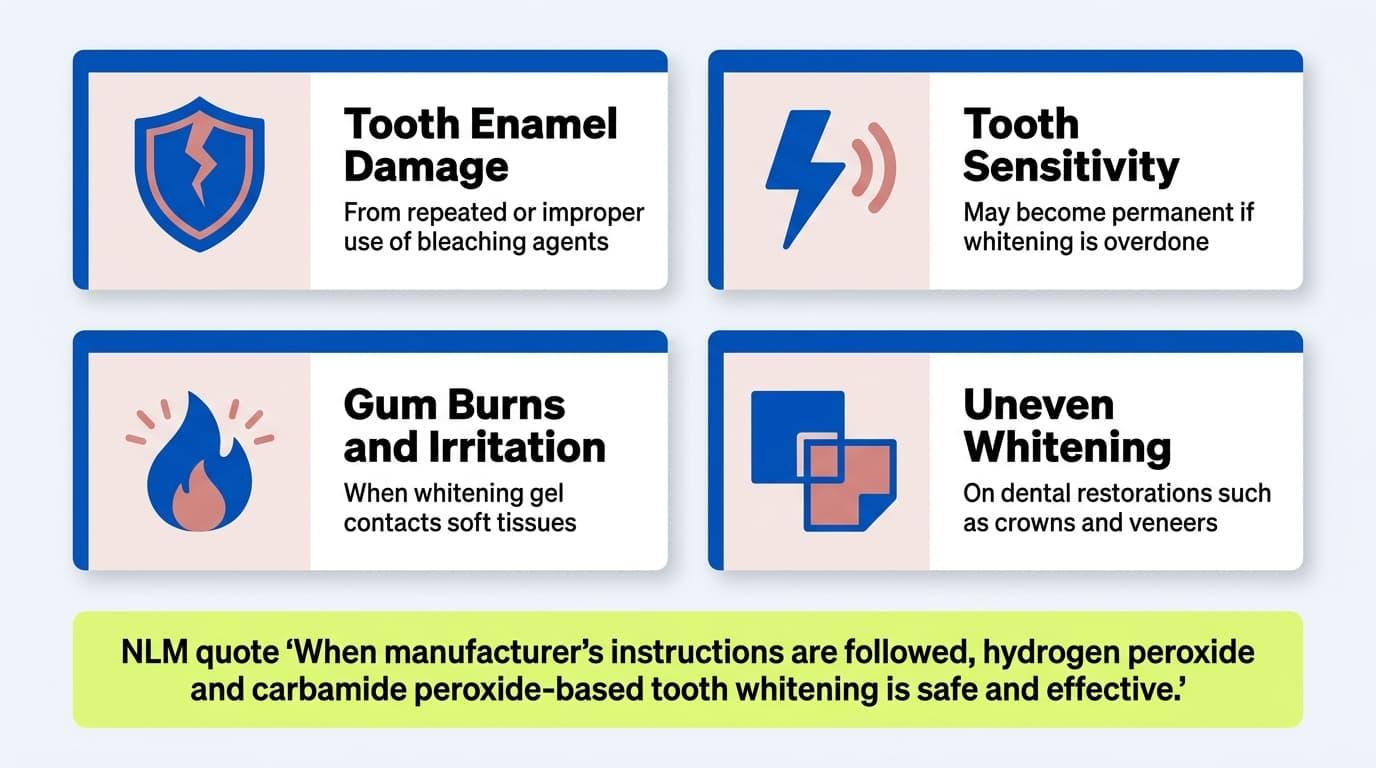
Teeth whitening is generally safe, especially when done under the supervision of a dental professional or when using over-the-counter products and other tooth whiteners as directed. However, overuse or misuse can lead to long-term oral health issues.
-
Tooth enamel damage from repeated or improper use of bleaching agents like hydrogen peroxide or carbamide peroxide
-
Tooth sensitivity, which may become permanent if whitening is overdone
-
Gum burns and irritation, especially when whitening gel contacts soft tissues; accidental swallowing can also cause a burning sensation in the mouth or throat
-
Uneven whitening or discoloration if used on dental restorations (e.g., crowns, veneers)
People with sensitive teeth, gum recession, or thin enamel should be especially cautious and consult a dentist before starting any whitening treatment.
According to the National Library of Medicine:
“When manufacturer’s instructions are followed, hydrogen peroxide and carbamide peroxide-based tooth whitening is safe and effective. Patients should be informed of the risks associated with tooth whitening and instructed on identification of adverse occurrences so that they may seek professional help as needed.” — NLM, Tooth Whitening: What We Now Know
That’s why it’s so important to not only follow directions carefully but also take a few extra steps to protect your smile during and after any whitening process.
To minimize these risks and protect your oral health, always follow proper aftercare instructions provided by your dental professional.
Attending regular dental checkups allows your dentist to monitor your teeth and gums, ensuring that your whitening treatments are both safe and effective. By taking these precautions, you can enjoy the benefits of a brighter smile while maintaining the health and integrity of your teeth and gums..
Choosing the Right Whitening Product
Selecting the right whitening product is crucial for achieving the desired results, so it helps to weigh the pros and cons of common whitening options. Here are some key points about whitening products:
-
Hydrogen peroxide is the most effective bleaching agent for teeth whitening.
-
Over-the-counter products like whitening strips and mouthwashes have bleaching agents applied directly, but at lower concentrations than professional options, including peroxide based gel.
-
These over-the-counter products may take longer to show results.
For more effective results, consider custom-made teeth whitening trays from dental professionals. Custom-fitted whitening trays from a dentist generally provide better results than over-the-counter whitening kits. Always look for products that have the ADA Seal of Acceptance to ensure their safety and effectiveness.
Final Words
Teeth whitening is well worth the effort, but it’s an investment that can take time. The results aren’t permanent, and they don't maintain themselves.
How long they last comes down to the method you choose, what you do in the first few days after treatment, and how consistent you are with touch-ups before fade becomes visible.
Most people who feel like whitening didn't work are actually dealing with a maintenance issue, not a product issue.
At SNOW®, we built our whitening range around that reality. Our formulas are designed to fit into your actual routine, not just for the initial cycle. Because brighter teeth should feel sustainable, not like something you have to redo from scratch every couple of months.
Explore SNOW Whitening Collection Today
Frequently Asked Questions
Wondering how long teeth whitening lasts and what affects your results? Here are quick answers to the most common questions about maintaining a brighter smile.
How long does teeth whitening last on average?
Teeth whitening lasts anywhere from a few weeks to several years, depending on the whitening method used. Professional treatments generally last the longest, while whitening strips and toothpastes require more frequent touch-ups. Daily habits also play a major role in how quickly results fade. Most people benefit from periodic maintenance treatments.
How long do results last if I drink coffee every day?
If you drink coffee every day, whitening results usually fade faster than average. Coffee is one of the most common causes of surface staining and can gradually darken teeth over time. Rinsing with water after drinking coffee may help slow the process. Regular touch-ups are often needed to maintain results.
Does whitening fade back to your original color?
No, whitening does not always fade completely back to your original color. Some relapse is normal over time, especially without maintenance. However, many people remain noticeably whiter than their starting shade even months after treatment. Touch-ups can help preserve results for longer.
Does brushing twice a day help keep teeth white?
Yes, brushing twice a day helps keep teeth white by removing plaque and surface stains before they build up. It also reduces the accumulation of substances that can discolor teeth over time. While brushing alone will not whiten teeth significantly, it helps maintain whitening results. Consistency is key for long-term maintenance.
What damages whitening results the fastest?
Tobacco use damages whitening results the fastest. Smoking and other tobacco products can quickly stain teeth and accelerate discoloration. Coffee, red wine, dark tea, and poor oral hygiene are also common causes of fading. Limiting these factors helps whitening results last significantly longer.


