

Purple toothpaste has taken over social media feeds with promises of instantly brighter teeth. The videos are convincing. The before-and-after shots are dramatic. And the question everyone is asking is the same: does it actually work?
The honest answer is yes, but not in the way traditional teeth whitening does. Purple toothpaste and other purple color-correcting products use color theory, not chemistry, to make teeth look brighter. Violet pigment neutralizes yellow tones on the surface of your teeth right after, leaving a result that’s instant, visible, and temporary. No bleaching is happening, and no stains are being removed from inside the tooth.
That’s not a knock on purple products; it’s just what they’re designed to do. For anyone looking for a fast brightening boost before photos, events, or a big moment, or trying to pair an instant fix with a longer-term whitening routine, they can be a useful finishing step. Knowing that helps you set the right expectations, compare purple toothpaste to real whitening, and decide when it fits into your routine. Ahead, we’ll break down how purple toothpaste works, where it falls short, whether it’s safe, how to use it, and which SNOW purple whitening products are worth considering.
Shop the SNOW Purple Collection
Key Takeaways
-
Purple toothpaste works by using violet pigment to neutralize yellow tones on the tooth surface
-
The result is immediate and visible, but it is optical, not chemical, and it is temporary
-
It does not bleach teeth, remove deep stains, or create a lasting shade change on its own
-
It works best before photos, events, or as a daily tone refresh between whitening sessions
-
SNOW offers the color-correcting technology in four formats: dissolving strips, powder, tablets, and a serum kit
-
For longer-lasting whitening, pair purple products with a peroxide-based whitening system
What Actually Is Purple Toothpaste?
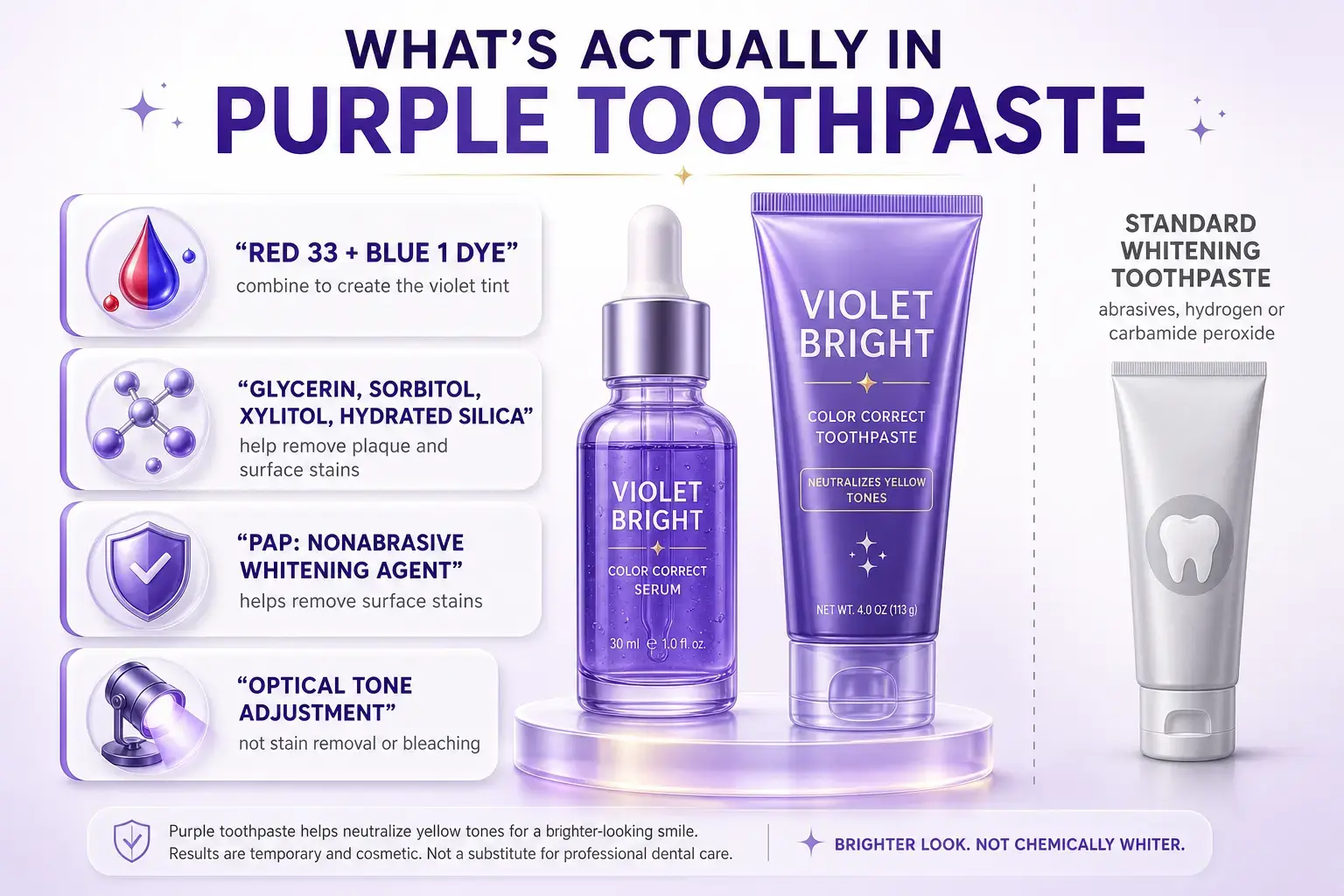
Purple toothpaste is a color-correcting oral care product. Most formulas use pigments, typically Red 33 dye and Blue 1 dye, to create a violet tint that temporarily deposits onto the tooth surface. Some formulas also include ingredients found in products like V34 Color Corrector Serum, including Glycerin, Water, Sorbitol, Xylitol, and Hydrated Silica, which helps remove plaque and surface stains. Some also use Phthalimidoperoxycaproic Acid (PAP), a nonabrasive whitening agent that helps remove surface stains. The goal is optical tone adjustment, not stain removal or bleaching.
This sets it apart from standard whitening toothpastes, which typically use abrasives or active agents like hydrogen peroxide or carbamide peroxide to physically or chemically lift stains from tooth enamel. Purple toothpaste does neither of those things. It sits on the surface, adjusts the visual tone, and rinses away.
How Purple Color Correction Works
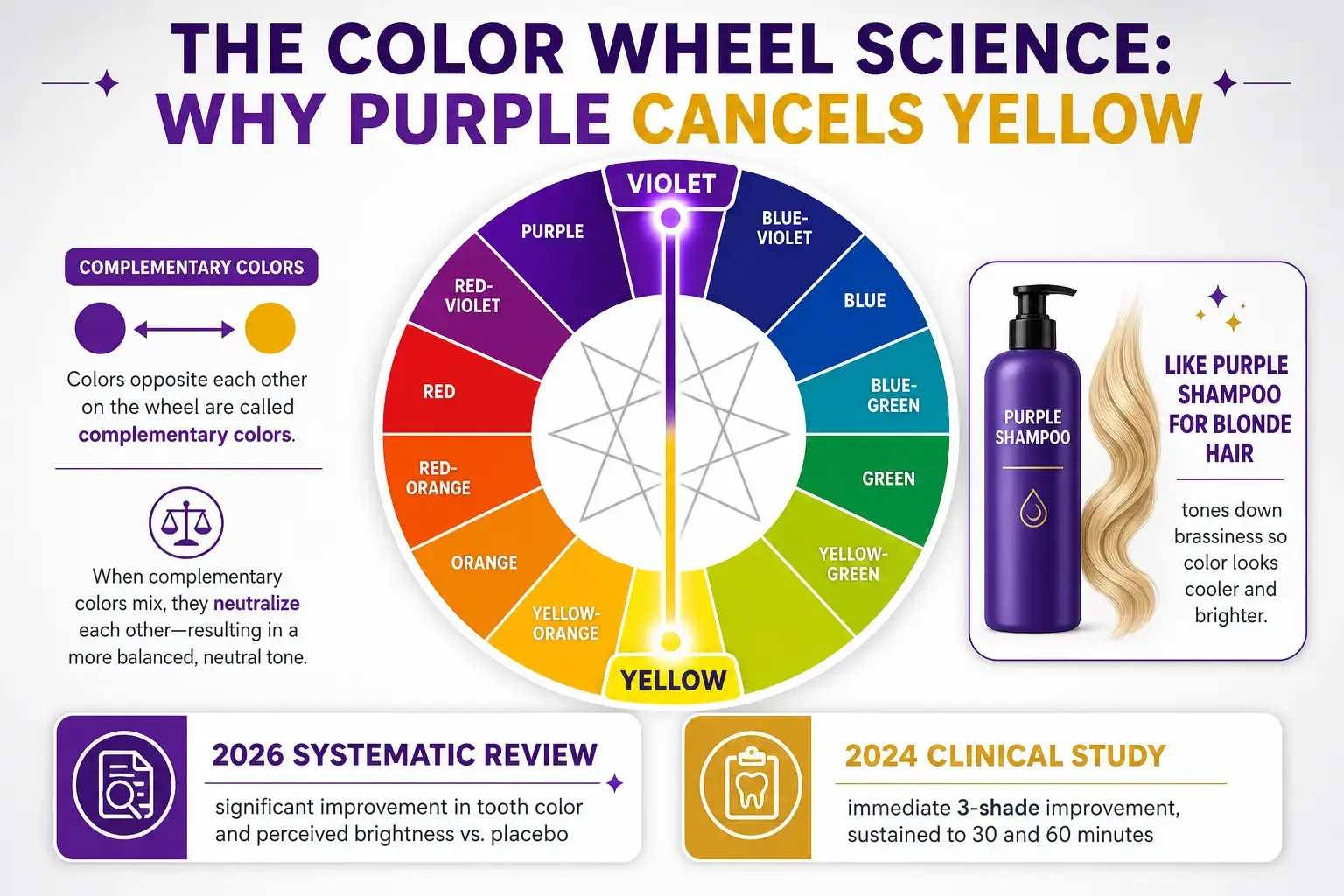
Purple color correction is based on one simple principle from color theory.
Purple and yellow sit directly opposite one another on the color wheel as complementary colors, which means violet pigment neutralizes yellow tones when placed over them.
To put it into perspective, think of purple shampoo for blonde hair. It doesn’t change the hair from the inside; it tones down brassiness so the color looks cooler and brighter. Purple teeth whitening products follow the same logic for your smile.
When violet pigment is applied to the tooth surface, it helps counteract yellow and reduce the look of yellow discoloration and broader tooth discoloration—an optical illusion that can make teeth appear whiter, not a change to the tooth itself.
No bleaching is happening. No stains are being lifted from inside the tooth structure.
The pigment sits on the surface, adjusts the visual tone, and fades with eating, drinking, and brushing.
A 2026 systematic review and meta-analysis published in the International Journal of Dental Hygiene found significant improvement in tooth color and perceived brightness with color-correcting products compared to placebo.
A 2024 randomized controlled clinical study published on PMC evaluating a color corrector serum found that a single application produced an immediate three-shade improvement in tooth appearance, with results extending to 30 and 60 minutes post-application.
That’s the science behind purple color correction: a real, immediate whitening effect that is optical, temporary, and cosmetic. For the right use case, that’s exactly what you want.
Does Purple Toothpaste Actually Whiten Teeth?
Sort of, but the distinction matters.
Purple toothpaste can make teeth appear brighter, but it doesn’t chemically whiten teeth. As an over-the-counter option, whitening purple toothpaste uses violet pigment to neutralize yellow tones on the surface, creating an immediate optical brightening effect and the look of whiter teeth.
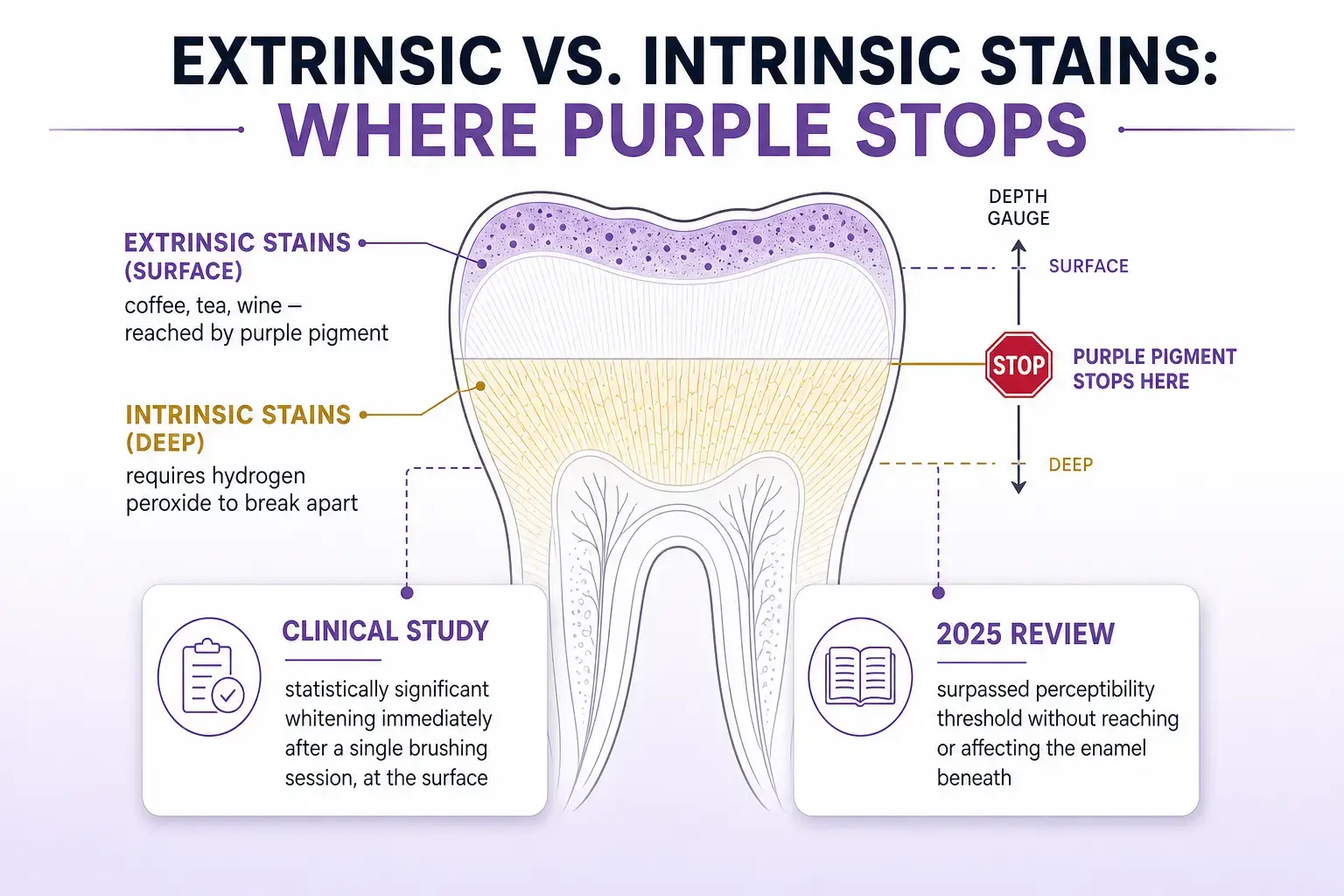
This works best on extrinsic stains, the surface-level discoloration caused by coffee, tea, or wine. It doesn’t address intrinsic stains, which sit deeper within the enamel and require a chemical agent like hydrogen peroxide to break apart.
The results are also temporary. Most people notice the brightening effect right after use, and those with mild staining may see noticeable results, but heavily stained teeth may not respond as well. The effect is extremely temporary and does not involve bleaching agents, so it typically fades after the next meal, drink, or brushing session. There’s no cumulative whitening building up over time from the color-correcting component alone.
A clinical study published on PubMed on blue covarine toothpaste found statistically significant tooth whitening improvement immediately after a single brushing session.
A 2025 systematic review on PMC covering peroxide-free color correctors found that peroxide-free color-correcting formulas achieved color change values surpassing the perceptibility threshold without significant enamel impact. So the brightening effect is real; it’s just optical and short-lived.
If you’re looking for a quick brightness boost before an event, purple products can deliver that, but this fast-acting whitening approach often falls short of professional teeth whitening or a professional whitening treatment for deeper stains. If the goal is lasting whiteness, however, a peroxide-based whitening system is the more appropriate path.
What Purple Whitening Can and Can’t Do
The clearest way to evaluate any purple whitening product is to separate what it genuinely delivers from what it cannot.
|
PURPLE WHITENING CAN |
PURPLE WHITENING CANNOT |
|---|---|
|
Make teeth look brighter right away |
Create a permanent shade change |
|
Neutralize mild surface yellow tones |
Remove deep or intrinsic stains |
|
Refresh your smile before photos or events |
Alter the shade of crowns or veneers |
|
Fit naturally between whitening sessions |
Replace a complete whitening routine |
|
Deliver instant visible results, no wait |
Build cumulative whitening over time |
Use it like a finishing touch, not your whole routine.
Purple Color Correction vs. Peroxide Whitening
These two approaches are not competing for the same job. The ADA explains that whitening bleaches like hydrogen peroxide and carbamide peroxide work by breaking stain molecules apart through the enamel. Purple color correction works optically on the surface. Most purple products do not contain fluoride ion or other cavity-focused actives found in traditional toothpaste.
Both have a place in a smart whitening routine, but many color-correcting serums do not contain fluoride and therefore do not help prevent tooth decay or support protection against tooth decay the way standard formulas do.
Traditional formulas often use stannous fluoride and sodium bicarbonate to remove plaque and support cavity prevention.
|
FACTOR |
PURPLE COLOR CORRECTION |
PEROXIDE WHITENING |
|---|---|---|
|
How it works |
Violet pigment on tooth surface |
Bleaches through enamel |
|
Speed |
Instant, after one use |
Gradual, over days to weeks |
|
How long results last |
Hours, until next meal or brush |
Weeks to months with routine use |
|
Best for |
Quick brightness before an event |
Deeper or lasting stain removal |
|
Works on deep stains |
No |
Yes, more effective with consistency |
|
Sensitivity risk |
Generally lower |
Varies by formula and concentration |
Purple is the instant tone reset. Peroxide is the longer-term investment. The ADA News whitening overview notes that looking for an ADA Seal of Acceptance is a useful benchmark when evaluating any whitening product.
When Purple Whitening Products Actually Make Sense
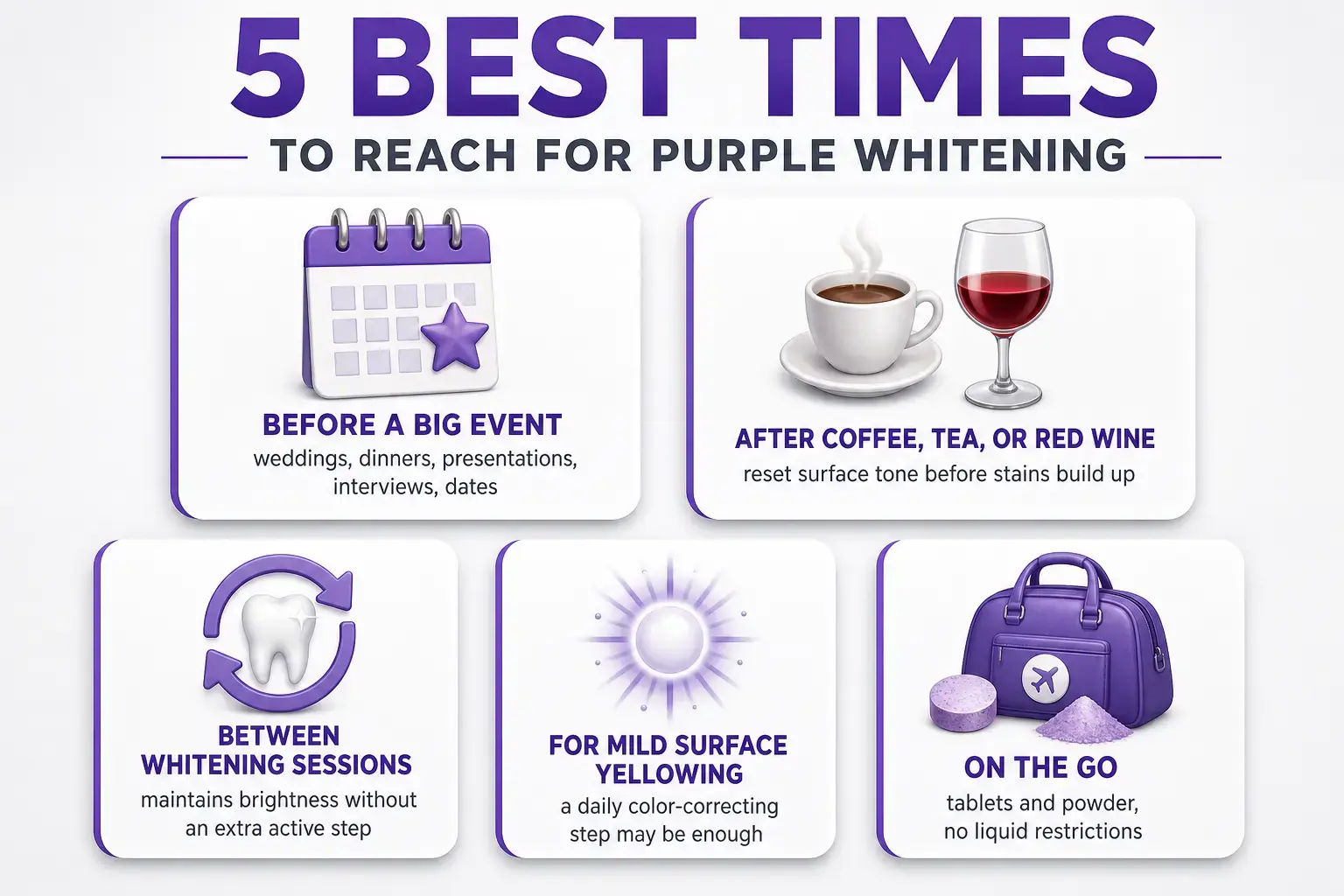
Purple color-correcting products have gained popularity as part of a social-media-driven whitening trend. Knowing when to reach for them makes all the difference.
-
Before a big event: Weddings, dinners, presentations, interviews, dates. As part of the new whitening trend, some brands claim fast brightening benefits, and a quick color-correcting step can deliver visible brightness in minutes with no waiting period and no sensitivity concerns.
-
After coffee, tea, or red wine: When surface yellow tones build up throughout the day, a purple product can quickly reset your tooth tone before stains become a longer-term issue.
-
Between whitening sessions: Purple products help maintain brightness without adding another active whitening step. They neutralize yellow tones as they develop and extend the life of your whitening results.
-
For mild surface yellowing: If your discoloration is light and surface-level, a daily color-correcting step may be all you need for a noticeably brighter appearance.
-
On the go: Color-correcting tablets and powders are compact enough to keep in a bag, a desk drawer, or a carry-on without any liquid restrictions.
Purple products are not the right fit for deep or intrinsic stains, or for serious teeth staining, and they work best as one step in a broader oral care routine rather than a standalone solution for long-term whitening goals. For those situations, a peroxide-based whitening system is the more appropriate path.
How Long Do Purple Whitening Results Last?
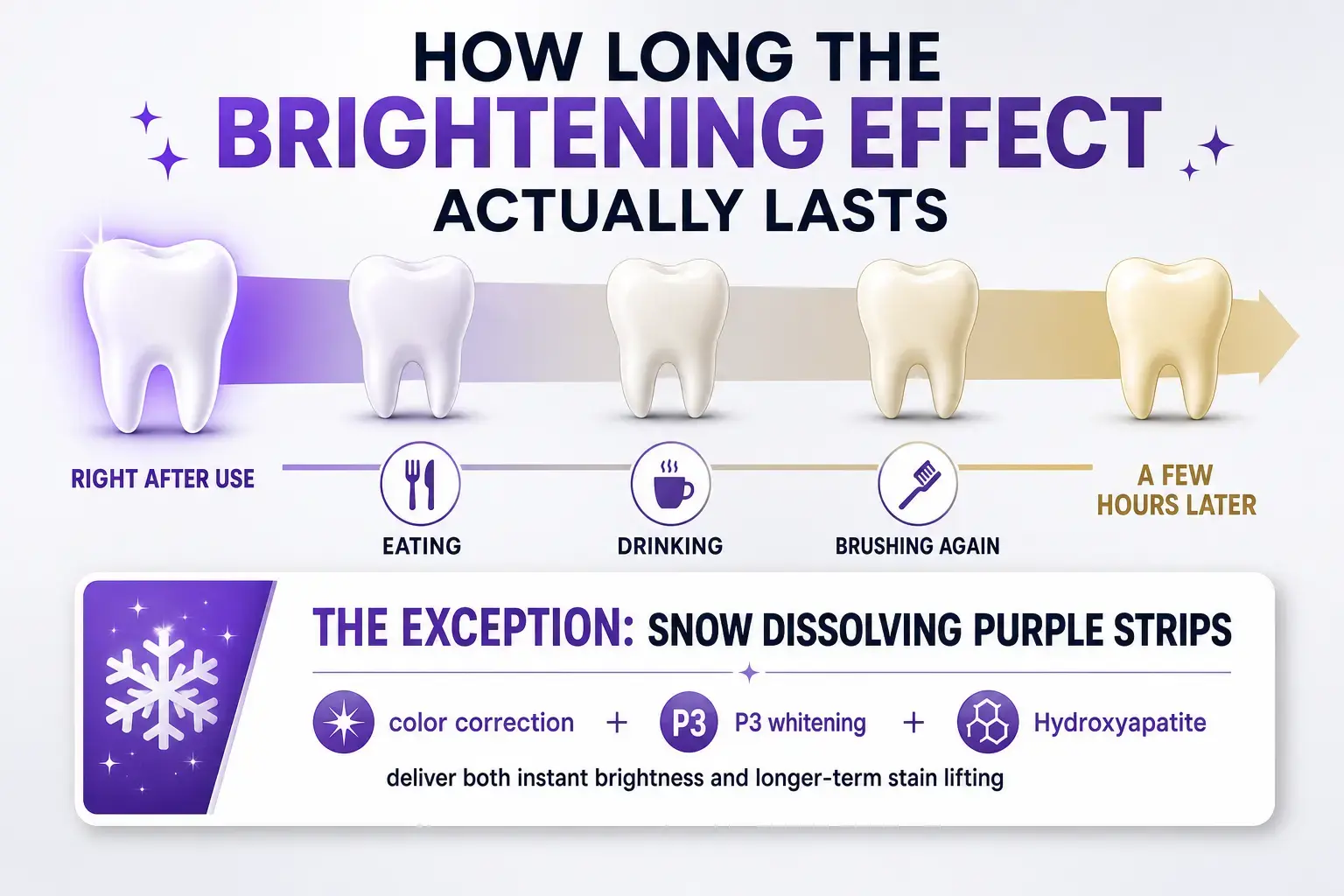
Color-correcting results are one of several temporary fixes for discoloration, and for most users the brightening effect lasts only a few hours. For most users, the brightening effect lasts until the violet pigment fades from eating, drinking, rinsing, or brushing again. That window is typically a few hours and creates a whiter appearance rather than lasting whitening.
That’s why timing matters. Use purple products close to the moment you want the result. Right before a photo, a meeting, or a dinner is the ideal window.
The exception is the SNOW Dissolving Purple Strips. Because they combine color-correcting technology with P3 whitening formula and Hydroxyapatite, they deliver both instant optical brightness and longer-term stain lifting with consistent use. Results from the whitening component build over time the same way standard whitening strips do.
For the fastest fading, dark foods and drinks immediately after use will reduce the effect sooner. To protect results, rinse with water after coffee, tea, or wine, and use the purple product close to the moment it matters most.
Are Purple Whitening Products Safe?
Purple color-correcting products are generally low-risk for healthy adults when used as directed, and many formulas are gentler for tooth sensitivity because they usually lack strong bleaching agents. The pigments creating the violet tint are cosmetic colorants, the same type used widely across food and personal care products.
Purple toothpaste is not currently reviewed by the American Dental Association for safety and effectiveness, so more research is still needed.
Some purple formats also include Hydroxyapatite alongside the color-correcting pigment. A 2025 in vitro study published on PMC comparing hydroxyapatite and blue covarine found that hydroxyapatite-inclusive formulas showed enamel-supportive properties alongside stain reduction, which adds to the safety profile of those formulas.
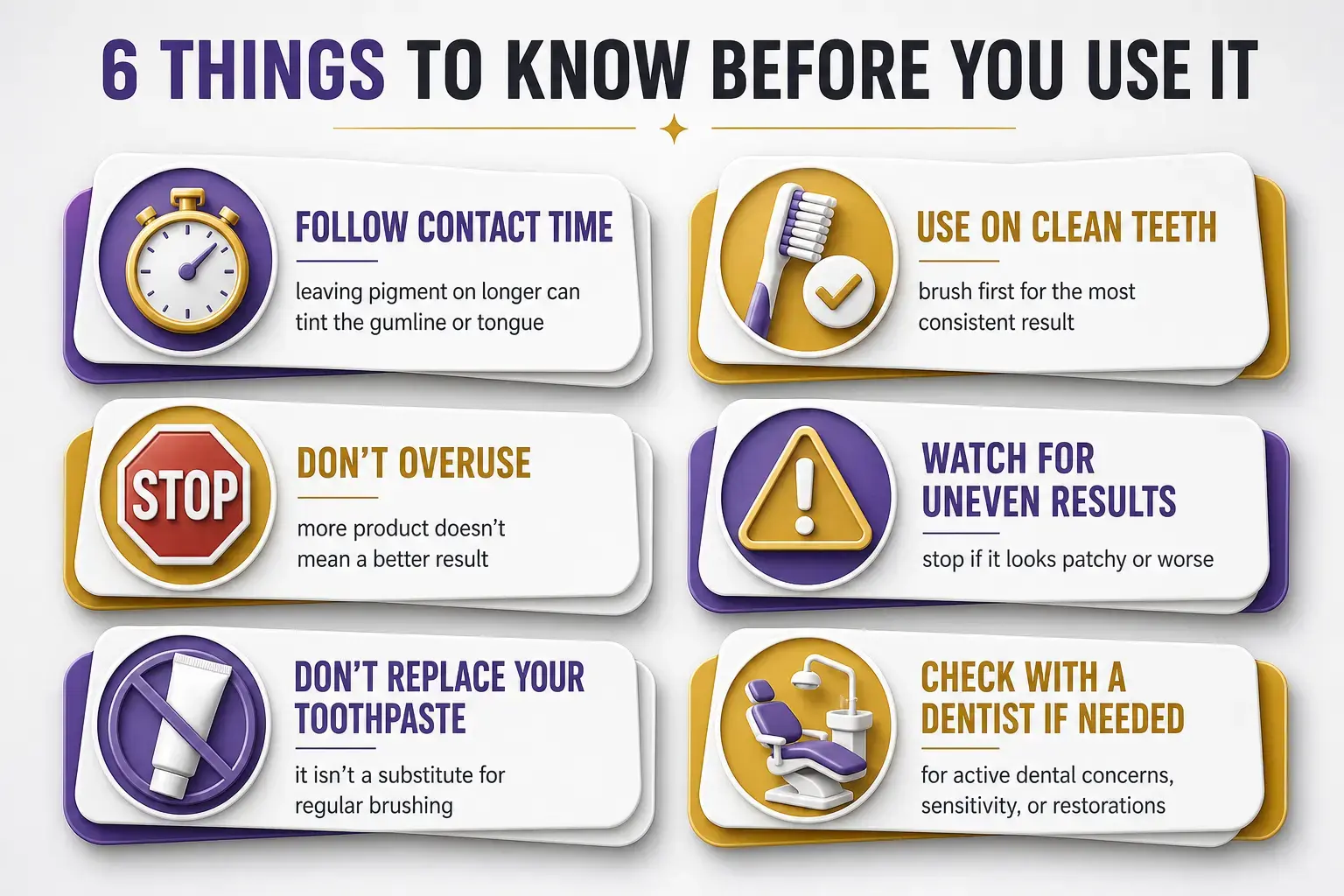
A few things to keep in mind before using any color-correcting product:
-
Follow contact time directions: Leaving pigment on longer than directed can cause temporary tinting around the gumline or on the tongue. The dyes may also affect oral tissues and can trigger allergic reactions in some users. This is not permanent, but it is worth following the recommended timing.
-
Use on clean teeth: Pigment applied over plaque or buildup can look uneven. Brush first for the most consistent result.
-
Do not overuse: More product doesn’t produce a better result with color-correcting technology. Stick to the recommended amount.
-
Watch for uneven results: Some users report surface stains looking darker after use, so stop if the appearance seems worsened or patchy.
-
Don’t replace your usual toothpaste: It should not take the place of regular brushing with a standard toothpaste that can remove bacterial plaque and support oral health.
-
Check with a dental professional if needed: If you have active dental concerns, heavy sensitivity, or restorations, the ADA recommends a dentist consultation before adding any new color-correcting product to your routine.
How to Get the Color-Correcting Effect Right Now
If you want to try color-correcting technology without waiting for purple toothpaste to land on shelves, SNOW already offers it in several formats, which is helpful if you’re reading purple toothpaste reviews and comparing formulas as much as delivery methods.
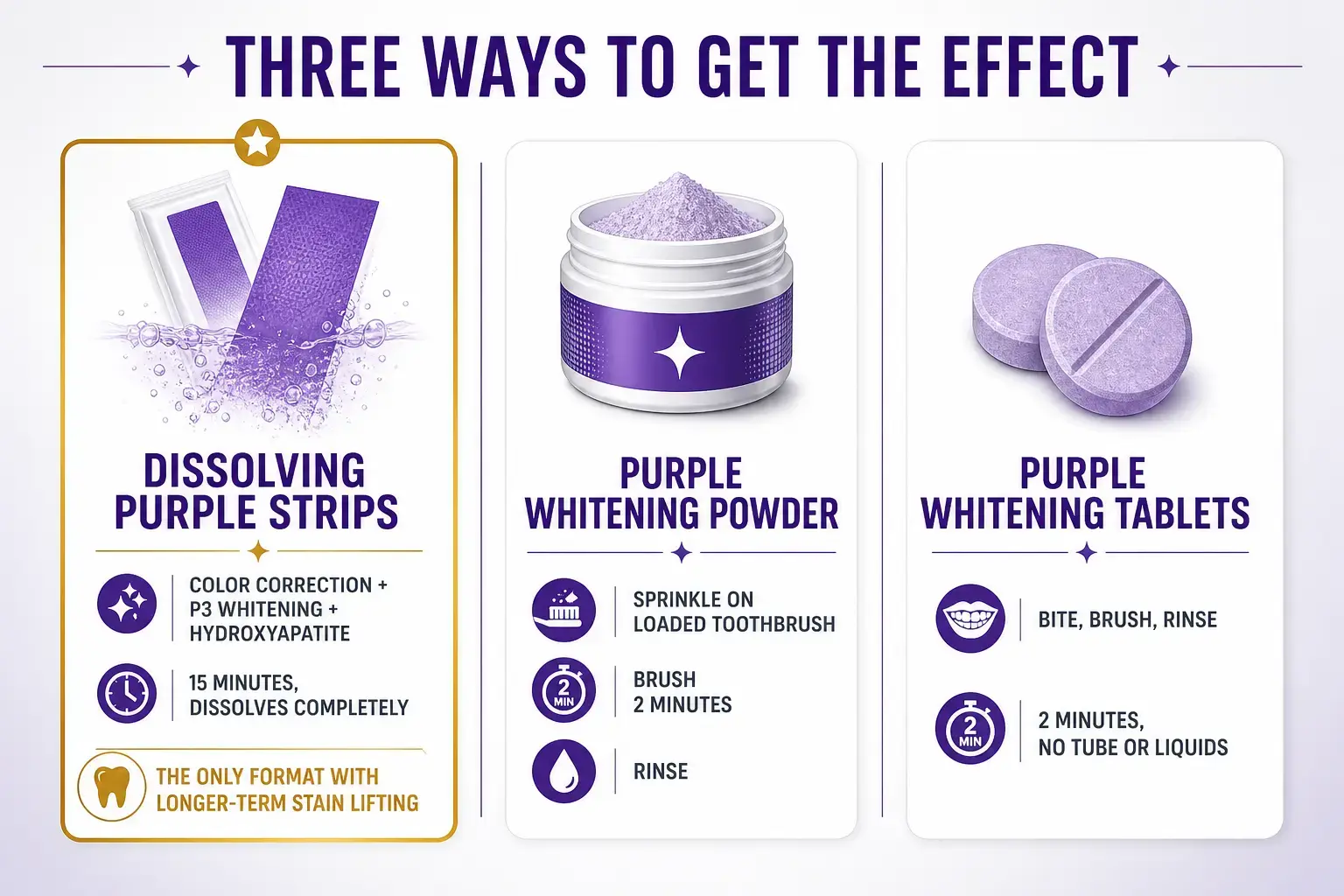
The SNOW Dissolving Purple Strips combine instant color correction with P3 whitening technology and Hydroxyapatite, so you get the optical brightness plus actual stain lifting in one 15-minute step that dissolves completely.
Across the market, some formulas rely on purple micro particles or purple micro color-correcting technology to offset yellow tones, while others add micro-polishers to help remove surface stains, as seen in products like Colgate Optic White Purple.
If you prefer something that fits into your existing brushing routine without any extra steps, the SNOW Purple Whitening Powder is worth trying. All you have to do is sprinkle it onto your loaded toothbrush, brush for two minutes, and rinse. Same color-correcting results, no routine change required.
For on-the-go brightness before a meeting, a dinner, or a photo, the SNOW Purple Whitening Tablets are the most portable option in the lineup. Bite, brush, rinse. Done in two minutes with no tube, no liquids, and no bag space required.
Explore the full SNOW Purple Collection to find the format that fits your routine.
So, Does Purple Toothpaste Work?
Yes, purple toothpaste works, and it is not just a gimmick, but its benefits are limited to temporary color correction. It uses color-correcting technology to neutralize yellow tones on the surface of your teeth, helping your smile look brighter right away. It is not a replacement for traditional whitening, and it does not chemically alter enamel. If you want deeper or longer-lasting change, professional teeth whitening options become more relevant. Think of it as a complement to your routine, not the whole routine.
For surface tone correction before an event, a photo, or between whitening sessions, it genuinely delivers. For longer-lasting brightness, pair it with a peroxide-based whitening system that goes beyond the surface.
For the most complete result, pair a color-correcting product with an active whitening routine. SNOW's whitening kits handle the deeper stain lifting and longer-term shade improvement. Purple products handle the instant tone refresh in between, so use purple toothpaste when you want a quick visual boost and look elsewhere for bigger whitening changes.
SNOW's purple lineup gives you four ways to get that instant color-correcting result: dissolving strips for brightness plus whitening, powder for daily flexibility, tablets for on-the-go ease, and the serum kit for a complete setup.
Shop SNOW Purple Whitening Products
FAQs About Purple Toothpaste
Still wondering how purple toothpaste fits into your routine? These quick answers clear up the most common questions.
Does purple toothpaste actually work?
Yes, purple toothpaste works for temporary optical brightening. It uses violet pigment to neutralize yellow tones on the tooth surface, so your smile looks brighter right after use. The result fades with eating, drinking, rinsing, or brushing again. It is best used before photos, events, or between whitening sessions.
Does purple toothpaste whiten teeth permanently?
No. Purple toothpaste creates a short-term color-correcting effect rather than a lasting shade change. For longer-lasting results, you need a whitening routine that uses peroxide-based chemistry. The ADA explains that whitening bleachings like hydrogen peroxide and carbamide peroxide are the established active agents for actual tooth whitening.
How long does purple toothpaste last?
Purple toothpaste usually lasts for a few hours, until the pigment fades from daily eating, drinking, or brushing. It works best when used close to the moment you want the result. Right before a photo, a meeting, or a dinner is the ideal timing.
Is purple toothpaste safe to use?
Purple color-correcting products are generally low-risk for healthy adults when used as directed. The pigments are cosmetic colorants widely used across food and personal care, but they should not replace cavity-focused toothpaste because they may not address bacterial plaque or calculus buildup. The ADA recommends consulting your dentist before adding any new product to your routine, especially if you have active dental concerns, sensitivity, or restorations.
Can purple toothpaste remove coffee stains?
Purple products can make coffee-stained teeth look less yellow right away by neutralizing the surface tone. They do not remove actual coffee stains over time. For that, a peroxide-based whitening product is more effective.
What is the difference between purple toothpaste and whitening toothpaste?
Purple toothpaste uses violet pigment to create a temporary visual brightening effect. Whitening toothpaste typically uses abrasives or low-concentration peroxide to address surface stains over time, and traditional formulas may also use ingredients that help remove bacterial plaque and support cavity prevention. The ADA explains the difference between these mechanisms clearly. Purple is for instant tone correction. Whitening toothpaste is for gradual surface stain management. Both can have a place in the same routine.
Can yellow teeth get white again?
Surface-level yellow stains from coffee, tea, and wine can often be visibly improved. Purple products create an instant brightening effect by neutralizing yellow tones, but for a more significant or lasting shade change, a peroxide-based whitening system is the right tool. Results depend on the cause and depth of the discoloration.


