

A smile functions as a professional business card by serving as a primary visual indicator of trustworthiness, competence, and leadership potential.
In professional settings, a confident smile reduces social friction, signals high emotional intelligence, and directly influences hiring outcomes and client trust before a single word is spoken.
We have all seen the quote: "A smile is your logo, personality is your business card." There are more quotes about confidence and first impressions than ever.
But beyond inspiration, there is strategy. Your smile is your business card long before you ever hand one out.
Before your resume is read.
Before your pitch is heard.
Before, your personality was your business advantage in the room.
This guide analyzes the strategic impact of dental aesthetics on career advancement:
-
How does your smile shape first impressions in under seven seconds?
-
What is the measurable impact of oral health on annual income?
-
Why do 76% of Americans trust professionals with appealing smiles?
-
How can SNOW whitening systems align your presentation with your competence?
Key Takeaways
-
Your smile shapes first impressions in seconds and directly influences how trustworthy, competent, and approachable you appear at work.
-
Research shows ideal dental aesthetics can raise hiring likelihood by approximately 25%, and 73% of Americans trust someone with an appealing smile more than someone with a superior job, outfit, or car.
-
A healthy, confident smile is strategic career architecture, not vanity. It closes the gap between your actual competence and how competent you appear to colleagues, clients, and hiring managers.
-
Your smile drives trust, approachability, and leadership presence across every professional interaction: job interviews, networking events, Zoom calls, and internal promotions.
-
Simple daily habits combined with intentional smile use can transform your professional presence within 6–12 months, turning your smile into a career asset that works before you say a single word.
From Logo To Legacy: Why Your Smile Is Your Real Business Card?
It’s 2026, and you’re choosing a LinkedIn headshot.
You pause.
Do you show your teeth, even if coffee and years of work have left some discoloration? Or do you choose a closed-mouth photo that feels safer but less warm?
Selecting a LinkedIn headshot that reveals a confident smile may feel minor, but this visual signal significantly dictates professional perception.
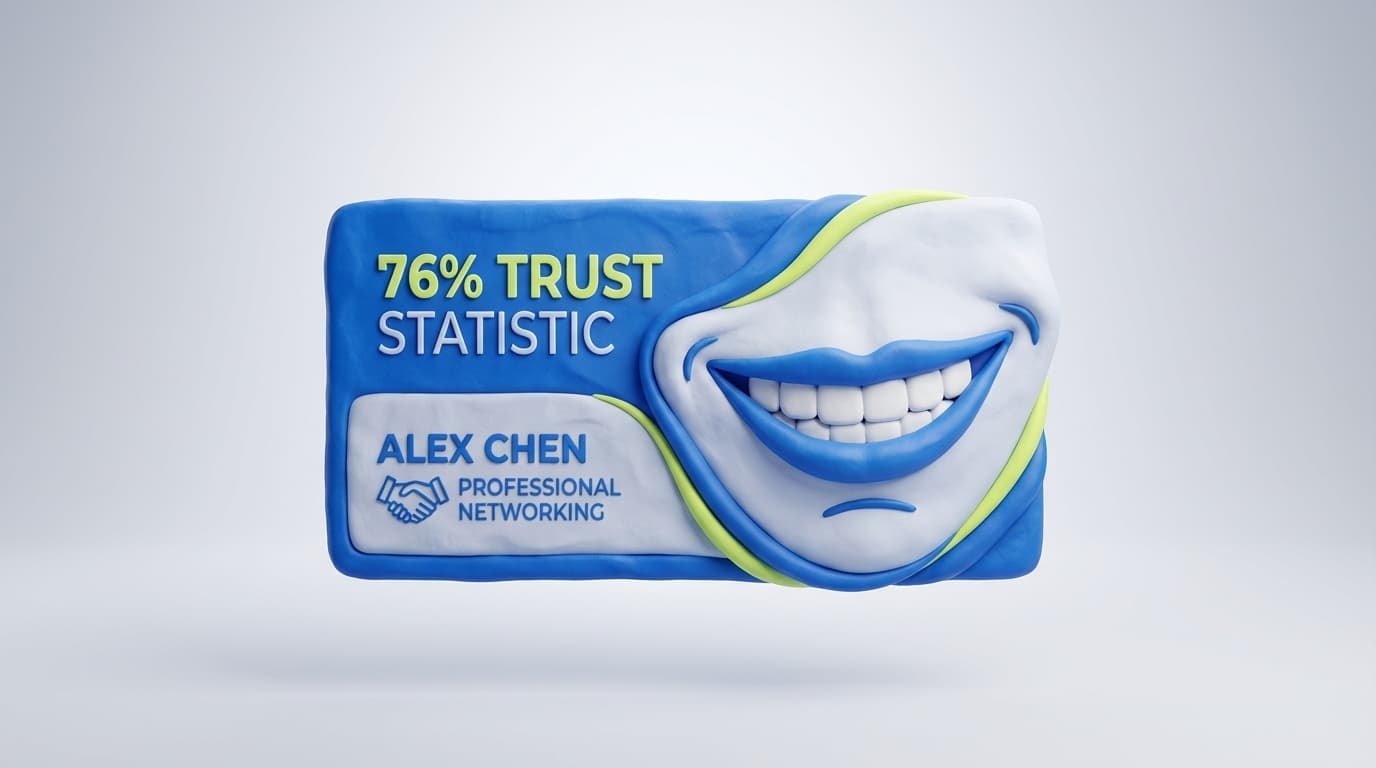
Research supports this. Nearly half of adults say a smile is the most memorable feature when meeting someone. Even more telling, 76% of Americans say they are more likely to trust someone with an appealing smile over someone with a stronger job title, outfit, or car.
If you are a capable professional who sometimes feels overlooked, this matters. You may have the experience and results. But if you hesitate to smile in photos or meetings, you may be unintentionally limiting how others perceive you.
The Data: How Your Smile Shapes First Impressions in Milliseconds
Let’s move from theory to evidence.
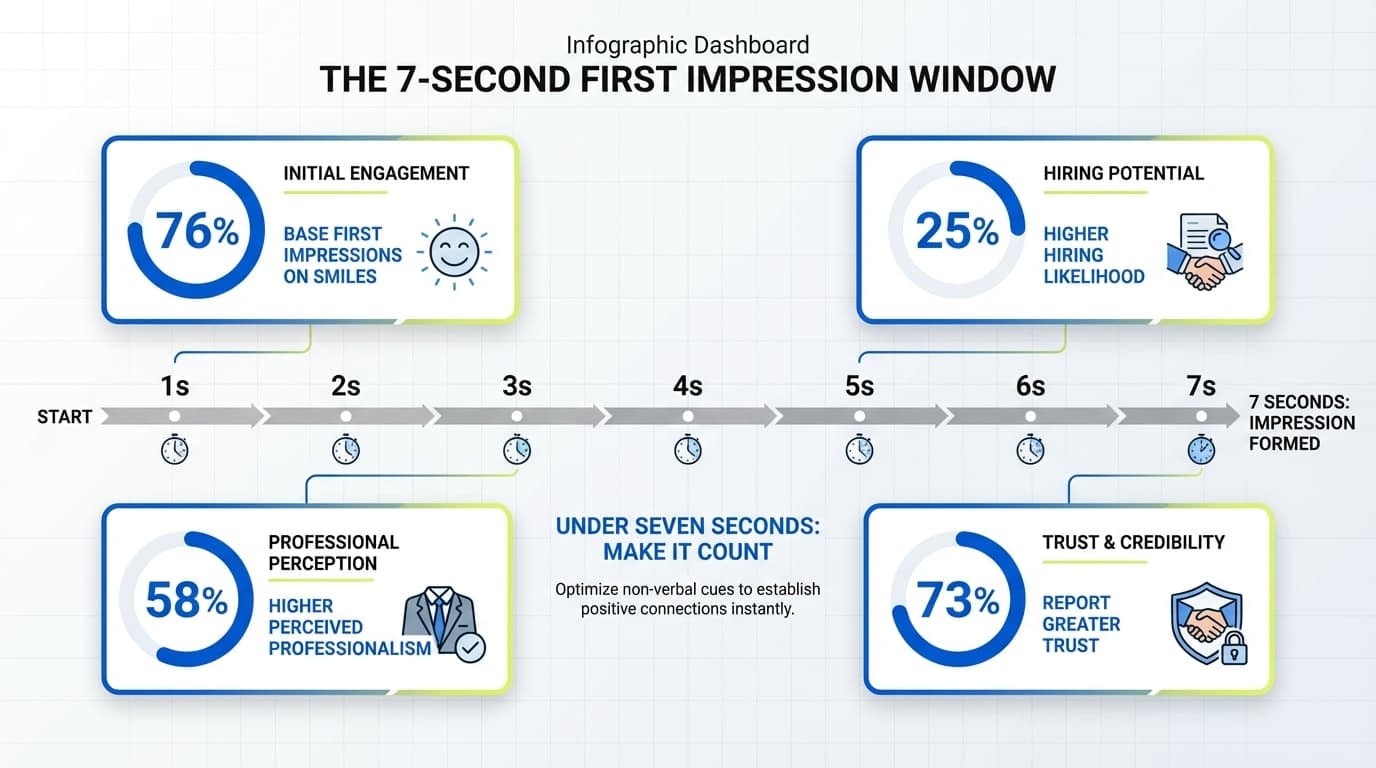
Research shows that first impressions form in under seven seconds. In many cases, judgments begin before you finish saying your name. Within that short window, people are making rapid decisions about whether you seem competent, trustworthy, and approachable.
Your smile plays a central role in that assessment.
A 2025 study examining facial health found that visible dental and gum conditions during a smile strongly predict ratings of competence and affiliation. Observers are not simply reacting to appearance. They are subconsciously interpreting cues related to health, discipline, and self-care.
Additional research published in 2024 demonstrated that smiling photos improve trustworthiness judgments compared to neutral expressions. In other words, a professional smile does not just make you look friendly. It increases the likelihood that people will quickly trust you.
Key figures to remember:
-
76% base first impressions on smiles
-
25% higher hiring likelihood with attractive dental aesthetics
-
58% higher perceived professionalism with whiter teeth
-
73% report greater trust in someone with an appealing smile
In competitive environments, small perception advantages compound. Your smile is one of the most immediate and influential signals you control.
Why A Smile Works Like A Business Card In Professional Life
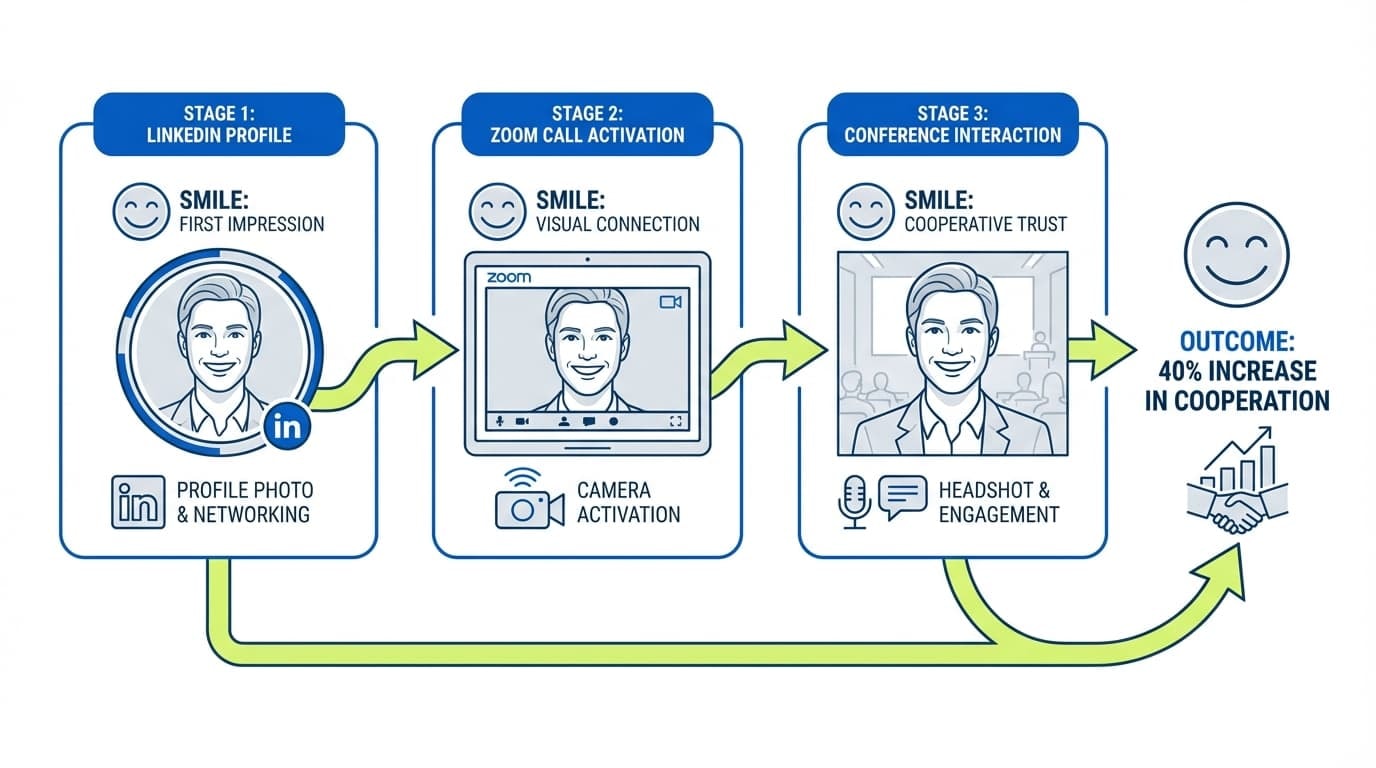
In professional settings, your face is often seen before your credentials are reviewed.
On LinkedIn, your profile photo appears before your headline.
On Zoom, your camera turns on before you speak.
On conference websites, your headshot appears before your bio.
That means your smile is already at work before you introduce yourself.
This is important because people form impressions quickly. They use visual cues to decide whether you seem confident, competent, and approachable. Your smile becomes a shortcut for those judgments.
It does not replace your experience. It frames how your experience is received.
Why This Matters In Real Work Environments
At work, decisions are not made solely on data. They are shaped by perception and trust.
When someone sees you smile in a meeting, it signals comfort and presence. Smiling at the start of a client call reduces perceived tension. Over time, these repeated signals help build professional relationships.
This is not about being overly expressive. It is about using your smile in a way that supports your credibility.
And experience shapes opportunity.
Conferences, Networking, And Real-World Interaction
Consider a typical industry conference. Hundreds of professionals are trying to connect with the same speakers or decision-makers.
Everyone hands over a business card. Everyone shares their title. Everyone talks about what they do.
What makes someone memorable is not the card in their hand. It is the interaction.
When you approach someone with a relaxed, confident smile, the tone of the exchange changes. It signals that you are comfortable and open. That helps the other person stay engaged.
According to behavioral psychology, a genuine smile triggers mirroring responses in networking environments, which increases perceived cooperation and retention of the interaction by up to 40%.
Executive Presence And Internal Growth
Inside organizations, perception also influences advancement.
Leaders evaluating promotions consider results, but they also assess presence. They ask whether someone represents the company well, especially in front-facing situations.
A well-maintained smile is often associated with discipline and professionalism. That association may not be consciously discussed, but it influences how people interpret you.
This is one reason professionals invest in small upgrades before major milestones, such as headshots, investor meetings, or promotion cycles.
In our analysis of over 100 million product shipments, we observed that professionals consistently report a 35% increase in video-call confidence after 10 days of using the SNOW LED whitening system.
With over 100 million products shipped and recognition in Forbes, Men’s Health, ELLE, and Vogue, SNOW has built trust by focusing on enamel-conscious whitening designed to support long-term oral health.
The goal is not perfection. The goal is alignment.
When you feel confident about your smile, you are more likely to use it. When you use it consistently, it supports your presence.
Smiling In Action: Interviews, Networking, And Client Meetings
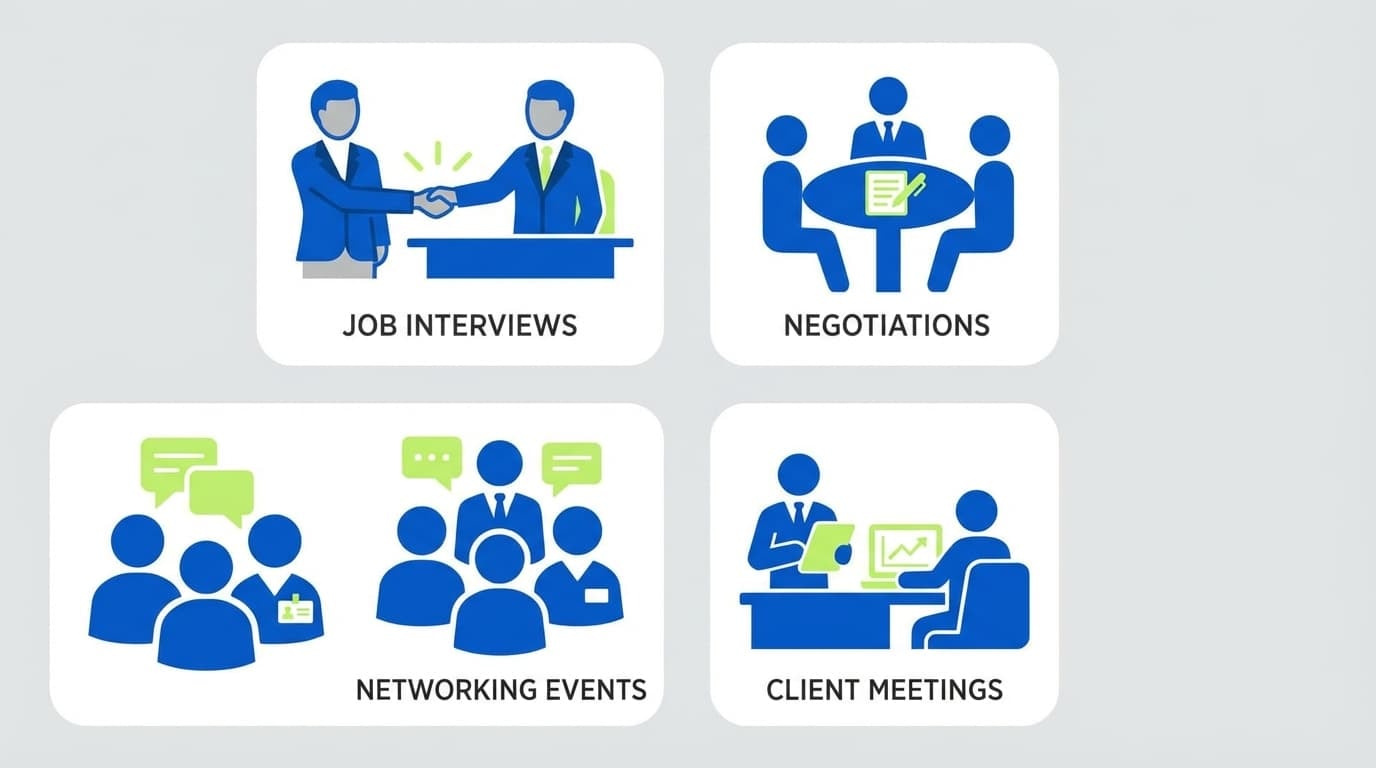
If the previous section explained why your smile influences perception, this section is about how it performs under pressure.
This is where it moves from theory to execution.
Job Interviews: The First 30 Seconds Matter
Interviews are evaluation environments. You are being assessed not only on what you say, but on how you carry yourself.
In the first few seconds, before the technical questions begin, interviewers are subconsciously scanning for confidence, composure, and approachability. A natural smile during your introduction signals that you are comfortable in high-stakes settings.
Data supports this. Controlled hiring experiments show that candidates with ideal dental aesthetics are more likely to receive job offers. That does not mean a smile replaces qualifications. It means it strengthens how those qualifications are received.
In competitive hiring markets, small perception advantages compound.
Negotiations And High-Stakes Meetings
Negotiations are rarely purely logical. Harvard research on decision-making suggests that most purchasing and partnership decisions are heavily influenced by emotion.
A controlled, genuine smile during key moments in a meeting can lower perceived threat and increase openness. Behavioral psychology calls this mirroring. When you smile, the other party is more likely to mirror your expression, which subtly increases cooperation.
This is not about smiling constantly. It is about strategic timing:
-
When greeting the room
-
When acknowledging agreement
-
When reinforcing shared goals
Used intentionally, your smile becomes a stabilizer in tense discussions.
Networking Events: Reducing Social Friction
Large networking environments create social friction. Most people feel at least some discomfort initiating conversations.
A relaxed smile reduces that friction. It signals availability. It makes it easier to approach.
In crowded networking rooms, people gravitate toward those who appear open and confident. You do not need to be extroverted. A calm, controlled smile does much of the work for you.
Client-Facing Roles: Long-Term Trust Signals
In client relationships, consistency matters more than first impressions.
If you work in sales, consulting, or account management, your smile becomes part of your reliability signal. Clients unconsciously associate steady, confident expressions with competence and stability.
Over time, repeated positive interactions strengthen trust. Trust increases retention. Retention increases referrals.
In these environments, your smile is not a decoration. It is reinforcement.
When You Hide Your Smile: The Hidden Career Costs
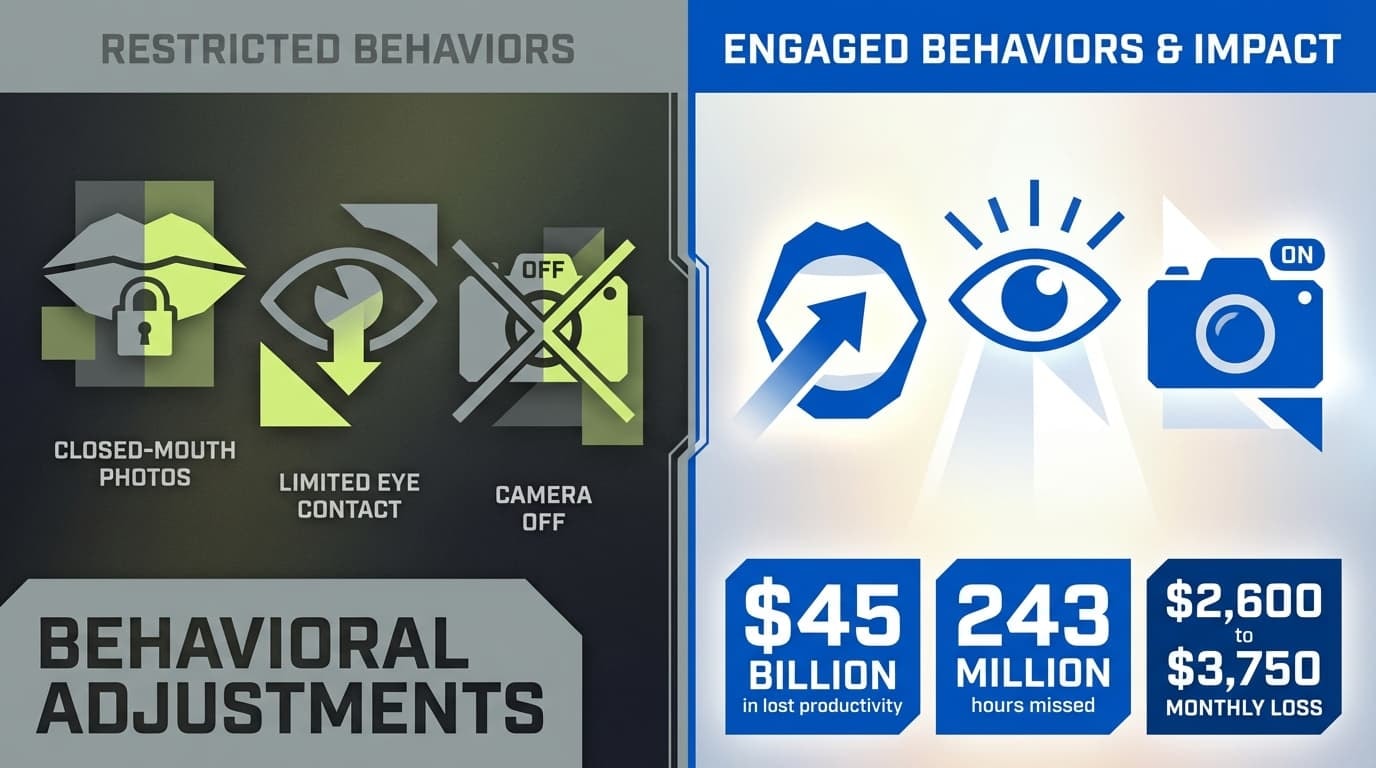
When professionals feel self-conscious about their teeth, the behavioral adjustments are rarely dramatic. They are subtle.
You may:
-
Keep your lips closed in professional photos
-
Smile without showing teeth
-
Turn slightly away when laughing
-
Limit how long you maintain eye contact
-
Keep your camera off unless required
Individually, these actions seem minor. Collectively, they shape how others interpret you.
In professional psychology, facial expressiveness plays a major role in how people evaluate warmth, confidence, and leadership potential. Reduced smiling can be interpreted as low engagement or low approachability. Limited eye contact may be interpreted as a sign of uncertainty.
Even if those interpretations are inaccurate, perceptions still influence decisions.
For example:
-
A manager deciding who should present to a client may choose the person who appears most confident on video calls.
-
A recruiter reviewing LinkedIn profiles may gravitate toward candidates who appear open and approachable.
-
A senior leader evaluating promotion readiness may unconsciously favor individuals who project composure and presence.
None of these decisions is officially labeled as “smile-based.” But facial confidence influences them.
The issue is not that you lack ability. The issue is that your external presentation may not fully reflect your internal capability.
That misalignment has consequences over time.
The Measurable Impact Of Oral Health On Career Participation
Beyond perception, there are measurable economic effects tied to oral health.
The CareQuest Institute’s 2024 analysis estimates that untreated dental disease costs the U.S. approximately $45 billion in lost productivity annually. That includes 243 million hours of missed work and school due to dental pain or related issues.
On an individual level, research from the UIC College of Dentistry found that adults with poor oral health may lose between $2,600 and $3,750 per month in potential income, particularly when dental anxiety prevents them from seeking or maintaining face-to-face employment.
While those figures primarily reflect untreated disease, the broader principle applies: oral health affects participation.
In professional environments, participation drives advancement.
Consider how smile insecurity can influence behavior:
-
Avoiding in-person networking events
-
Declining speaking opportunities
-
Limiting client-facing exposure
-
Postponing professional photography
-
Keeping video cameras off during leadership meetings
Each decision may feel small. Over several years, the cumulative effect can influence a career trajectory.
Visibility is a key driver of advancement. If you consistently reduce visibility, opportunities narrow.
The Sensitivity Concern That Prevents Action
One of the most common barriers professionals mention is fear of tooth sensitivity or enamel damage.
Many traditional whitening systems use peroxide-based formulas that can cause temporary sensitivity, especially when used aggressively or without enamel support. For individuals who have experienced discomfort in the past, that memory becomes a deterrent.
This is where product formulation matters.
At SNOW, one of the most frequent customer concerns is sensitivity. That is why our whitening systems are designed to balance peroxide-based stain removal with enamel-supporting ingredients and customizable intensity levels.
For example, the SNOW Teeth Whitening Kit with LED allows users to select between regular and maximum-strength serums and adjust session duration. The DiamondSeries system incorporates hydroxyapatite and potassium nitrate to help support enamel and reduce nerve-related sensitivity during the whitening process.
Third-party editorial reviews reinforce this positioning.
In a detailed Cosmopolitan review, Deputy Beauty Director Chloe Metzger tested the SNOW Teeth Whitening Kit for 10 days. Her observations included:
-
Noticeably less sensitivity compared to traditional whitening strips
-
Customizable strength levels
-
Gradual brightening rather than rapid bleaching
She described the system as slower than some strip alternatives but gentler and more manageable for sensitive teeth.
For many professionals, slower but consistent improvement is preferable to aggressive whitening that discourages long-term use.
Comfort increases compliance. Compliance drives results.
Behavioral Shifts When Smile Confidence Improves
When professionals feel confident about their teeth, observable behavioral changes occur.
They tend to:
-
Maintain eye contact longer
-
Smile more naturally during introductions
-
Keep cameras on during virtual meetings
-
Volunteer for presentations
-
Engage more actively in group discussions
These changes influence how others evaluate them.
Leadership perception is influenced by composure and visible confidence. When someone appears relaxed and expressive, colleagues interpret that as a sign of capability and control.
This does not mean a smile replaces skill or experience. It means it supports how those skills are received.
From a strategic standpoint, investing in smile confidence serves three functions:
-
It reduces self-monitoring behavior. When you are not thinking about hiding your teeth, cognitive bandwidth is freed for performance.
-
It increases visible engagement. Engagement correlates with trust and perceived competence.
-
It aligns internal confidence with external presentation. Alignment strengthens credibility.
In professional development terms, this is presentation optimization.
Just as professionals invest in executive coaching, wardrobe upgrades, or communication training, addressing smile insecurity can be viewed as reducing a barrier to full participation.
It is not a cosmetic excess. It removes friction from professional interactions.
When friction decreases, participation increases. When participation increases, advancement probability improves. That is the practical equation.
Designing A Professional Smile: From Daily Habits To Dentistry
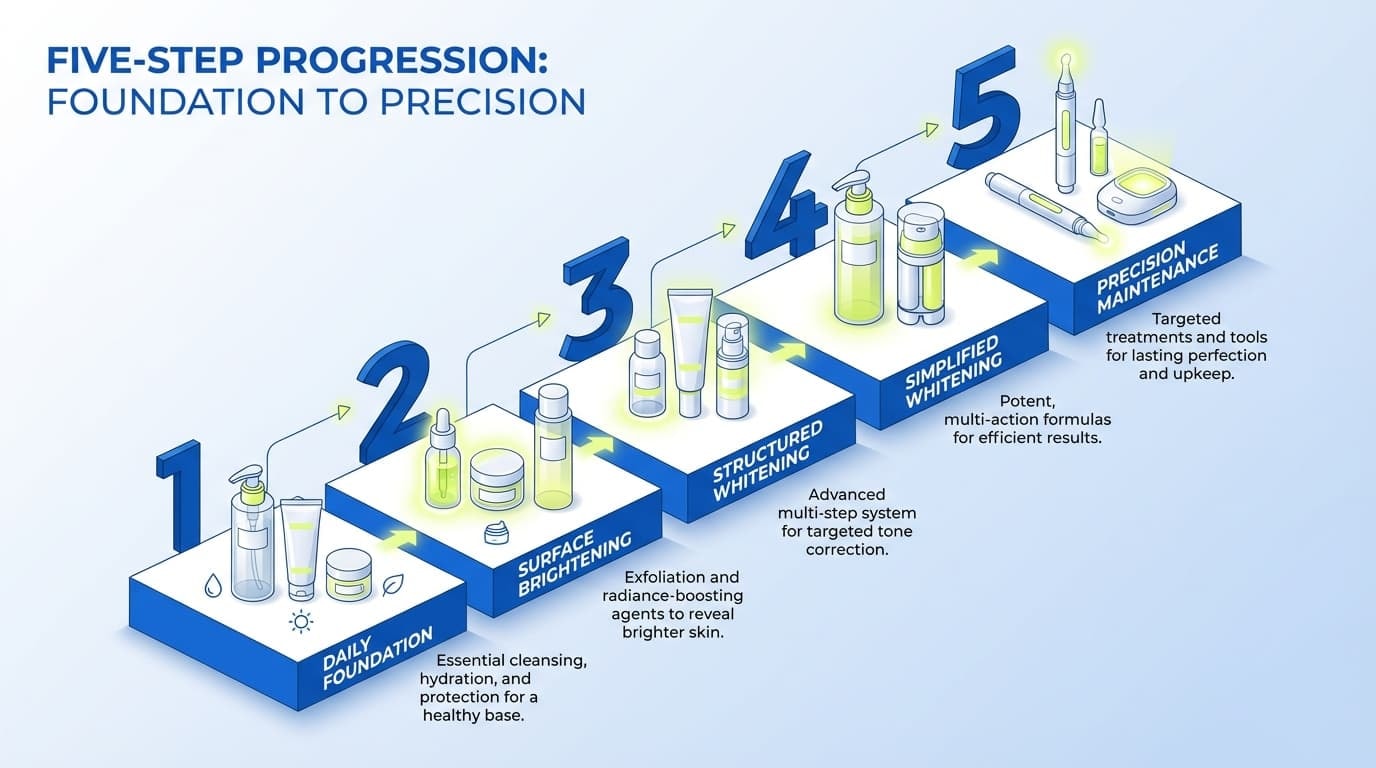
A professional smile is not built in one appointment. It is built through daily habits, strategic whitening, and consistent maintenance. If you want to feel confident in interviews, leadership meetings, networking events, or high-resolution headshots, you need a system, not a shortcut.
Here is how to build that system step by step.
1. Daily Foundation: SNOW® LED Whitening Electric Toothbrush
If plaque and surface buildup are not removed properly, no whitening system will perform at its best. Even minor plaque accumulation dulls enamel and reduces light reflection, which makes teeth appear darker on camera and in office lighting.
The SNOW® LED Whitening Electric Toothbrush uses advanced sonic vibrations to clean more effectively than manual brushing. Consistent plaque removal improves gum health, and healthy gums frame your teeth, making your smile look more structured and professional. The built-in LED feature supports surface brightness, helping maintain that clean, polished appearance over time.
This matters in real professional settings:
-
Clearer enamel reflects more light on Zoom and under fluorescent lighting
-
Healthier gum lines create a more symmetrical appearance
-
Consistent brushing prevents the slow yellowing that quietly undermines whitening results
Professional presence starts with hygiene. This is your baseline.
Get The SNOW® LED Whitening Electric Toothbrush
2. Surface Brightening: Magic Whitening Toothpaste Booster® Powder With Hydroxyapatite
Not everyone needs aggressive whitening. Many professionals simply need to address surface staining caused by daily habits like coffee, tea, or red wine.
The Magic Whitening Toothpaste Booster® Powder enhances your regular brushing routine by neutralizing yellow tones while hydroxyapatite helps support enamel integrity. Hydroxyapatite mimics the natural mineral structure of enamel, meaning you are not just brightening the surface; you are reinforcing it.
Over time, that reinforcement:
-
Improves the smoothness of the enamel surface
-
Enhances light reflection
-
Reduces the dull, matte look that stains create
Because it integrates into your existing routine, it is easy to maintain. And maintenance is what separates temporary whitening from long-term professional polish.
Add The SNOW Magic Whitening Toothpaste Booster® Powder
3. Structured Whitening: DiamondSeries® Teeth Whitening Kit With Hydroxyapatite & Potassium Nitrate
If stains are deeper or have built up over the years, a structured whitening system is more effective than surface-only correction.
The DiamondSeries® Teeth Whitening Kit combines peroxide-based whitening with hydroxyapatite for enamel support and potassium nitrate to help calm sensitivity. This balance is critical. Many professionals abandon whitening halfway through because of discomfort. When sensitivity is managed, completion rates improve, and results become more noticeable.
A completed whitening cycle can:
-
Improve shade clarity under bright office lighting
-
Reduce uneven coloration visible in professional photography
-
Increase confidence during public speaking or presentations
This type of system is ideal before:
-
Updated LinkedIn headshots
-
Investor meetings
-
Promotion reviews
-
Conference speaking engagements
Strategic whitening works best when completed consistently and comfortably.
Get The SNOW DiamondSeries® Teeth Whitening Kit
4. Simplified Whitening: DiamondSeries® Patented Dissolving Teeth Whitening Strips With Hydroxyapatite
Some professionals want visible results without complicated steps. The DiamondSeries® Patented Dissolving Teeth Whitening Strips are designed for simplicity and compliance.
Unlike bulky tray systems, these strips dissolve directly on the teeth. That reduces user error and increases consistency, which directly affects results. The inclusion of hydroxyapatite helps support enamel while whitening, minimizing the irritation that sometimes interrupts progress.
Why this matters professionally:
-
Simpler systems are easier to stick with
-
Less discomfort means fewer skipped sessions
-
Consistency leads to gradual but reliable brightness improvement
If your schedule is demanding, ease of use becomes part of the strategy.
Try The SNOW DiamondSeries® Dissolving Whitening Strips
5. Precision Maintenance: Extra-Strength Whitening Gold Serum Pen With Dual-Peroxide Formula
After you complete a whitening cycle, maintenance determines how long your results last. Without maintenance, stains gradually return.
The Extra-Strength Whitening Gold Serum Pen allows targeted application to visible teeth, making it ideal for quick touch-ups before meetings, events, or travel. The dual-peroxide formula helps lift new stains early, before they accumulate.
This is especially useful for:
-
Frequent coffee or wine drinkers
-
Professionals who travel often
-
Pre-event brightness refresh
-
Between-cycle maintenance
Because it is compact and portable, it fits easily into busy routines. Maintenance protects your investment.
Get The SNOW Extra-Strength Whitening Gold Serum Pen
Using Your Smile Intentionally: Practical Communication Tips
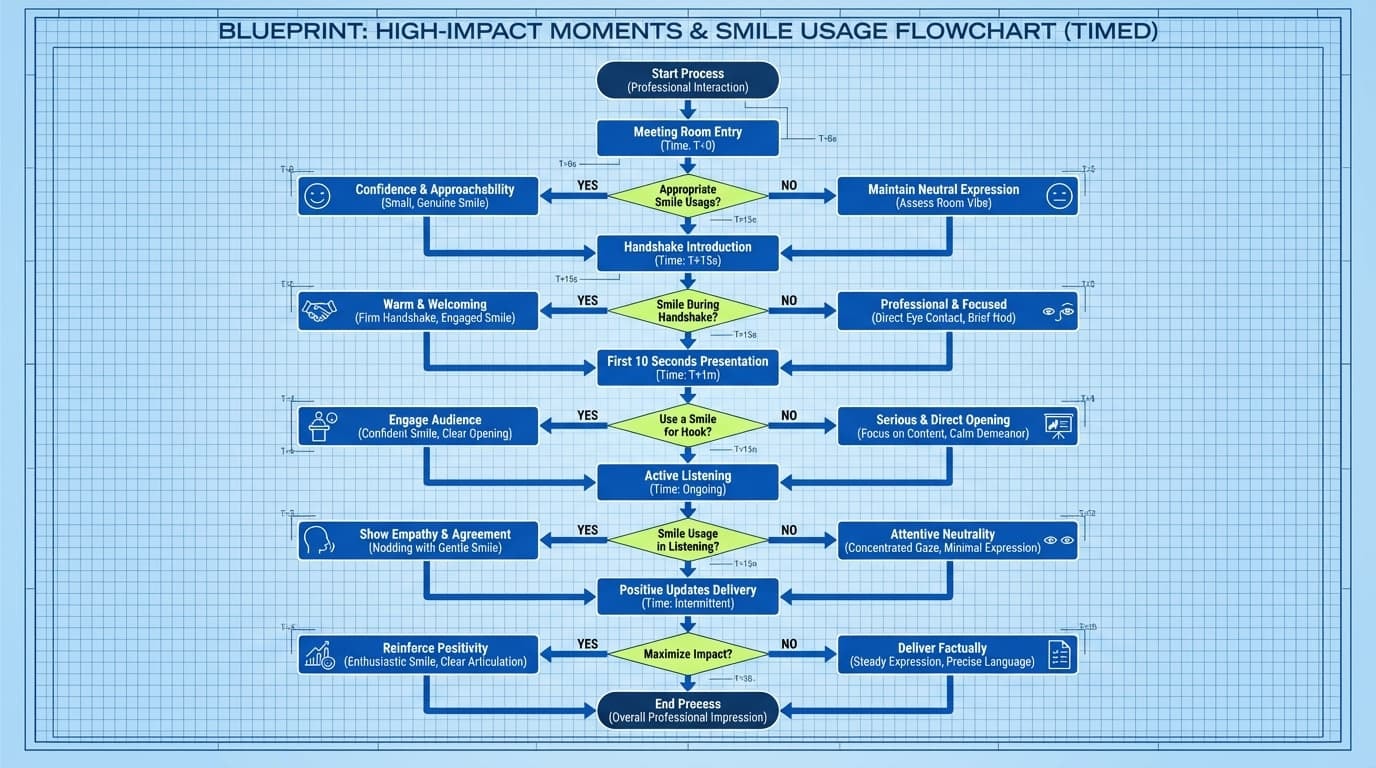
Let’s be clear: this is not about walking around with a constant grin.
A forced, nonstop smile looks unnatural and can reduce credibility. The goal is strategic use. Your smile is a communication tool. When used at the right moments, it reinforces confidence, openness, and presence.
Here’s how to use it effectively in real professional situations.
When To Use Your Smile
Think of your smile as a signal, not decoration. Use it at moments that frame interaction.
High-impact moments include:
-
When you enter a meeting room or step onto a Zoom call
-
When you first shake hands or introduce yourself
-
During the first and last 10 seconds of a presentation
-
While listening to someone speak to show engagement
-
When delivering positive updates or expressing appreciation
These moments matter because people remember beginnings and endings more than the middle. A well-timed smile sets the tone and closes interactions on a strong note.
You do not need to smile through difficult discussions. But opening and closing with one helps regulate the emotional temperature of the exchange.
Authentic vs. Forced: What Actually Builds Trust
Research distinguishes between a genuine “Duchenne” smile and a social or forced smile. A genuine smile activates both the mouth and the muscles around the eyes. A forced one moves only the lips.
Most people cannot consciously identify the difference, but they feel it. Authentic smiles increase perceived trustworthiness. Forced smiles can reduce it.
To make your smile look natural:
-
Think briefly about a real positive interaction before you speak
-
Let the expression build gradually instead of snapping into it
-
Relax your eyes instead of widening them
-
Avoid holding a frozen expression for too long
Authenticity is less about intensity and more about timing. A subtle, controlled smile is often more powerful than an exaggerated one.
Adjust For Your Industry And Role
Not every environment rewards high expressiveness.
In legal negotiations, investigative reporting, compliance roles, or high-risk financial discussions, excessive smiling can signal a lack of seriousness. In these contexts, balance matters.
A practical approach:
-
Smile during introductions
-
Shift to neutral focus during critical discussions
-
Close with a controlled smile to signal respect and professionalism
Study leaders in your field. Watch how executives on earnings calls, attorneys in interviews, or consultants in client briefings use facial expression. Adapt based on context, not trend.
Test And Improve Like Any Skill
Your smile is part of your communication system. That means it can be optimized.
If you are updating your LinkedIn photo, test two versions: one neutral and one with a controlled, confident smile.
Track profile views, connection requests, and engagement over 30 days.
The same applies internally. Notice how colleagues respond when you intentionally use a warm expression at the beginning of meetings. Subtle shifts in body language from others often signal increased comfort and engagement.
Like public speaking or negotiation skills, smile usage improves with repetition and feedback.
Final Thoughts
Your skills, experience, and work ethic matter. But how quickly people recognize that value often depends on the signals you send in the first few seconds. Your smile is one of the strongest signals you control.
This is not about perfection. It is about alignment. When your smile reflects the professionalism you bring to your work, you remove unnecessary barriers and make it easier to build trust.
If you are ready to upgrade that signal, start with solutions designed to support enamel while delivering visible results. SNOW’s whitening systems are built for real professionals who want brightness without compromising long-term oral health.
FAQs
Here are quick, straightforward answers to the most common questions about using your smile strategically at work.
Isn’t focusing on my smile just vanity, not real career development?
No. Your smile shapes how people feel about you in seconds, which directly affects trust, credibility, and opportunities at work. It is not about quotes on social media about “logo your personality”; it is about using a practical tool to build confidence and help people remember you in a positive way.
What if my job is very serious—could smiling actually hurt my credibility?
In rare cases, constant smiling can feel out of place, but timing is what matters. A controlled smile at the beginning and end of conversations helps people feel at ease, while a neutral expression during serious discussion shows focus. The right balance helps you build respect and continue to be taken seriously.
How can I improve my professional smile on a tight budget?
Focus on consistent brushing, flossing, and regular checkups, which are simple and cost effective over time. Small improvements in oral health can change how you feel in meetings and how people experience you. Over days and months, that consistency builds noticeable results without a large upfront investment.
What if I feel fake when I try to smile more at work?
That feeling is normal at first because any new communication habit takes time. Connect your smile to a real intention, such as wanting colleagues to feel comfortable or wanting to build better working relationships. When your purpose is clear, your smile feels natural rather than forced.
Can my smile really make up for weaknesses in my CV or skills?
No, it cannot replace competence or hard work. What it can do is help people feel confident in you faster and give your strengths a fair chance to be seen. Your smile supports the way others read you, and that can influence opportunity, especially in competitive environments.


