

PVP, or polyvinylpyrrolidone, is a film-forming ingredient used to help give whitening strips their structure. It isn’t the ingredient bleaching your teeth. In peroxide-based whitening strips, that job belongs to the peroxide.
Ingredient lists have a talent for making a simple beauty routine sound like a chemistry final. Hydrogen peroxide sounds familiar enough. Then PVP shows up, and suddenly your whitening strips have assigned homework.
The good news is that PVP’s role is much simpler than its full name suggests. It works as part of the supporting formula around the whitening ingredient, rather than doing the whitening itself. Ahead, we’ll break down what PVP does, how it differs from peroxide, what to look for on a whitening-strip label, and where it fits into SNOW’s formula.
Key Takeaways
-
PVP, short for polyvinylpyrrolidone, is a supporting ingredient used for film formation, binding, and product structure.
-
PVP doesn’t whiten teeth by itself. In peroxide-based whitening, the active agent does the work.
-
PVP can support the film and structure of a whitening strip, but the finished product’s performance depends on the complete formula and design.
-
PVP is only one part of the formula. Peroxide type, directions, wear time, and how the strip fits all matter to the whitening experience.
-
For SNOW shoppers, the useful question isn’t simply ‘Does it contain PVP?’ It’s whether the full strip formula fits the routine you’ll actually use consistently.
What PVP Actually Does in Whitening Strips
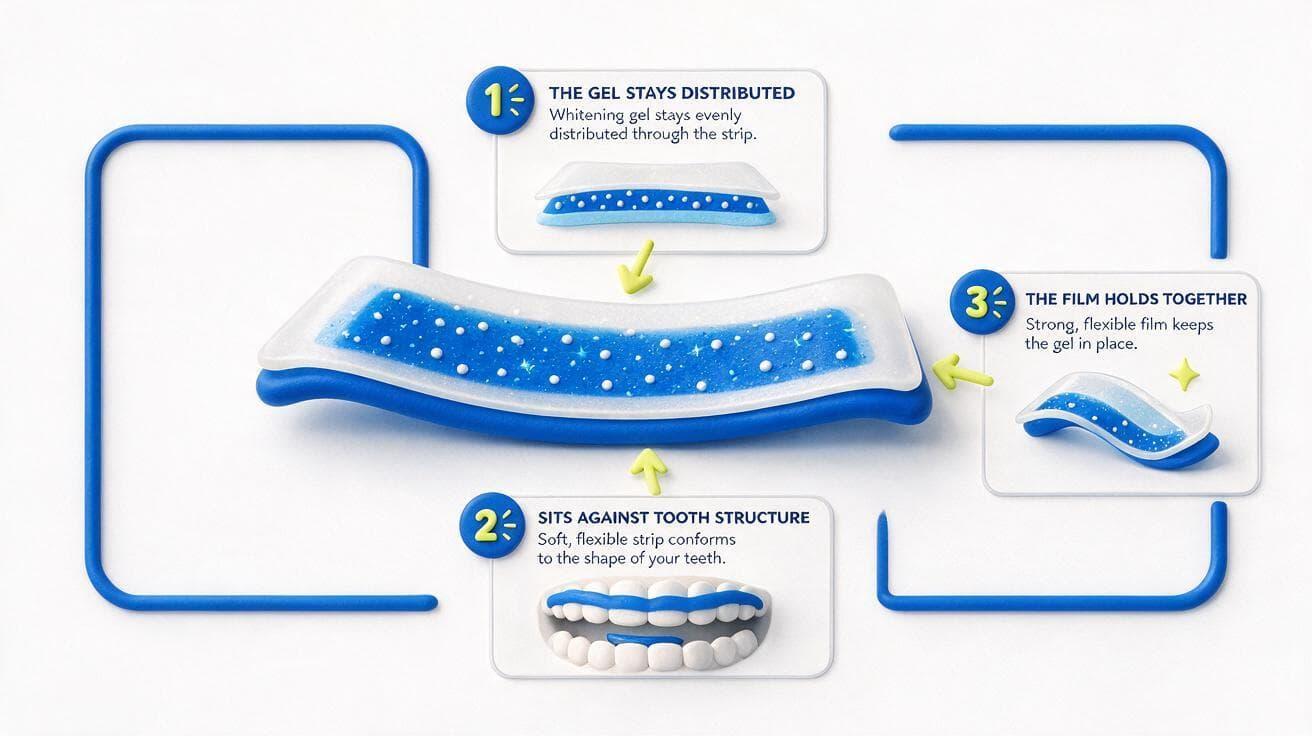
Polyvinylpyrrolidone, or PVP, is a synthetic polymer used in many product formulas because it can form films and help bind ingredients together. In a whitening strip, those properties are useful because the strip and its gel need structure. PVP isn’t there to change tooth color on its own. For the chemistry-minded, PVP is also known as povidone.
The easiest way to picture it is a group project where PVP is the person keeping everyone in the room. The whitening agent gets the glamorous before-and-after job. PVP helps the formula stay organized enough for that job to happen.
In practical terms, PVP can help support the film and structure of a whitening strip. But seeing PVP on an ingredient list doesn’t tell you by itself how strongly a strip will adhere, how evenly its gel will be distributed, or how well the product will whiten.
Those outcomes depend on the full formulation and product design, not one supporting ingredient working alone.
PVP Is Not the Whitening Agent
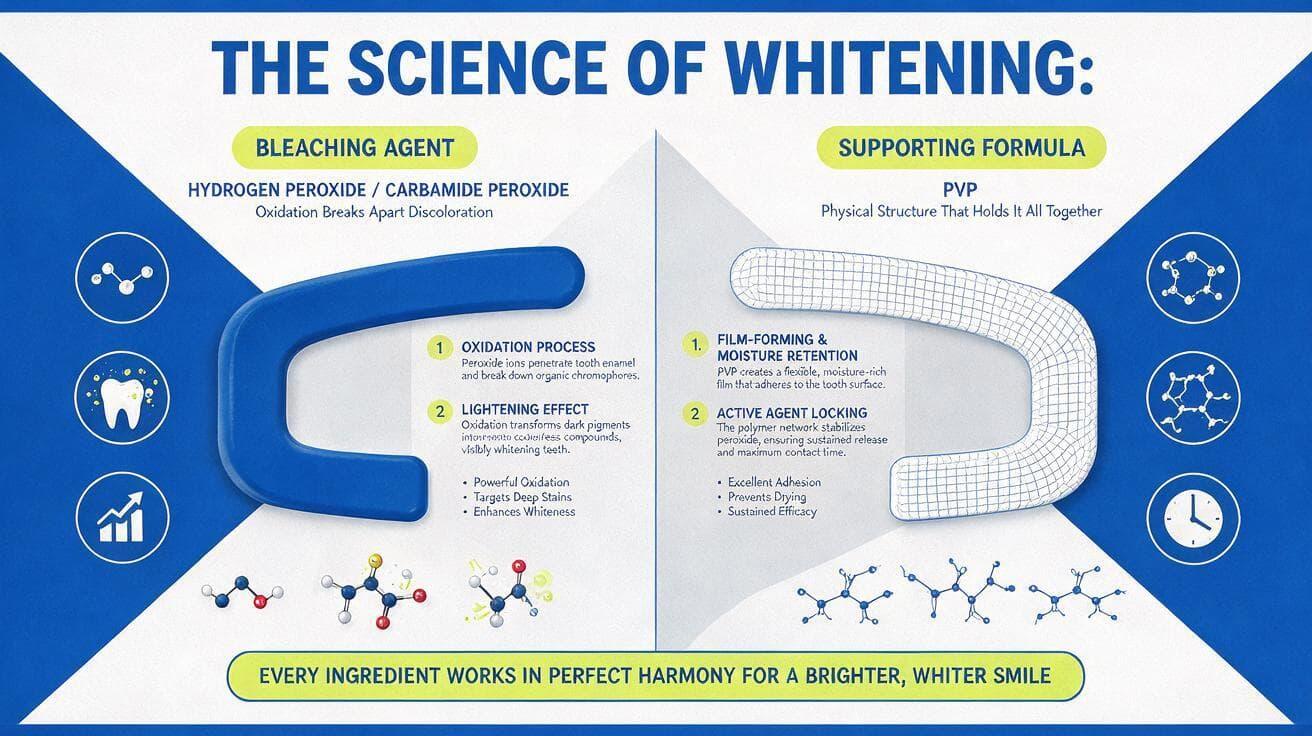
This distinction matters because PVP teeth-whitening searches often blur the line between two very different jobs. Ingredients such as hydrogen peroxide or carbamide peroxide are used as bleaching agents in teeth whitening. Peroxide-based whitening changes tooth color through oxidation, while PVP supports the physical formula around that process.
Same strip. Different assignments. Calling PVP the ingredient that whitens teeth would be like crediting the phone case for taking the photo. Helpful setup, wrong employee.
Why Strip Structure and Contact Matter
A whitening strip can have the right ingredients and still be annoying to use if it refuses to stay where you put it. PVP can help support the strip’s film-forming system, but it doesn’t work alone or guarantee stronger adhesion, better gel distribution, or more even whitening.
How a strip behaves on your teeth depends on the complete formula and product design. In other words, spotting PVP on an ingredient list tells you something about its supporting role, not how well the finished strip will perform.
If the strip keeps sliding or lifting, follow the product directions rather than adding more gel or extending the wear time. Tooth sensitivity and gingival irritation can occur with peroxide-based whitening, so more isn’t automatically better. Stop use if you develop significant pain, swelling, or irritation.
PVP Works With the Rest of the Formula, Not Alone
PVP makes more sense when you look at it as one part of a complete formula. SNOW’s standard Dissolving Teeth Whitening Strips offer a useful real-product example:
|
Ingredient |
Role in SNOW Dissolving Strips |
|---|---|
|
Hydrogen peroxide |
Listed whitening ingredient |
|
PVP / polyvinylpyrrolidone |
Listed by SNOW as a film-forming ingredient |
|
Pectin |
Listed by SNOW as a film-forming ingredient |
This is a product-specific example, not a universal whitening-strip formula. Ingredient lists and formulations can change, so always check the current product packaging for the most up-to-date information.
The useful distinction is simple: the whitening ingredient and the supporting ingredients have different jobs. Understanding how whitening ingredients work together can make the rest of the label much less intimidating.
Is PVP Generally Safe, and What About Sensitive Teeth?
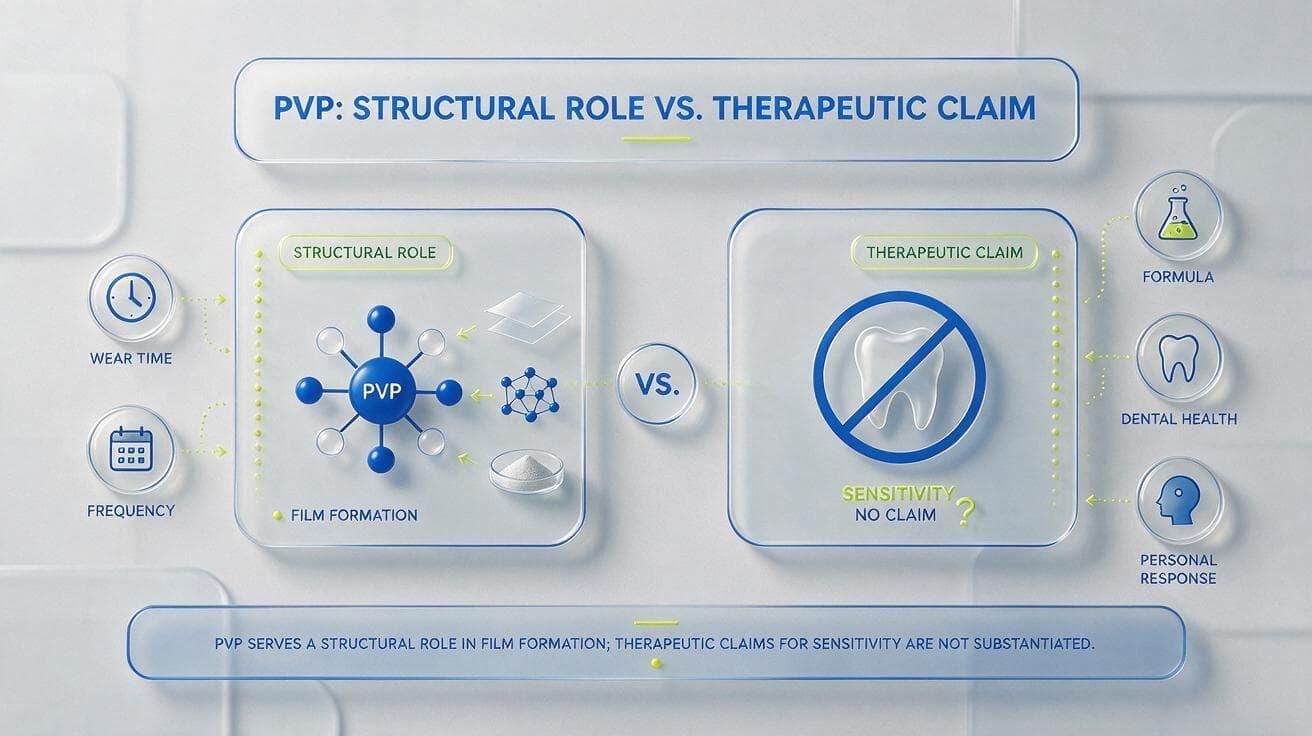
PVP shouldn’t be framed as an ingredient that treats, prevents, or reduces tooth sensitivity. Its role in a whitening-strip formula is structural, not therapeutic.
Sensitivity is a separate part of the whitening decision. Whitening-related sensitivity has been studied with peroxide-based products, and gum irritation can also occur. Wear time, frequency, the whitening formula, your starting dental health, and how you personally respond all matter.
If you have sensitive teeth, don’t assume a PVP ingredient automatically makes a product the right fit. Read the full directions and formula, use the product as directed, and stop if whitening causes pain or discomfort that concerns you. Your nerves do not care that the ingredient list looked aesthetically reassuring.
The same goes for enamel claims. PVP’s presence isn’t proof that a strip prevents enamel damage, repairs tooth enamel, or creates a therapeutic protective barrier. Those are different claims and need different evidence.
Where PVP Fits in SNOW Dissolving Whitening Strips
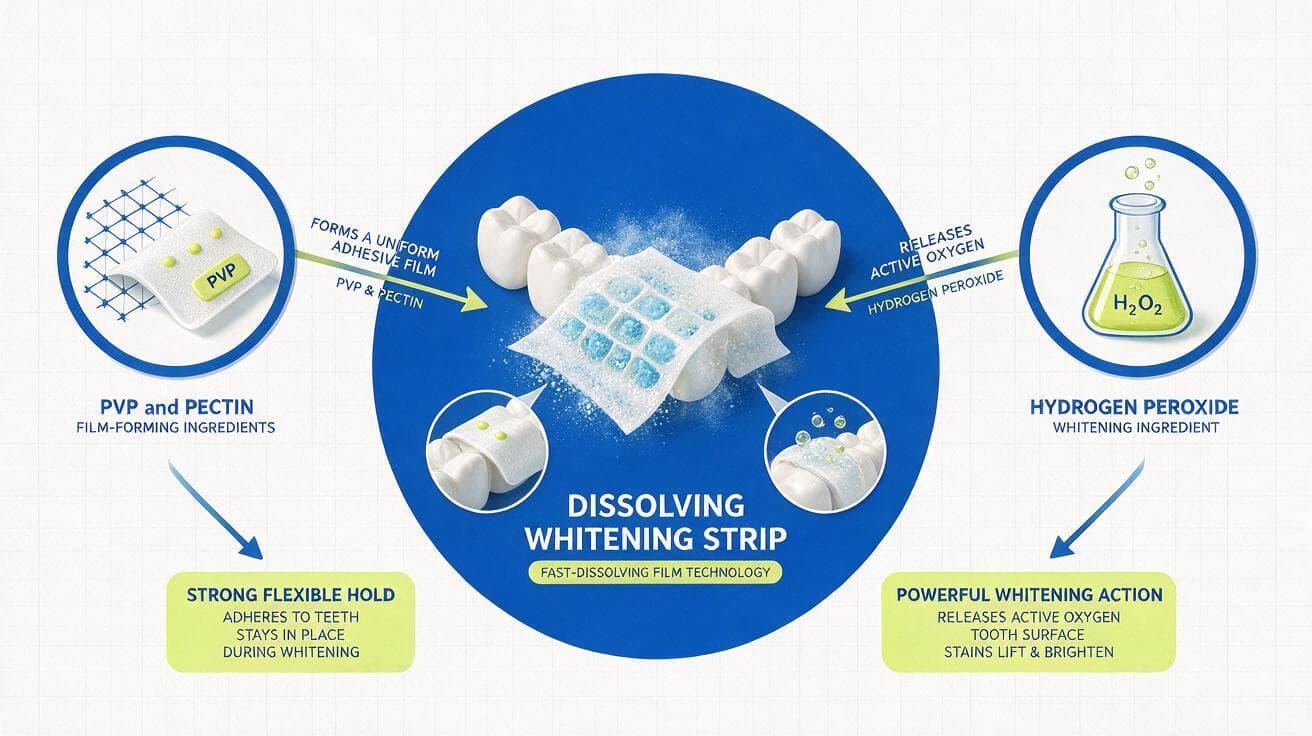
SNOW Dissolving Teeth Whitening Strips give us a real example of how these ingredient roles come together. The standard dissolving strips list PVP and pectin, which SNOW describes as film-forming ingredients, alongside hydrogen peroxide, the listed whitening ingredient.
That distinction is the useful part. PVP isn’t doing the bleaching itself. It forms part of the supporting formula around the whitening ingredient in a strip designed to dissolve during use.
Ingredient lists and formulations can change, so always check the current packaging for the most up-to-date information.
Choose SNOW Dissolving Whitening Strips
How to Read PVP on a Whitening Label Without Overthinking It
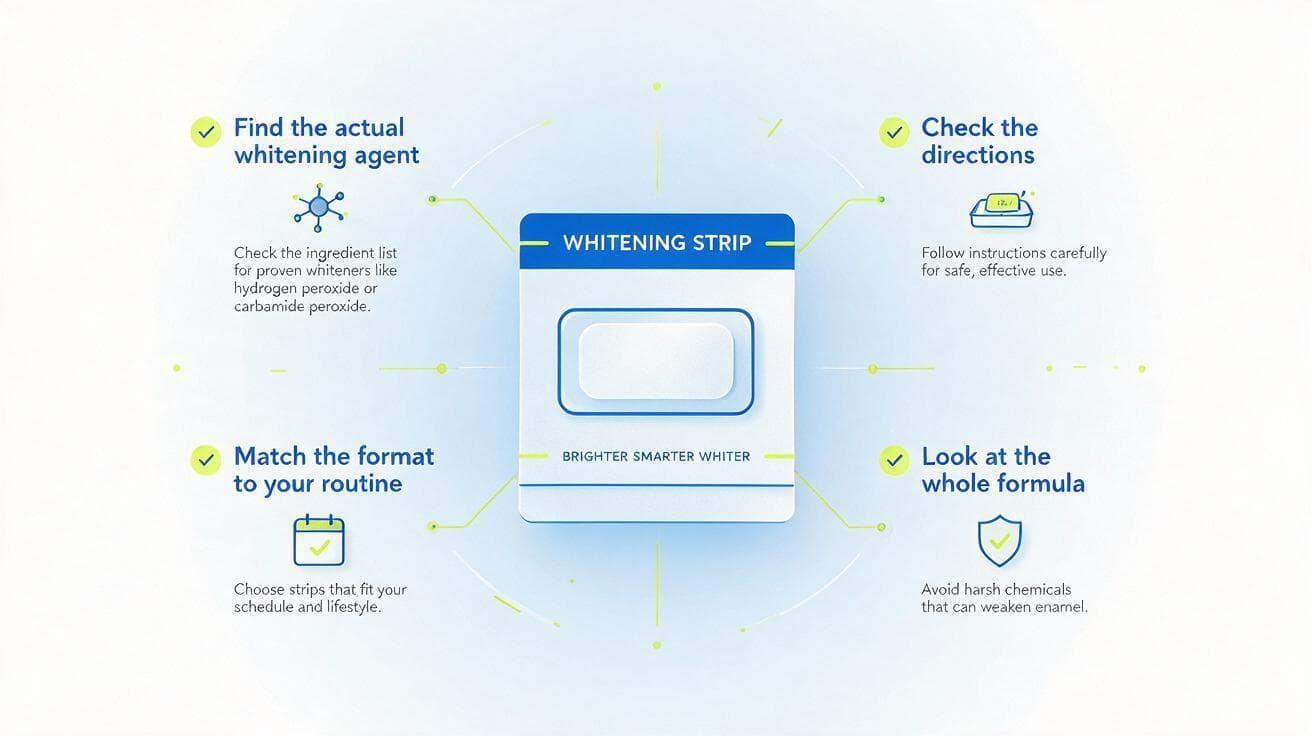
You don’t need to become a cosmetic chemist in the toothpaste aisle. When you see PVP, or polyvinylpyrrolidone, on a label, read it as a clue about product structure, then keep going.
-
Find the actual whitening agent. Is the product clear about the ingredient doing the bleaching?
-
Check the directions. Wear time and frequency should be easy to understand before the strip touches your teeth.
-
Look at the whole formula. PVP is only one ingredient, and its presence doesn't tell you everything about how a strip works. Check which ingredient is actually responsible for whitening, then read the rest of the formula in context.
-
Match the format to your routine. A theoretically impressive formula is not very useful if you hate wearing it by night two.
Ingredient-conscious does not have to mean ingredient-afraid. If a label raises questions, comparing whitening ingredients worth watching can help separate a real formulation concern from a scary-looking name.
PVP Matters, but the Whole Strip Decides the Routine
PVP doesn’t need to be the star whitening ingredient to have a job. It can support the film-forming system, while the whitening ingredient does the bleaching work. In SNOW Dissolving Teeth Whitening Strips specifically, PVP and pectin are listed as film-forming ingredients, while hydrogen peroxide is the listed whitening ingredient.
That’s why understanding how whitening strips work is more useful than judging a product by one unfamiliar ingredient. Look at the full formula, follow the directions, and choose a format you can use correctly and consistently.
PVP does not need top billing. It just needs to do its part. Very supporting cast. Very important to the plot.
FAQs About PVP in Whitening Strips
PVP sounds technical, but the useful questions are pretty practical. Here are a few things worth knowing before you judge a strip by one ingredient.
Does PVP itself whiten teeth?
No. PVP is a supporting ingredient, not a bleaching agent. In SNOW Dissolving Teeth Whitening Strips specifically, PVP is listed as a film-forming ingredient, while hydrogen peroxide is the listed whitening ingredient. Other whitening products may use different formulations, so check the label rather than assuming every strip works the same way.
What should I do if a whitening strip irritates my gums?
Stop using the strip if you develop significant or persistent irritation, pain, swelling, or another reaction that concerns you. Don’t extend the wear time or add more product to compensate for a strip that isn’t sitting correctly. Follow the product directions, and speak with a dentist if symptoms continue.
Do all dissolving whitening strips contain PVP?
No. “Dissolving” describes the product format, not one universal ingredient list. Different brands and formulas can use different film-forming and supporting ingredients. Check the current ingredient list on the product packaging if PVP is something you specifically want to identify.


