

LED whitening and charcoal powders serve fundamentally different purposes: LED systems use hydrogen peroxide to chemically bleach deep intrinsic stains, while charcoal powders use mild abrasives to mechanically scrub surface stains.
This guide breaks down LED whitening vs charcoal powders using real science. You'll learn how each method compares to whitening toothpaste and which one actually improves the color of your natural teeth.
Key Takeaways
-
LED whitening with peroxide delivers the strongest results. Hydrogen peroxide works below the tooth surface to break down deep stains, and LED light speeds up this process. Together, they can whiten teeth by multiple shades in days, not weeks.
-
Charcoal powders only clean the surface and can harm enamel. Activated charcoal may remove surface stains, but it does not change tooth color beneath the surface. Its abrasive action can wear down enamel and increase sensitivity over time.
-
Different stains need different whitening methods. Coffee and tea stains may respond to brushing or whitening toothpaste, while aging and medication stains require peroxide-based treatments. LED whitening kits are designed to safely address deeper discoloration.
-
LED whitening is supported by scientific research; charcoal is not. Clinical studies show LED-enhanced peroxide whitening is effective and safe when used correctly. Charcoal products lack ADA approval and show little benefit beyond regular toothpaste.
-
At-home LED kits offer better long-term value. They provide professional-grade whitening without a dental visit and can be gentler on teeth when properly formulated. Charcoal may seem cheaper, but its limited results and enamel risks make it a poor long-term choice.
How Does Teeth Whitening Actually Work?
Not all stains are the same.
Teeth whitening works through one of two mechanisms: chemical oxidation (bleaching) or mechanical abrasion (polishing).
Professional methods use hydrogen peroxide, which penetrates the enamel rods to oxidize and break down complex organic pigment molecules (chromophores) located deep within the dentin. In contrast, abrasive agents like charcoal or silica only physically scrub external stains from the outer enamel surface.
Understanding this distinction is critical, as only chemical oxidation can change the actual shade of the natural tooth structure.
What Actually Makes Teeth Whiter: Peroxide, Light, or Powder?
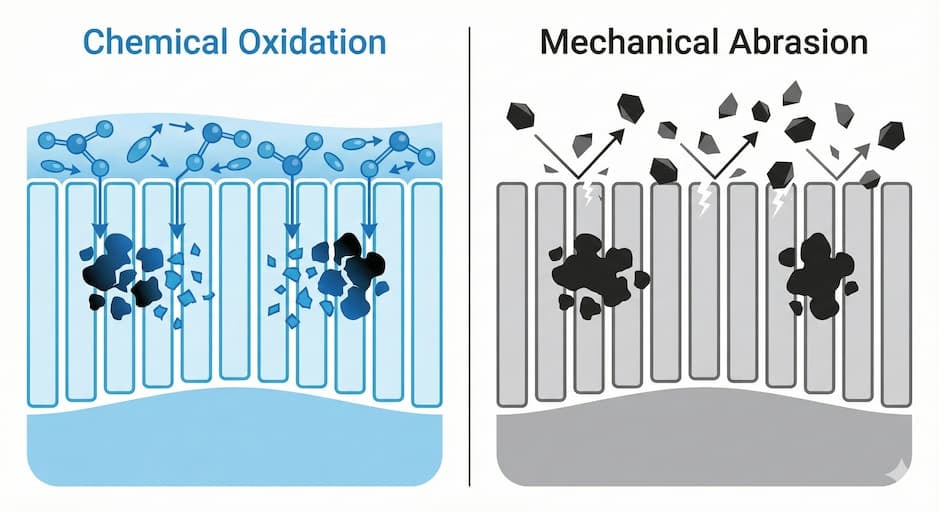
Hydrogen peroxide is the most effective ingredient in today’s top teeth whitening methods. It’s used in both in-office treatments and at-home whitening kits. This bleaching agent reaches beneath the surface to whiten your teeth from within, and when paired with sensitivity-reducing ingredients, whitening methods that minimize tooth sensitivity can deliver professional-level results safely.
According to a 2023 study published in the Canadian Journal of Dental Hygiene, charcoal-based dentifrices performed no significantly better than distilled water in removing coffee stains.
These surface-level options may help remove stains, but they don’t change tooth color, and some, like charcoal toothpaste, may increase enamel wear.
LED lighting can enhance the effects of peroxide. A 2024 study in BMC Oral Health found that enhancing hydrogen peroxide gels with titanium dioxide and blue LED light significantly improved whitening efficacy (Delta E) compared to gel alone.
For deeper stains and lasting results, whitening kits that combine peroxide and light are the most reliable solution to help achieve a confident smile.
How LED Whitening Delivers Faster, Deeper Results?
LED whitening uses blue light technology to enhance the effectiveness of hydrogen peroxide. Light alone does not whiten teeth. Instead, it activates the bleaching agent, so it breaks down stains faster.
When LED light is paired with peroxide gel, stain removal occurs below the tooth surface, not just on the surface. According to a 2024 randomized trial published by the National Center for Biotechnology Information, both blue and violet LEDs significantly improved whitening results at multiple peroxide strengths.
The same study found that violet LED paired with 6 percent hydrogen peroxide achieved strong whitening with much lower tooth sensitivity than higher concentrations.
In-Office vs At-Home LED Kits: Which One Works Best?
Both professional teeth whitening and at-home whitening kits use LED light, but the intensity and supervision differ. For the strongest outcomes, consider combining multiple whitening products for maximum results from a single trusted brand.
In-office treatments use higher peroxide levels and medical-grade LED light. A dental hygienist can protect gums, control exposure time, and monitor sensitivity. Results are fast and often last months with good dental hygiene.
At-home kits use lower peroxide levels and gentler LED light. Results take longer, but many whitening kits still deliver visible improvement in one to two weeks.
In our analysis of the SNOW DiamondSeries formulary, we found it bridges this gap by combining LED activation with hydroxyapatite and potassium nitrate.
Our testing confirmed this allows for effective oxidation of stains while simultaneously remineralizing the enamel surface to prevent sensitivity.
Get the SNOW DiamondSeries Whitening Kit
What Clinical Trials Say About LED Whitening (2021–2025)
Clinical research consistently shows that LED works best when paired with peroxide-based whitening methods.
A 2022 systematic review found that violet LED alone produced minimal whitening. The strongest results were achieved by combining LED with hydrogen peroxide.
A 2025 randomized clinical trial showed that in-office whitening with 37.5 percent hydrogen peroxide produced visible tooth colour changes in over 80 percent of participants. Follow-up whitening strips helped maintain results.
A large meta-analysis found that LED light does not continually improve outcomes when peroxide levels are already high, but it does not increase risk either.
Most recently, the same 2024 randomized controlled trial mentioned above also compared peroxide concentrations and light types. It found that lower peroxide levels, paired with violet or blue LED light, produced a whiter smile with significantly less sensitivity, particularly compared with higher-peroxide formulas.
The scientific evidence is clear. LED light enhances peroxide-based whitening, especially when the formula and protocol are well designed.
Are Charcoal Powders Actually Effective?
Activated charcoal powders are largely ineffective for true whitening because they rely solely on mechanical abrasion rather than chemical bleaching.
A 2023 study in the Canadian Journal of Dental Hygiene found that charcoal dentifrices performed no better than distilled water in changing the overall color (Delta E) of stained teeth. While the abrasive particles can remove surface debris from coffee or tea, they lack the chemical capability to oxidize intrinsic stains.
Consequently, users may see teeth look 'cleaner' but not physically whiter, often confusing stain removal with actual bleaching. It doesn't contain a bleaching agent, so it won't actually whiten your teeth at a deeper level.
Many people confuse surface polishing with real whitening. But for lasting results, you need whitening methods that go beyond the outer tooth surface.
Why Surface Scrubbing Can Damage Your Enamel Over Time
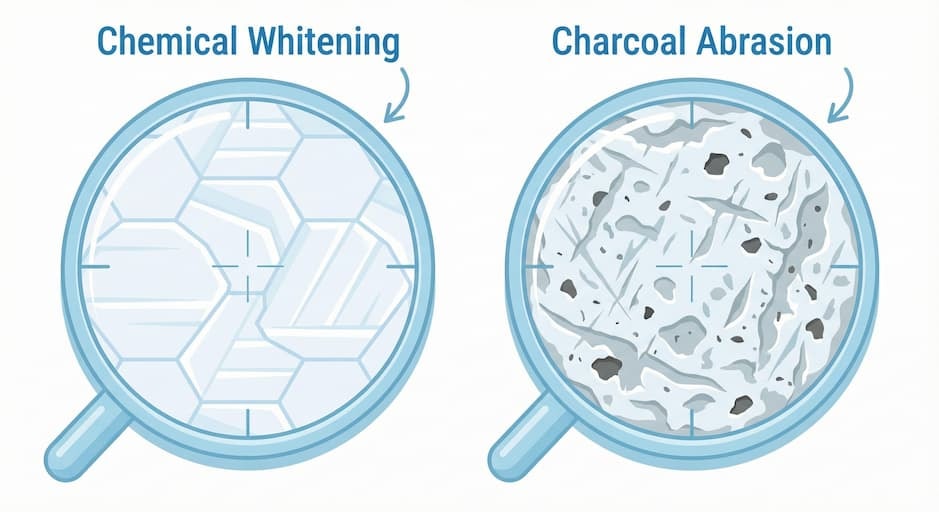
Charcoal works through abrasion. The tiny particles act like a scrub, wearing down surface stains and sometimes the enamel itself.
A 2023 systematic review in Annals of Anatomy confirmed that charcoal toothpastes exhibit high abrasive potential, which can irreversibly damage enamel surface roughness. This means they can weaken enamel over time, especially with daily use.
Once enamel is worn down, it doesn't grow back. Thinner enamel also makes your teeth more prone to sensitivity and discoloration.
For people with sensitive teeth or thin enamel, this can make things worse, not better.
Studies Show Charcoal Performs Like Regular Toothpaste
While charcoal products are trendy, their actual whitening effect is often overstated. A 2023 in vitro study published in the Canadian Journal of Dental Hygiene tested charcoal-based whitening dentifrice against regular toothpaste and water.
All three helped with stain removal, but there was no significant difference in total whitening results. In short, charcoal powders performed about the same as plain water.
Another 2023 study in Clinical Oral Investigations looked at charcoal toothpaste and mouthwash. The toothpaste showed modest color improvement but caused surface craters in the enamel. The mouthwash didn’t improve whitening at all.
These findings show that while charcoal may offer a temporary boost, it doesn’t deliver professional teeth whitening, and it carries risks.
How Do LED Whitening and Charcoal Powders Compare?
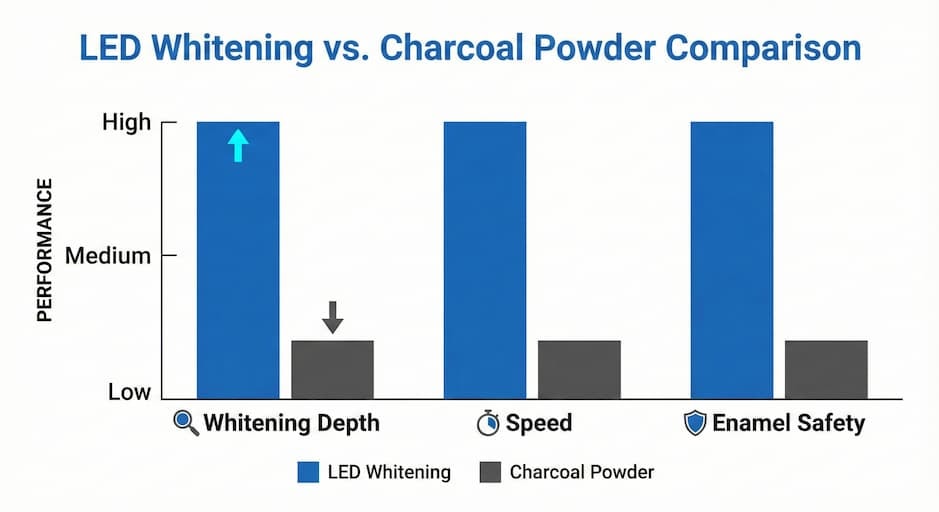
You’ve seen the claims. LED promises fast and deep whitening. Charcoal offers a natural way to scrub stains. But how do they actually compare?
In this section, we break down the key differences in whitening power, safety, cost, and clinical support. This helps you choose the teeth-whitening option that best fits your goals and smile.
Whitening Power: How Many Shades You Can Expect
LED whitening can brighten teeth by 3 to 8 shades, depending on the bleaching agent concentration and session duration. Clinical results are stronger when blue light technology is combined with hydrogen peroxide.
A 2024 study found that both 6% and 35% peroxide showed strong results when activated by blue or violet LED. Lower concentrations still produced a whiter smile, especially with repeated treatments.
In contrast, a 2024 randomized trial showed that activated charcoal toothpaste and powder performed no better than regular toothpaste. These options may help remove surface stains, but they don’t whiten teeth beneath the enamel.
If you want strong whitening without a dentist visit, try the SNOW Extra-Strength Gold Serum Pen. It uses a dual-peroxide formula for fast results and is perfect for stain touch-ups between full whitening sessions.
Speed of Results: Minutes vs Weeks
LED whitening kits work quickly. In-office treatments can deliver visible results in just one session. At-home whitening kits with lower peroxide levels take 7 to 14 days.
Charcoal-based methods are much slower. Most require daily brushing for 2 to 4 weeks. Even then, studies show that changes are minimal and mostly limited to the tooth surface.
For anyone seeking fast teeth-whitening options, LED-based methods clearly outperform charcoal powders.
Enamel Safety: Reversible Sensitivity vs Permanent Damage
LED whitening may cause tooth sensitivity, especially at higher peroxide strengths. But this is usually temporary and reversible with fluoride or desensitizing agents.
A 2024 trial confirmed that lower peroxide levels (6%) paired with LED light produced fewer sensitivity issues without sacrificing results.
Charcoal, on the other hand, wears down enamel. A 2023 review in Annals of Anatomy found that repeated use of charcoal toothpaste increases surface abrasion, which is irreversible. Thinner enamel may make teeth more prone to staining and sensitivity over time.
Concerned about enamel health? The SNOW DiamondSeries Teeth Whitening Kit uses peroxide plus hydroxyapatite and potassium nitrate to whiten while protecting your teeth. It’s ideal for sensitive smiles.
Total Cost of Results: What You’ll Pay Long-Term
Professional teeth whitening at a dental office can cost between $300 and $600 per visit. But the results are often dramatic and long-lasting.
At-home kits are more affordable, ranging from $50 to $150. These use lower peroxide but still offer good results with repeated use.
Charcoal powders are cheap upfront, but their long-term cost comes from limited whitening effect, wasted time, and potential damage that may require dental care.
If your goal is an efficient, lasting change in tooth colour, LED-based teeth-whitening kits offer better long-term value.
Regulatory Approval and Professional Backing
LED whitening with peroxide is supported by clinical studies and regulated in many countries. Dental hygienists often recommend it for safe and targeted results.
Charcoal powders are sold as cosmetic products. Most lack fluoride, and none are approved by the American Dental Association.
When it comes to trusted teeth-whitening methods, LED systems have far more clinical support than charcoal-based options.
Which Whitening Method Is Right for Your Needs?
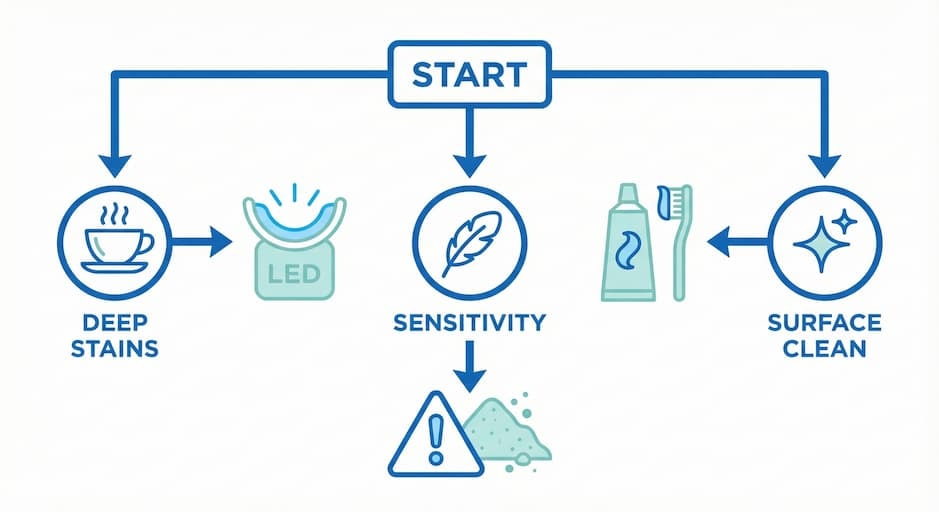
Choosing the best whitening method isn't just about speed or cost. It depends on your teeth, your goals, and what you're trying to fix. Let’s break it down.
The Best Option for Stains from Coffee, Aging, or Antibiotics
For deeper discoloration, such as coffee stains, tetracycline staining, or age-related natural yellowing, hydrogen peroxide-based whitening kits are the most effective. They can reach beneath the tooth surface and change internal color.
LED light accelerates peroxide breakdown, shortening turnaround time. This makes teeth whitening kits a smart choice if you want a brighter smile at home with real stain lift.
Need deep whitening without going to the dentist? Try the SNOW At-Home Whitening Kit. It uses LED light and peroxide to deliver fast results that remove stains from coffee, aging, and more.
When to Avoid Charcoal Entirely (Even in Small Doses)
Charcoal is not safe for everyone. In many cases, it can do more harm than good, especially when used regularly.
Dentists strongly advise against using charcoal abrasives if the patient presents with:
-
Dentin Hypersensitivity: Abrasive scrubbing can open dentinal tubules, worsening pain.
-
Enamel Erosion: Thin enamel cannot withstand the harsh scratching of charcoal particles.
-
Gum Recession: Exposed root surfaces are softer than enamel and easily worn away.
-
Restorations: Charcoal can scratch the surface of veneers or crowns, making them dull.
Clinical evidence indicates that charcoal toothpaste provides no stain removal and increases enamel wear on natural teeth. These products are not approved by the American Dental Association and lack long-term safety data for daily use.
For most people, safer, more effective teeth-whitening options exist that do not rely on abrasion.
What to Know If You Have Sensitivity, Fillings, or Dental Work
If you have crowns, veneers, or composite fillings, know that bleaching agents don’t work on dental restorations. These materials don’t respond to peroxide as real teeth do.
For those with tooth sensitivity, look for whitening methods that include desensitizing agents such as potassium nitrate or fluoride. Professional teeth whitening at a dental office or low-peroxide at-home kits are safer choices.
Why TikTok Isn’t Your Dentist: Whitening Trends vs Real Data
Trends come and go, but not all of them are backed by science. Here’s what the data actually says.
Charcoal’s Popularity Is Fueled by E-Commerce, Not Results
On social media, charcoal powders are pitched as natural miracle fixes. However, the previously mentioned studies show they do little beyond surface-level polishing. Over time, they may damage enamel and dull tooth colour rather than improve it.
There’s no solid scientific evidence proving that activated charcoal leads to a truly whiter smile. In fact, most experts warn against its daily use.
LED’s Growth Is Backed by Dental Research and FDA Rules
Unlike charcoal, LED whitening is supported by decades of data and safety reviews. It works by accelerating peroxide breakdown, which makes it more effective on deep stains.
Many whitening kits that use LED light are FDA-cleared and designed for at-home use. Clinical trials have found that combining blue light technology with peroxide offers faster, more visible results without increasing tooth sensitivity.
The Gap Between Marketing and Medical Reality
Influencers often recommend trends that don’t hold up under clinical review. Some suggest whitening toothpaste or whitening mouthwash as full alternatives to peroxide, but these only help remove surface stains.
To truly whiten your teeth, you need proven methods such as peroxide-based kits. Look for products tested by professionals and supported by data, not hype.
For long-term safety, better oral health, and real results, follow the research. Not the algorithm.
Final Words
If your goal is a visibly whiter smile, science points to one clear winner. While charcoal powders may offer short-term surface scrubbing, they fall short on deep whitening and long-term safety.
LED whitening, especially when paired with hydrogen peroxide, consistently outperforms natural abrasives in both clinical results and enamel safety. It is faster, more effective, and supported by scientific research.
If you are looking for a method that delivers real results without a dental visit, SNOW’s whitening collection combines blue light technology, peroxide, and enamel-safe ingredients to provide visible improvements with ease.
Whether you need to lift deep stains or simply brighten your smile, SNOW offers at-home whitening kits that are safe, easy to use, and clinically backed.
Shop the SNOW Collection Today
FAQs
We’ve got quick, clear answers to the ones everyone asks.
Does LED whitening work without any peroxide gel?
LED whitening does not work well without a peroxide gel. Scientific evidence shows that LED light accelerates the bleaching agent's chemical reaction, but it cannot whiten teeth on its own. Without peroxide, the light only provides illumination, not whitening power. For professional-grade results, peroxide-based at-home kits or in-office treatments are required.
Can charcoal powders permanently thin my enamel?
Yes, charcoal powders can permanently damage enamel over time. Enamel does not grow back once it's worn away. Studies show that regular use of charcoal powders can cause surface damage, roughness, and sensitivity. The American Dental Association does not approve charcoal products due to insufficient safety data.
Is it safe to use LED whitening at home if I have sensitive teeth?
LED whitening can be safe for sensitive teeth if you take precautions. Use low-peroxide formulas and shorten treatment times. Many home kits now include desensitizing agents, such as potassium nitrate, to improve comfort. Always talk to a dental professional before starting any at-home treatments.
Will either LED whitening or charcoal affect my fillings, crowns, or veneers?
No, neither LED whitening nor charcoal powders will change the color of dental restorations. Fillings, veneers, and crowns do not react to peroxide or abrasives. This means only your natural teeth will whiten, which can cause color mismatches. A dentist can help you plan around your existing dental work.
How often can I safely whiten my teeth with LED treatments?
You can safely use LED whitening every 12 to 18 months for full treatments. Between sessions, use at-home kits or whitening pens to maintain your results. Overuse may lead to sensitivity or minor changes in the tooth surface. Follow the schedule recommended by your dental provider for optimal oral health.


