

You have seen the TikTok videos. Someone applies a purple strip, waits a few minutes, and their smile looks instantly brighter. Then you scroll to a dentist calling it "just an optical illusion." So who is right?
Both, depending on which purple strip you are looking at. Most purple whitening strips create a temporary brightening effect that fades within a few hours once the dye washes away. But some newer formulas combine that instant color correction with real whitening agents like hydrogen peroxide or enamel-supporting ingredients like hydroxyapatite, offering more than just a temporary tint.
This article breaks down exactly how to tell which purple strips are quick-fix tints and which ones are worth consistent use. No guessing. Just a clear framework for shopping smarter.
Shop SNOW Purple Whitening Strips
Key Takeaways
-
Purple teeth whitening strips create an instant brightening effect through color-correcting purple pigment that neutralizes yellow tones, producing a temporary optical illusion rather than permanent whitening
-
Most purple strips without active whitening agents, like hydrogen peroxide, only tint the teeth. The effect lasts a few hours and disappears after rinsing, eating, or drinking
-
Some modern brands combine purple color correction with real whitening agents or enamel-supporting ingredients like hydroxyapatite, offering both instant brightness and longer-term benefits
-
Always check the ingredient list before buying. Products with only dyes and film-forming agents are temporary fixes. Products with hydroxyapatite or validated whitening agents are designed for both instant and longer-term results
Quick Answer: Do Purple Teeth Whitening Strips Actually Work?
Yes, but it depends on what "work" means to you.
Purple whitening strips do make teeth appear whiter instantly. The violet pigment uses basic color theory: purple and yellow sit opposite each other on the color wheel, so when applied to teeth, the purple visually neutralizes yellow stains. It is essentially a filter for your smile.
Here is the nuance the TikTok debate misses:
-
Dye-only strips: Temporary tint that disappears once rinsed away. No structural change to tooth color.
-
Dual-action strips: Combine color correction with hydrogen peroxide, PAP (phthalimidoperoxycaproic acid), or hydroxyapatite for both instant brightness and longer-term benefits.
A 2024 randomized controlled clinical study published in the Dentistry Journal tested the HiSmile V34 Color Corrector Serum against a placebo. A single application produced an immediate 3-shade improvement in tooth brightness. Two-thirds of subjects reported their teeth looked both whiter and brighter. However, the researchers confirmed the changes were temporary and did not persist long-term once the dye was rinsed away.
The bottom line: Purple strips work as intended. The ingredient list is what determines whether you are getting a temporary tint or something with more lasting benefits.
How Purple Teeth Whitening Strips Work (And Why They're Purple)
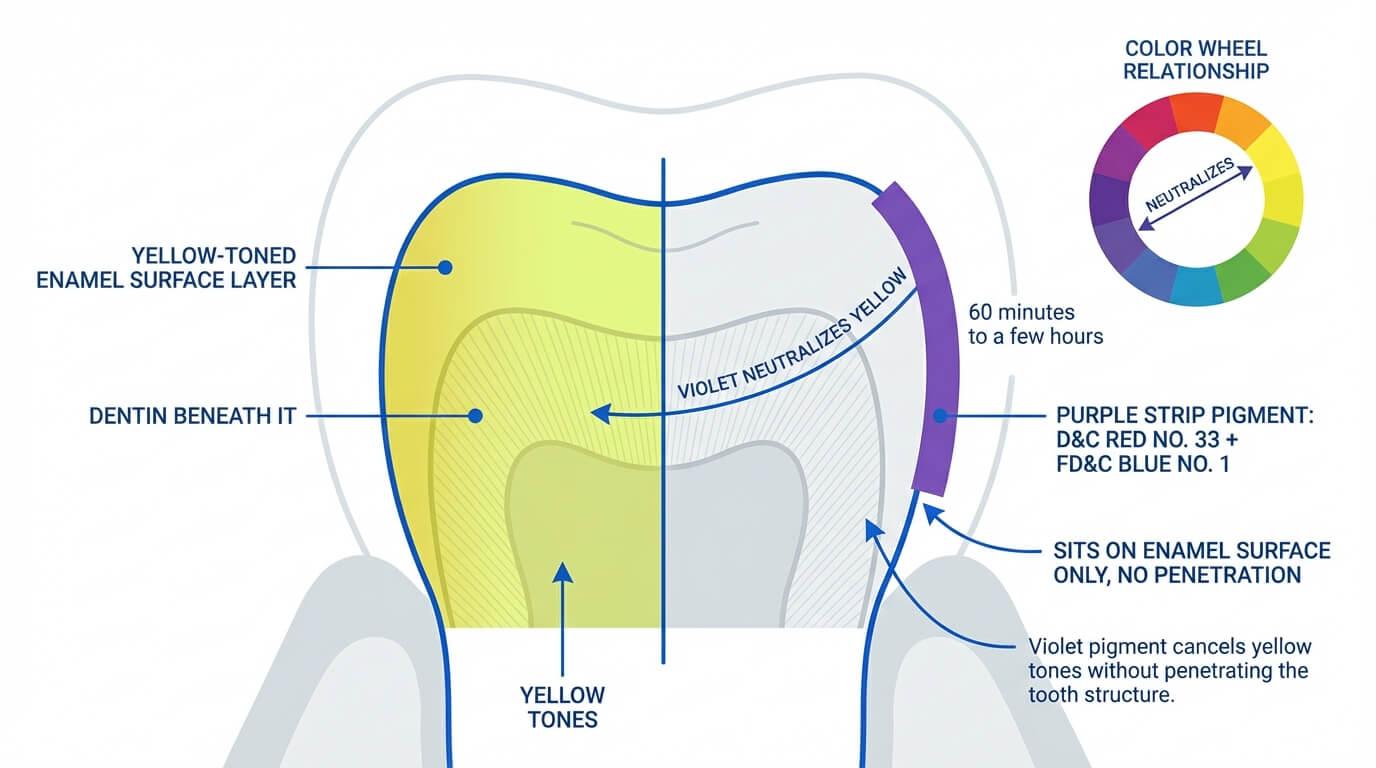
The purple color is not random. On the color wheel, purple (violet) sits directly opposite yellow. When violet pigments are applied to teeth with yellow undertones, they temporarily cancel out that yellow cast and create the appearance of instantly whiter teeth.
Common ingredients in the color-correcting formula:
-
D&C Red No. 33 + FD&C Blue No. 1: The colorants mixed to create the distinctive violet hue
-
Glycerin: A humectant that keeps the strip formula moist and helps it adhere
-
Cellulose gum: A film-forming agent that holds the dye against the tooth surface
-
Aqua: The base solvent that carries the active ingredients
-
Menthol: Added in some formulas for a fresh sensation during use
Here is the critical limitation: The dye sits on the surface of your tooth enamel. It does not penetrate into the tooth structure. Once you rinse, eat, or drink, the pigment washes away. Most users report the brightening effect lasts between 60 minutes and a few hours before teeth return to their original condition.
The purple dye itself does not bleach, does not remove surface stains from within the enamel, and does not alter the dentin layer underneath. Some formulas include active whitening agents such as phthalimidoperoxycaproic acid (PAP) or low-concentration hydrogen peroxide alongside the dye, but the purple color itself is purely for optical correction, not structural change.
What Science Says: Purple vs. Traditional Whitening Strips
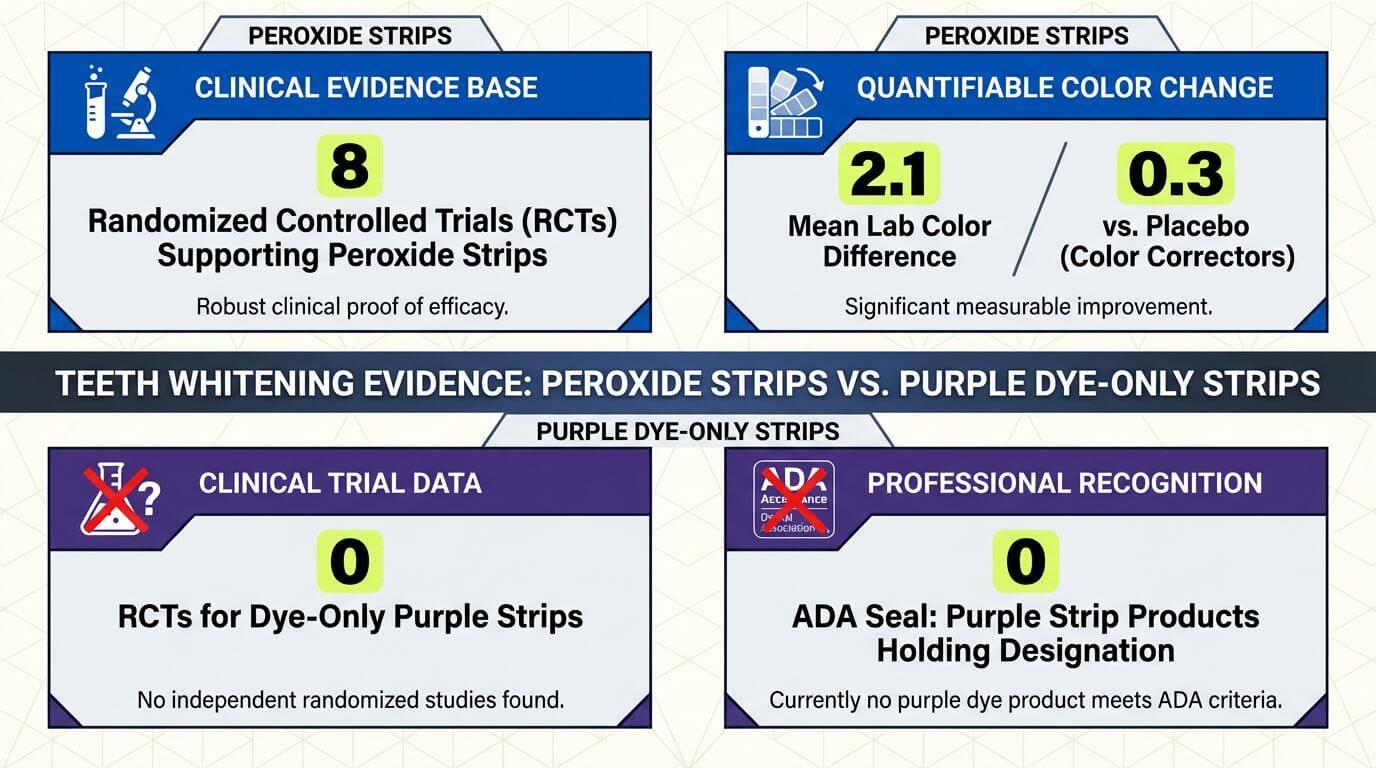
The clinical evidence for peroxide-based whitening strips is well established.
A 2015 meta-analysis published in PubMed reviewed 8 randomized controlled trials comparing whitening strips to tray-based bleaching. It found equivalent whitening efficacy between the 2 methods, with strips showing superior reduction in yellowness.
A 2025 Journal of Dentistry RCT found that 37.5% in-office HP treatment combined with 6% at-home whitening strips maintained whitening at 4 weeks, while in-office treatment alone lost its lightness gains without strip maintenance.
A 2025 systematic review in PMC on hydrogen peroxide-free color correctors found a mean lab color difference of 2.1 (versus 0.3 for placebo) after a single 60-minute application. The authors confirmed that the visual enhancement is temporary and does not result in permanent whitening.
Now for the honest truth about purple-only strips: As of April 2026, there are no peer-reviewed RCTs demonstrating that standalone purple color-correction strips (dye-only formulas) can permanently whiten teeth.
According to the American Dental Association, products with the ADA Seal of Acceptance have demonstrated safety and effectiveness for whitening. No purple strip product currently holds this designation.
Peroxide strips are clinically proven to change tooth color over the course of weeks. Purple-only strips are not. They work more like makeup for your smile.
Instant vs. Lasting: The 2 Types of Purple Whitening Strips
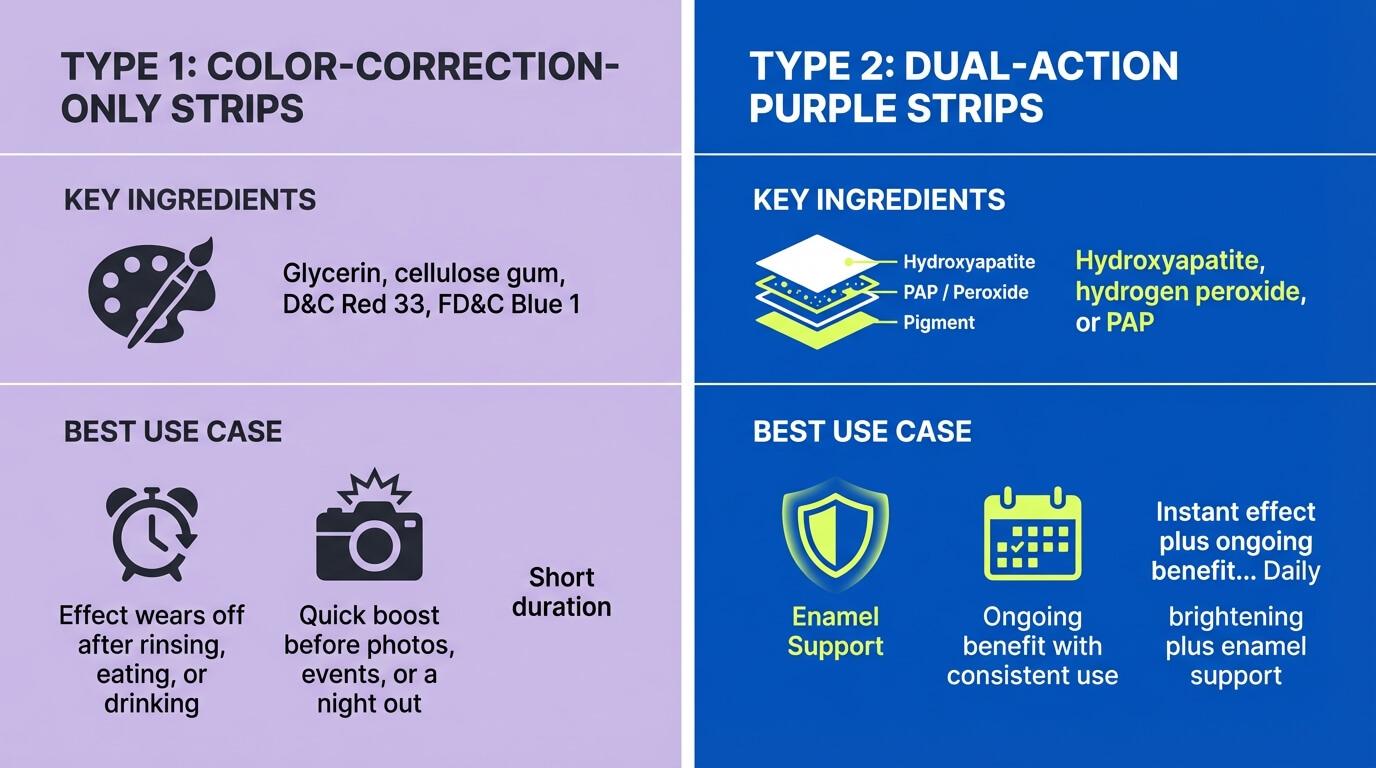
The real question is not "do purple strips work?" It is "what exactly is this purple strip doing while it is on your teeth?" There are 2 distinct categories.
Type 1: Color-Correction-Only Strips
These products rely primarily on violet pigments and film-forming agents. There are no active whitening ingredients.

Type 2: Dual-Action Purple Strips
Newer formulas combine purple color correction with active whitening or enamel-supporting ingredients. These go beyond optical tinting.

How the dual mechanism works:
-
Instant: Purple pigment neutralizes yellow tones on the surface, so teeth appear brighter immediately
-
Ongoing: Hydroxyapatite, a mineral naturally found in tooth enamel, supports enamel structure over time, helping teeth maintain a brighter, smoother appearance with consistent use
Simple rule of thumb: if the ingredient list shows only dyes and film-formers, expect a temporary tint. If you see hydroxyapatite, hydrogen peroxide, or PAP, you are looking at a strip designed for both instant and longer-term results. The SNOW Dissolving Purple Whitening Strips combine a violet pigment complex with hydroxyapatite and stain-lifting technology. They dissolve completely on your teeth, no peel-off mess, and are designed for people who want instant brightness alongside enamel support.
Shop SNOW Purple Whitening Strips
Safety and Side Effects: How Do Purple Strips Compare?
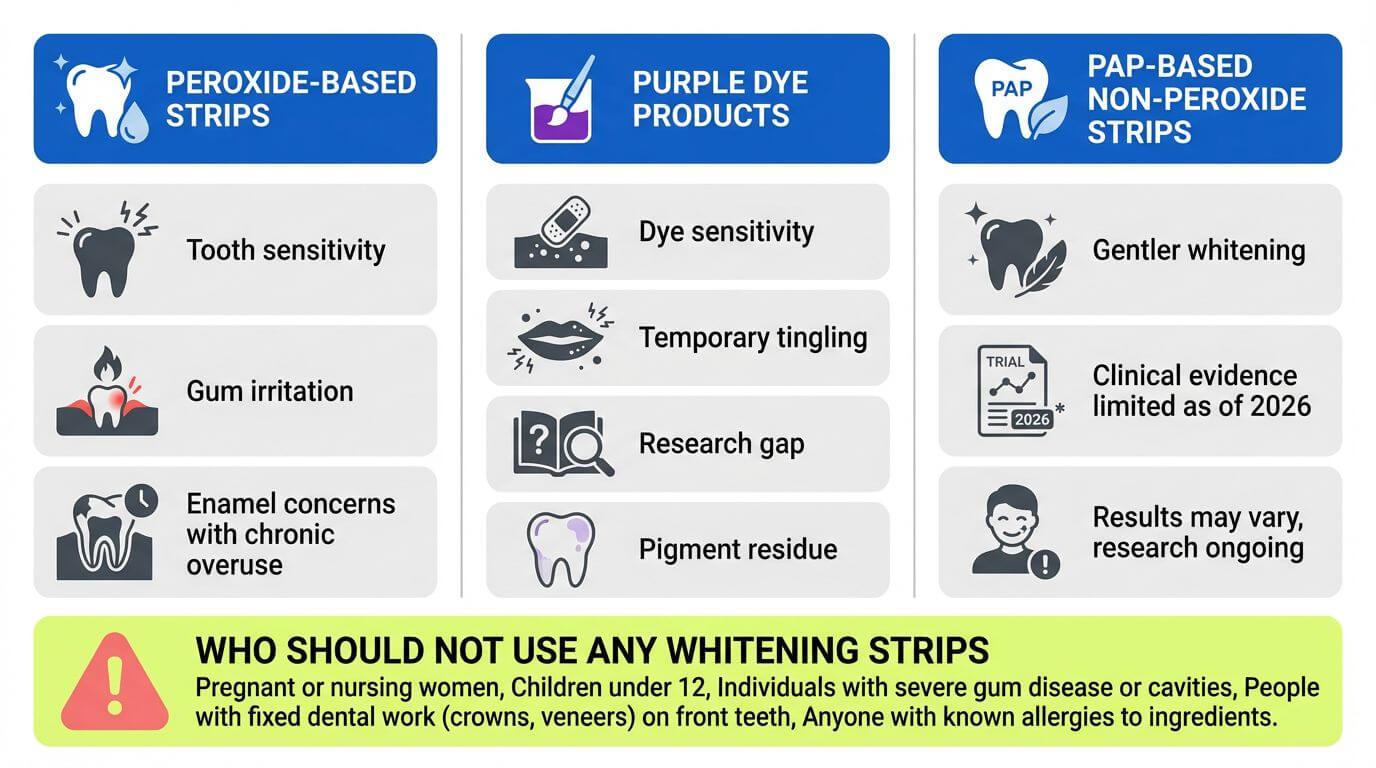
"Gentle" does not mean "risk-free." Both purple strips and traditional whitening products have safety considerations worth understanding before your first use.
Peroxide-Based Strips
Traditional peroxide strips are clinically proven, but they come with known side effects to be aware of:
-
Tooth sensitivity: Hydrogen peroxide temporarily increases enamel permeability, exposing dentin nerve endings. Usually resolves days after stopping use.
-
Gum irritation: Chemical contact from the gel can cause redness or irritation, with a higher risk for those with receding gums
-
Enamel concerns: Chronic overuse at high concentrations is associated with increased sensitivity over time
Purple Dye Products
Purple dye strips carry their own set of considerations that are less discussed but worth knowing before you buy:
-
Dye sensitivity: D&C Red 33 and FD&C Blue 1 are generally recognized as safe but can cause irritation or allergic reactions in some individuals
-
Temporary tingling: Some users report mild sensitivity or tingling during use, which usually resolves quickly
-
Research gap: Long-term effects of repeated purple dye exposure on enamel and oral tissues have not been formally studied
-
Pigment residue: Strong pigment that washes off teeth also washes off elsewhere. Users report staining on toothbrush bristles, sinks, and clothing
PAP-Based Non-Peroxide Strips
PAP is increasingly common in newer purple strip formulas as a gentler alternative to hydrogen peroxide.
PAP (phthalimidoperoxycaproic acid) is a peroxide-free oxidizing agent in some purple strips. Shows promise for gentler whitening, but clinical evidence at consumer strip concentrations remains limited as of 2026
Who Should Not Use Any Whitening Strips
Always consult a dental professional before use if any of the following apply:
-
Untreated cavities or active gum disease
-
Cracked, chipped, or loose teeth
-
Exposed roots or mouth ulcers
-
Extreme baseline tooth sensitivity
-
Pregnancy or breastfeeding
-
Children under 12 years of age
Discontinue use and consult a dentist if irritation occurs.
How Purple Strips Stack Up Against Other Whitening Options
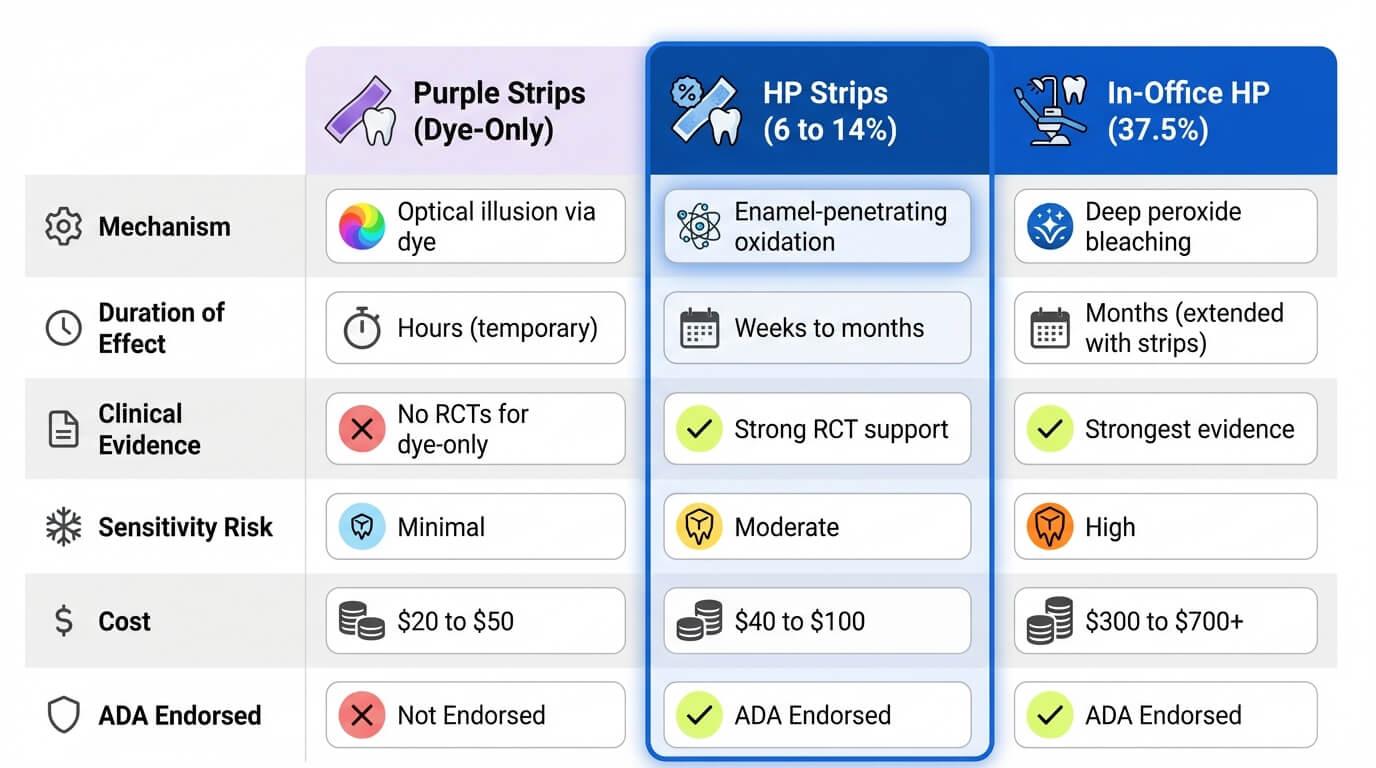
Purple strips are 1 tool in a wider whitening toolkit. Here is how they compare at a glance.

A 2021 Frontiers in Dental Medicine review confirmed that whitening strips are the most effective over-the-counter whitening option across the majority of studies, outperforming dentifrices, rinses, and paint-on gels. The favorable results are largely attributed to their higher hydrogen peroxide concentration and increased contact time with enamel.
Once you understand what each type does, matching the right strip to your goal becomes straightforward:
-
Purple-only strips: Quick cosmetic boost before a night out, content creation, or photos. Not for long-term whitening plans.
-
Dual-action purple strips with hydroxyapatite: Bridge the gap between instant brightening and enamel support. A gentler option for those who struggle with strong peroxide strips.
-
Peroxide strips or in-office treatment: When you want measurable, lasting shade improvement over several weeks or months.
How to Read the Label: Choosing a Purple Strip That Is Not Just Hype
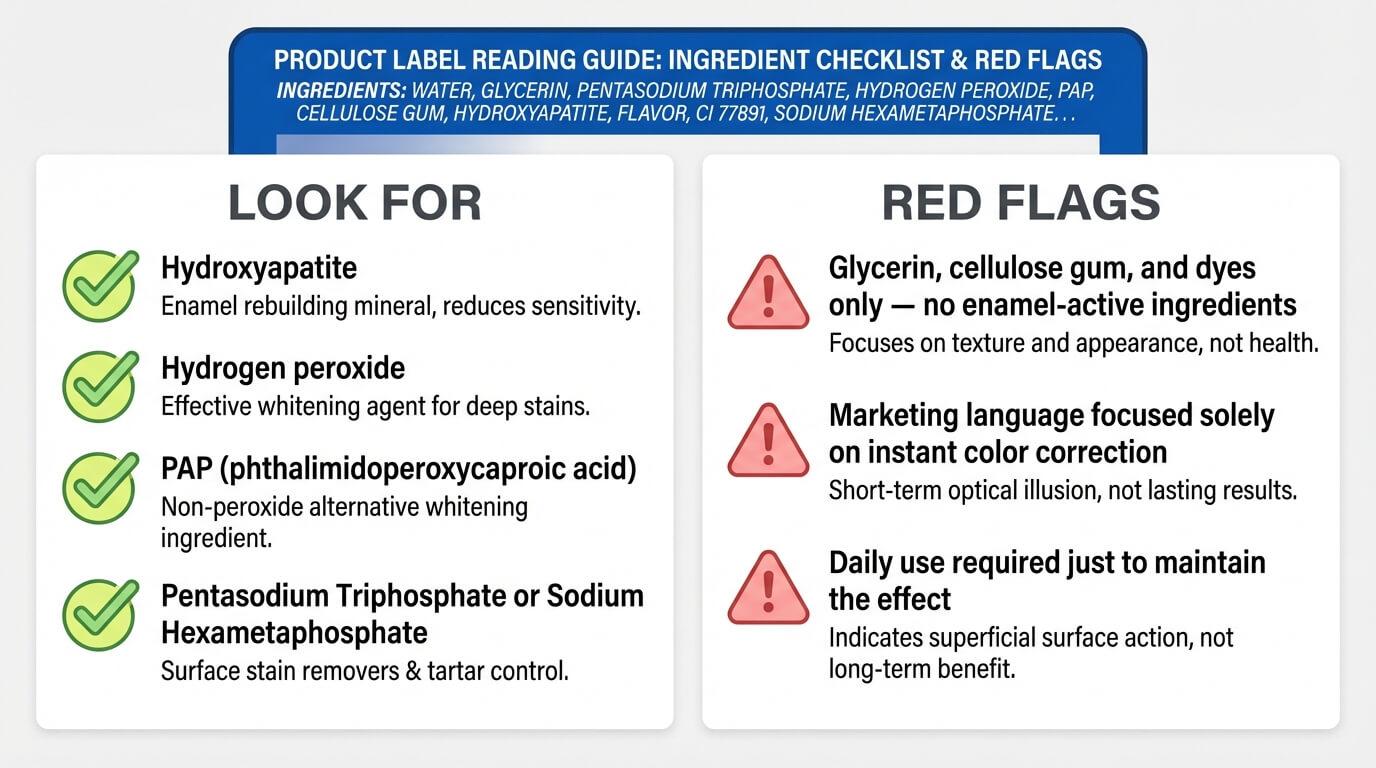
The smartest way to shop for purple strips is to read ingredient lists, not to count TikTok views or review counts.
What to Look For (Real Benefits)
These are the ingredients that separate a genuine dual-action strip from a tint-only product:
-
Hydroxyapatite: A mineral naturally found in tooth enamel. Included in some formulas to support enamel structure and longer-term brightness with consistent use
-
Hydrogen peroxide: A proven whitening agent in low concentrations. Look for this if you want a measurable shade change over time
-
PAP (phthalimidoperoxycaproic acid): A peroxide-free whitening alternative in some formulas. Gentler on sensitive teeth
-
Support ingredients: Pentasodium Triphosphate or Sodium Hexametaphosphate for stain prevention and a cleaner enamel surface
What Signals a Tint-Only Product
If you see any of these on the label or product page, you are looking at a temporary-fix product only:
-
Ingredient list dominated by glycerin, cellulose gum, and dyes (Red 33, Blue 1) with no enamel-active ingredients
-
Marketing language focused solely on "instant color correction" or "optical brightening" without mentioning stain removal or enamel support
-
Usage directions recommend very frequent or daily use just to maintain the effect. This suggests the product depends entirely on continuous pigment application
Additional Shopping Tips
Beyond the ingredient list, these extra checks help you spot quality products before you buy:
-
Check for third-party recognition (beauty awards, verified purchase reviews) that mention both instant results and improvement with consistent use, not just first-use excitement
-
Look at customer reviews discussing use over multiple weeks. Dual-action strips should show comments about maintained brightness, not just immediate "wow" reactions
-
Check the product packaging and product details page for honest language about the temporary nature of color correction
How to Use Purple Whitening Strips for Best Results
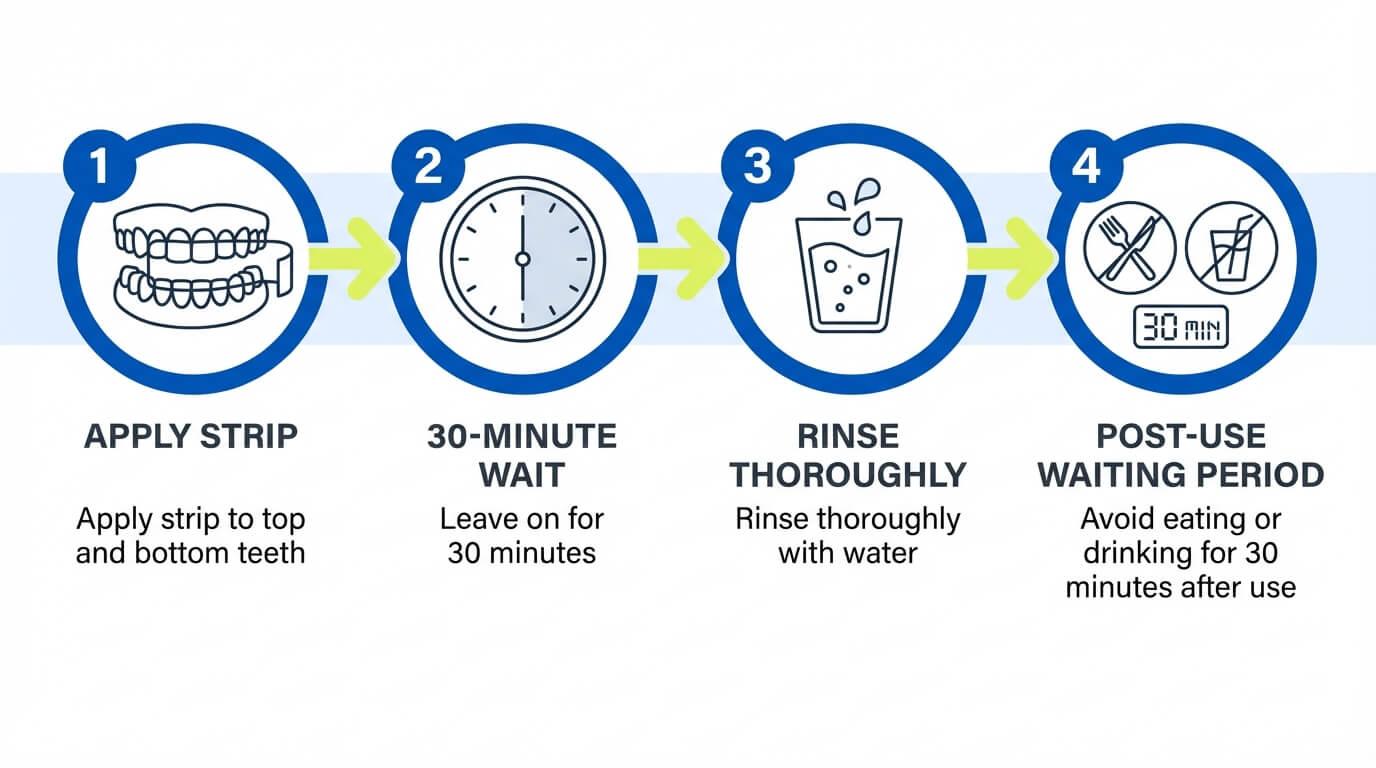
Follow these steps for the best experience and to get the most out of your strips:
-
Step 1: Apply 1 strip to your top teeth and press it down firmly. Fold the excess over the back of your teeth to secure it. Repeat on the bottom teeth.
-
Step 2: Leave the strips on for 30 minutes before removing.
-
Step 3: Rinse your mouth thoroughly with water to remove any residue.
-
Step 4: Avoid eating or drinking for 30 minutes after use to let the ingredients work and to protect your results.
Always follow the instructions provided with your specific product. Discontinue use immediately if irritation occurs.
Where Dual-Action Purple Strips Fit Into Your Routine
Think of dual-mechanism purple strips as a "going out" plus "maintenance" tool, not a hardcore clinical treatment.
Realistic use scenarios:
-
Before events, date nights, or content creation, when you want whiter teeth instantly
-
A few times per week, if you have sensitive teeth and struggle with strong peroxide strips
-
After drinking coffee or tea, when your teeth look temporarily dull, and you need a quick refresh
Pairing strategies for best results:
-
Use dual-action purple strips between or after professional whitening sessions to maintain brightness without re-bleaching
-
Rinse your mouth after dark drinks like coffee and tea to limit contact time with teeth
-
Avoid eating or drinking immediately after application to let the ingredients do their work
These strips are especially appealing to people who already have relatively white teeth but experience daily dullness from coffee, tea, or other staining habits. They offer a gentle, fast refresh without the tooth sensitivity that comes with aggressive peroxide formulas.
Final Words
Purple whitening strips work as intended. The purple pigment genuinely neutralizes yellow tones, making your smile look brighter immediately. But most purple strips do not permanently whiten teeth.
The ingredient list decides whether you are getting a temporary filter or a smarter part of your full whitening routine. SNOW Dissolving Purple Whitening Strips with Hydroxyapatite are designed for people who want both: instant optical brightening combined with enamel support for longer-term results. No peel-off, no mess, and formulated for daily use on sensitive teeth.
Shop SNOW Purple Whitening Strips
Frequently Asked Questions About Purple Teeth Whitening Strips
Have more questions? Here is what people ask most about purple whitening strips.
Do purple teeth whitening strips provide permanent whitening?
No, most purple strips only create a temporary optical illusion by neutralizing yellow tones with violet pigments. The effect usually lasts a few hours and disappears after rinsing or eating. Only dual-action strips with enamel-supporting or whitening ingredients offer longer-term benefits.
What ingredients should I look for in effective purple whitening strips?
Look for hydroxyapatite, which supports enamel health, and for validated whitening agents such as low-concentration hydrogen peroxide or PAP. Strips with only purple dyes and film-formers provide temporary color correction without any lasting whitening benefit.
Are purple whitening strips safe to use?
Generally, purple strips are safe for most healthy adults. Some users experience sensitivity or irritation from dyes like D&C Red No. 33 or FD&C Blue No. 1. Peroxide-containing strips may cause temporary tooth sensitivity or gum irritation. Always follow product instructions and consult a dentist if you have existing oral health issues.
How long should I leave purple whitening strips on my teeth?
Most products recommend leaving strips on for 30 minutes. After removal, rinse your mouth and avoid eating or drinking for 30 minutes to maximize results. Always follow the specific instructions on your product packaging.
Can I use purple whitening strips if I have sensitive teeth?
Dual-action strips with hydroxyapatite are often gentler than traditional peroxide strips and may be better suited for sensitive teeth. If you experience irritation or sensitivity, discontinue use and consult your dentist for guidance.
How do purple whitening strips compare to traditional peroxide strips?
Traditional peroxide strips provide clinically proven, lasting whitening over weeks but carry a higher risk of tooth sensitivity. Purple-only strips offer instant, but temporary, brightness through color correction alone. Dual-action purple strips aim to combine instant optical brightening with enamel support for longer-lasting results with consistent use.


