

Choosing between a manual vs electric toothbrush can feel confusing, but the right option depends on your habits. Both manual and electric toothbrushes can protect your oral health when used correctly.
An electric toothbrush uses automated motion and a timed brush head to help clean teeth and gums, while a manual toothbrush relies on proper brushing technique.
In this guide, we compare electric and manual toothbrushes, explain how electric brushes work, and help you decide whether a manual or electric toothbrush fits your routine best.
Key Takeaways
-
For most people in 2025, a good-quality electric toothbrush with a soft head removes more plaque (about 21% more after three months) and reduces gingivitis (about 11% more) than a manual brush—but a manual brush with excellent technique can still be just as effective.
-
A 2019 Cochrane Systematic Review, incorporating data spanning 11 years, show powered brushes help the average brusher more, mainly because they compensate for poor technique and short brushing times.
-
Cost, dexterity, travel needs, and environmental impact are the real deciding factors: manual toothbrushes win on price and portability, while electric wins on ease of use, timers, and gum protection features.
-
For preventing cavities, the biggest factors are fluoride toothpaste, brushing twice a day for 2 minutes, and daily interdental cleaning (floss or other aids)—not just whether the brush is manual or electric.
-
Choose the option you’ll use correctly and consistently, and consult your dentist or hygienist if you have braces, gum disease, or limited hand mobility.
How Toothbrushing Protects Against Plaque, Cavities, and Gum Disease
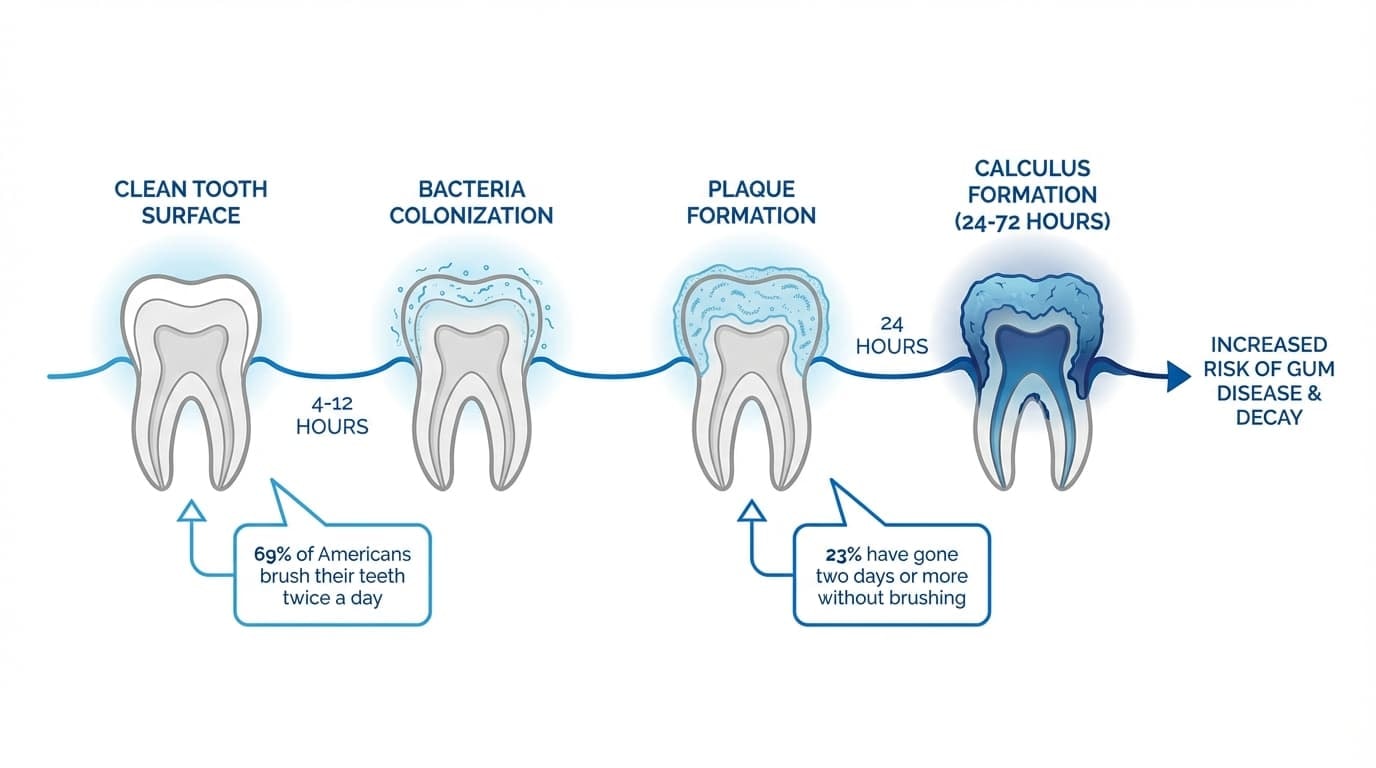
Brushing your teeth isn’t just about keeping your breath fresh. Mechanical biofilm disruption (brushing) is the primary defense against periodontal disease and caries.
Within 4 to 12 hours of eating, oral bacteria like Streptococcus mutans colonize teeth to form a biofilm known as plaque. If not disrupted via mechanical brushing, this biofilm mineralizes into calculus (tartar) within 24 to 72 hours, a hardened deposit that creates a rough surface for further bacterial adhesion and can only be removed by professional scaling.
When you eat or drink, especially anything sugary or starchy, that bacteria creates acid. If left uncleaned, it can start breaking down your enamel, leading to cavities, gum inflammation, and eventually gum disease.
The fix is simple, but not everyone sticks to it.
-
Only 69% of Americans brush their teeth twice a day, which is the basic recommendation from dental professionals.
-
Nearly 23% have gone two days or more without brushing, giving plaque time to harden into tartar. Once it becomes tartar, only a dentist can remove it.
-
Among young adults aged 18 to 24, almost 37% have skipped brushing for multiple days.
These habits can catch up quickly. People who brush twice daily are 22% more likely to report good oral health.
Brushing also spreads fluoride across your teeth, helping to strengthen enamel and protect against acid damage. It's one of the easiest and most important habits for your teeth and gums. And it only takes two minutes, twice a day.
How Effective Are Manual Toothbrushes for Plaque Removal?
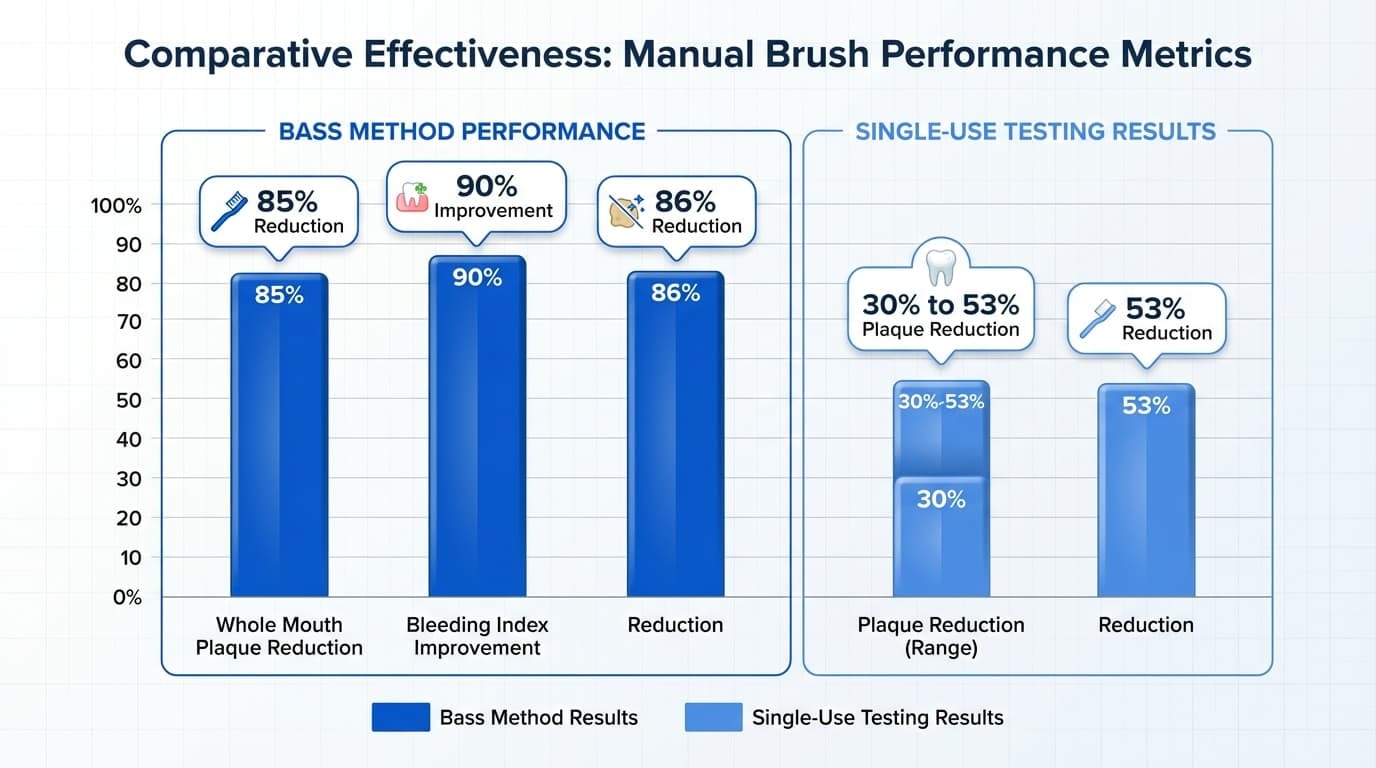
A traditional manual toothbrush can be highly effective when used with proper brushing technique. In supervised clinical trials using the Bass method, manual brushes achieved up to 85% whole mouth plaque reduction and 90% bleeding index improvement, as shown in this study.
Single-use testing also found 30 to 53% plaque reduction measured by Quigley Hein and Navy plaque indices.
When clinical researchers strictly control brushing technique (using the Bass method), manual toothbrushes achieve 85% plaque removal, virtually matching the 86% reduction of powered devices.
These results confirm that manually cleaning teeth effectively is possible when form and time are correct.
Advantages of a Manual Toothbrush
When used correctly, several strengths stand out:
-
Cost Efficiency: A low entry price ($2-$5) with minimal replacement costs.
-
Tactile Feedback: Offers the user full control over pressure, reducing the risk of cervical abrasion.
-
Portability: Requires no charging infrastructure or batteries, making it ideal for travel.
Disadvantages and Limitations of Manual Toothbrushes
However, performance depends heavily on the user:
-
Without correct technique, plaque removal can drop by up to 50%
-
Many people underbrush, with 40% failing to reach the full two minutes
-
No built-in timer or pressure sensors to guide brushing technique
-
Difficult for people with limited mobility, arthritis, or orthodontic appliances
-
Hard bristles can increase gum inflammation and enamel wear
How Do Electric Toothbrushes Improve Gingival Health?
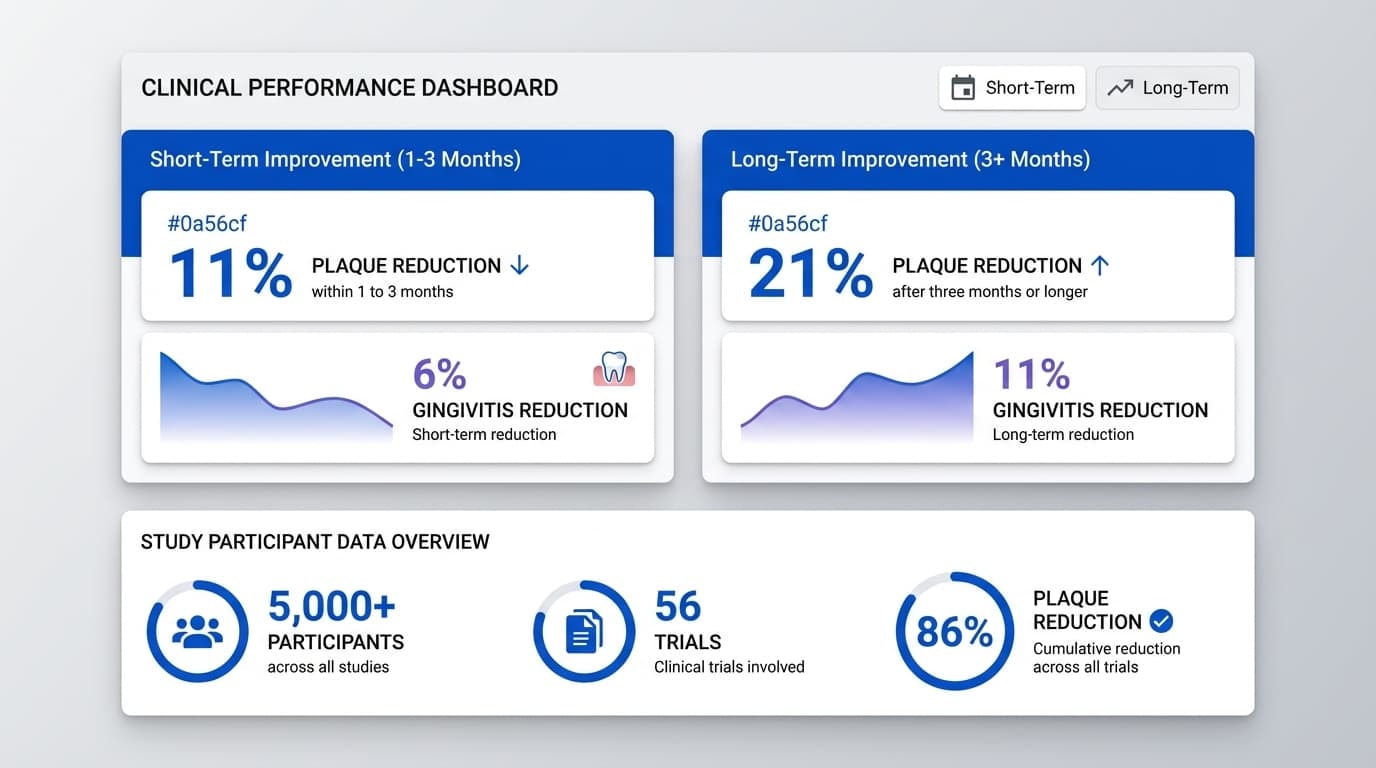
Powered toothbrush technology is designed to improve consistency in plaque removal. Large-scale clinical studies show electric toothbrushes reduce plaque by 11% within 1 to 3 months and 21% after three months or longer.
Gingival outcomes also improve, with 6% short-term and 11% long-term reductions in gingivitis across 56 trials involving more than 5,000 participants. Rotation-oscillation designs achieved 86% plaque reduction when used optimally.
This explains why electric toothbrushes tend to outperform manual ones in everyday use.
Advantages of Electric Toothbrushes
Several practical benefits make powered brushing appealing:
-
Built-in timer helps ensure brushing twice a day for the full two minutes
-
Pressure sensors reduce gum damage and tooth sensitivity
-
More consistent plaque removal for users with poor technique
-
A smaller toothbrush head improves access around orthodontic appliances
-
Helpful for preventing gingivitis and supporting long-term gum health
Disadvantages and Practical Drawbacks of Electric Toothbrushes
There are still limitations to consider:
-
Higher upfront and ongoing replacement head cost
-
Requires charging and battery maintenance
-
Vibration may feel uncomfortable for some users
-
Less convenient for frequent travelers
-
Effectiveness still depends on correct positioning and not scrubbing
Manual vs Electric: Cleaning Effectiveness and Gum Health
This is the question most people care about. Which toothbrush actually cleans better and protects your gums?
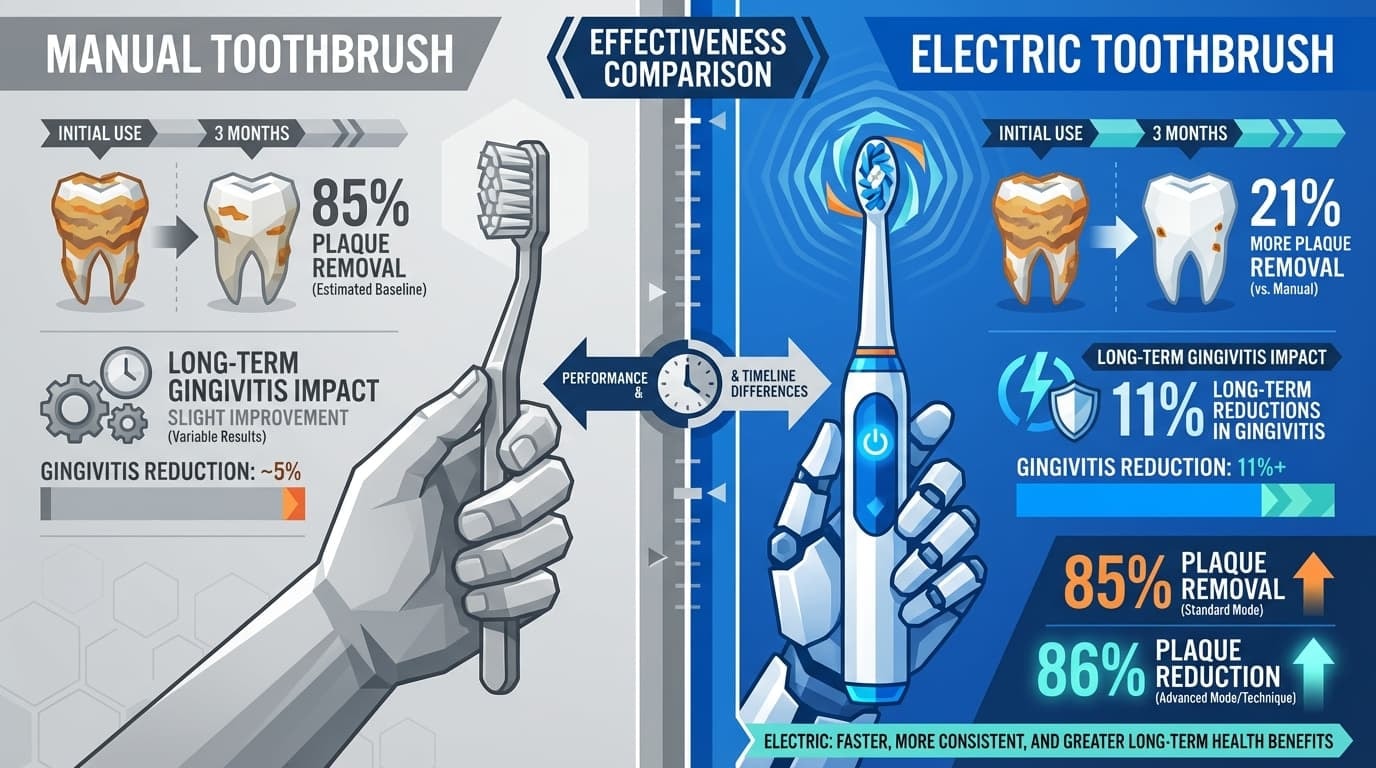
Electric toothbrushes tend to perform better for everyday users. Clinical findings show they remove about 11 percent more plaque within the first one to three months and up to 21 percent more after three months. Gum health improves too, with 6 percent short-term and 11 percent long-term reductions in gingivitis. Rotation and oscillation brush designs show the strongest results.
That said, manual toothbrushes can be just as effective when used correctly. In supervised settings where proper brushing technique was followed, manual brushes achieved up to 85 percent plaque removal and 90 percent improvement in bleeding, nearly matching powered brushes at 86 percent plaque reduction.
The difference is not the toothbrush. It is how people brush.
Most adults do not brush for the full two minutes or maintain consistent technique. Electric brushes help close that gap by guiding timing and movement, making proper cleaning easier to maintain.
They also help with:
-
More consistent plaque removal along the gumline
-
Better delivery of fluoride toothpaste into grooves and tight areas
-
Reduced risk of overbrushing when pressure sensors are used
Both options are safe for teeth and gums when paired with soft bristles and gentle pressure. Damage usually comes from brushing too hard or too briefly, not from the brush itself.
Who benefits most?
Electric toothbrushes often work best for people who rush brushing, miss areas, wear braces, have gum disease, or struggle with hand mobility.
Manual toothbrushes can perform equally well for those who follow good brushing technique, brush twice a day for two full minutes, and stay consistent.
If the same plaque spots keep showing up at dental visits, it may be less about the brush you own and more about whether your routine supports effective daily cleaning.
Impact on Different Users (Average Brusher vs Highly Motivated Brusher)
Not everyone brushes the same way. Here’s how your habits affect which toothbrush might work better for you:
-
If you’re an average brusher, you might rush through brushing, miss spots, or brush less than twice a day. In that case, an electric toothbrush can help you do a better job by timing each session and automating the brushing motion. It basically supports your brushing, so you don’t have to think about it as much.
-
If you’re a highly motivated brusher who takes your time, uses proper brushing technique, and consistently hits the two-minute mark, a manual brush can deliver nearly identical results. When used correctly, there’s often no major difference in outcomes between the two types.
-
If you have gum disease, implants, braces, or limited hand mobility, an electric toothbrush can make cleaning much easier. The smaller brush head and automated movement help clean around tricky spots, such as wires and tight spaces. According to a 2021 study published in the Journal of Clinical Periodontology, seniors utilizing powered brushes retained 19% more teeth over an 11-year longitudinal study compared to manual brush users.
In clinical practice, dental professionals often utilize manual brushes personally due to their mastery of technique, yet they prescribe electric brushes to 90% of patients to compensate for average dexterity limitations.
Cost, Convenience, and Environmental Impact
Choosing between a manual and an electric toothbrush goes beyond just cleaning teeth. It’s a personal choice that depends on cost, lifestyle, environmental values, and how consistently you brush. For many, the best toothbrush is the one that fits smoothly into their daily routine and is actually used twice a day, every day.
Let’s explore the key differences in terms of cost, convenience, and eco-friendliness to help you make the most informed decision for your oral health.
3-Year Cost Comparison
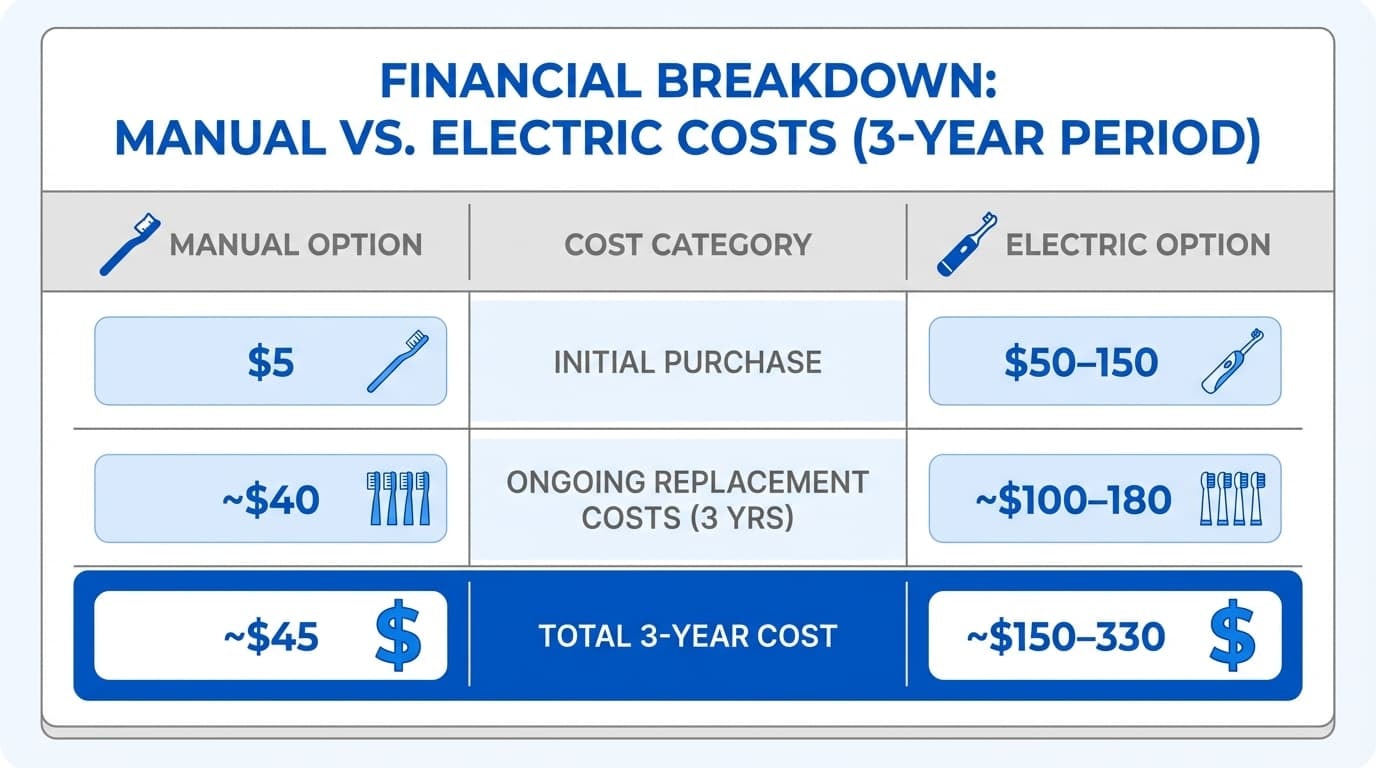
If budget is your top priority, a manual toothbrush is clearly the more cost-effective option. A good manual brush costs just a few dollars and works well when paired with proper brushing technique. However, if you struggle with consistency or pressure, you may benefit more from the automated support an electric toothbrush provides.
That’s where a tool like the SNOW LED Electric Toothbrush comes in. It’s crafted for precision cleaning with minimal effort, equipped with a built-in timer and soft bristles to protect your teeth and gums. While it may cost more up front, many users find the long-term benefits well worth it, including less time spent at the dentist.
Shop the SNOW LED Whitening Toothbrush
Everyday Convenience
Convenience is another key factor that can make or break your routine. Let’s face it, we’re more likely to brush our teeth correctly and consistently when the process is simple and enjoyable.
-
Manual brushes are easy to use, need no charging, and are perfect for quick packing. You can find one almost anywhere, making them ideal for backup or travel.
-
Electric toothbrushes simplify the job with automated movement, pressure sensors, and built-in timers. This helps avoid underbrushing, which still affects around 40% of users who don’t reach the full 2-minute mark.
-
The SNOW Electric Toothbrush offers five modes, long battery life, and a sleek, travel-ready design, combining effectiveness with ease of use. It’s perfect for everyday use, especially if you want to improve your brushing habits without overthinking them.
Whether you need a reliable tool for daily care or a low-maintenance brush you can trust while traveling, convenience can make a big difference.
Environmental Considerations
Eco-conscious shoppers are thinking beyond cost. How your brush impacts the planet also matters.
-
Over three years, the average manual toothbrush creates roughly 216 grams of plastic waste. Replacing an entire handle and brush head every 3–4 months adds up quickly.
-
In contrast, electric toothbrushes typically use replaceable heads only, creating just 50 grams of waste during the same time.
-
However, electric brushes use about 2.5 kWh of power over three years and contain lithium-ion batteries, which must be recycled properly to avoid environmental harm.
If sustainability is important to you, there are eco-friendlier versions of both. Manual brushes with bamboo handles or replaceable heads significantly reduce waste. Meanwhile, SNOW’s electric brush is designed for long-term durability, minimizing the need for frequent replacements and packaging.
Which One Should You Use?
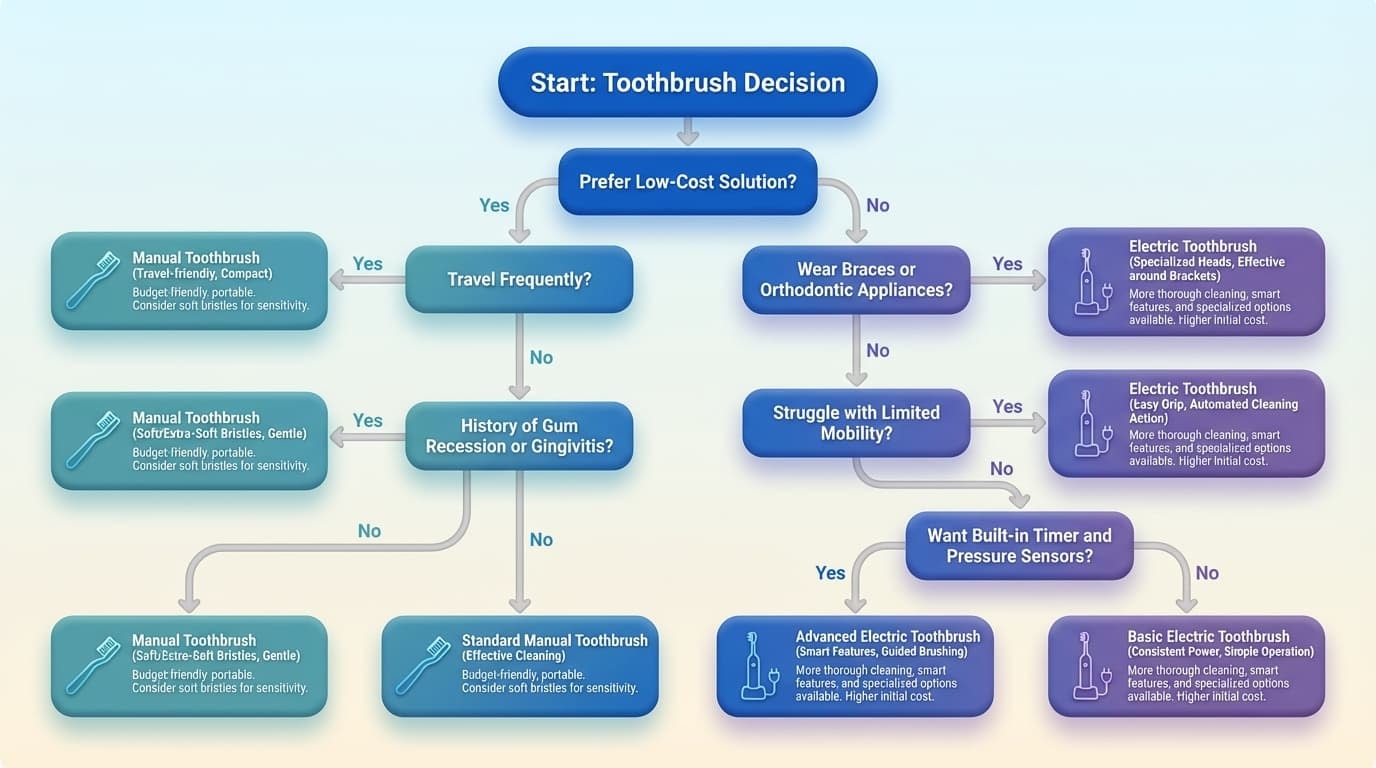
There’s no one-size-fits-all answer, but here are some guidelines to help you decide.
A Manual Toothbrush Might Be Better If You:
-
Prefer a low-cost solution and don't want to deal with batteries or chargers
-
Travel frequently and want something ultra-light and disposable
-
Have excellent brushing technique and consistently brush your teeth twice a day
-
Want to minimize electronic waste
-
Find the vibrations of electric brushes uncomfortable or irritating
An Electric Toothbrush Might Be Better If You:
-
Have a history of gum recession, gingivitis, or frequent plaque buildup
-
Wear braces, bridges, or other orthodontic appliances
-
Struggle with limited mobility in your hands, such as arthritis or tremors
-
Often rush brushing or brush too hard, causing irritation
-
Want help staying on track with features like a built-in timer and pressure sensors
Best of Both Worlds?
You don’t have to choose just one. Many people use a manual brush while traveling and an electric brush at home. This hybrid approach helps you stay consistent no matter the situation.
If you’re looking to upgrade your oral care, the SNOW LED Electric Toothbrush is a smart investment. It’s engineered to make brushing effortless, reduce the risk of gum recession, and support long-term oral hygiene.
Shop the SNOW LED Whitening Toothbrush
Safety and Special Populations
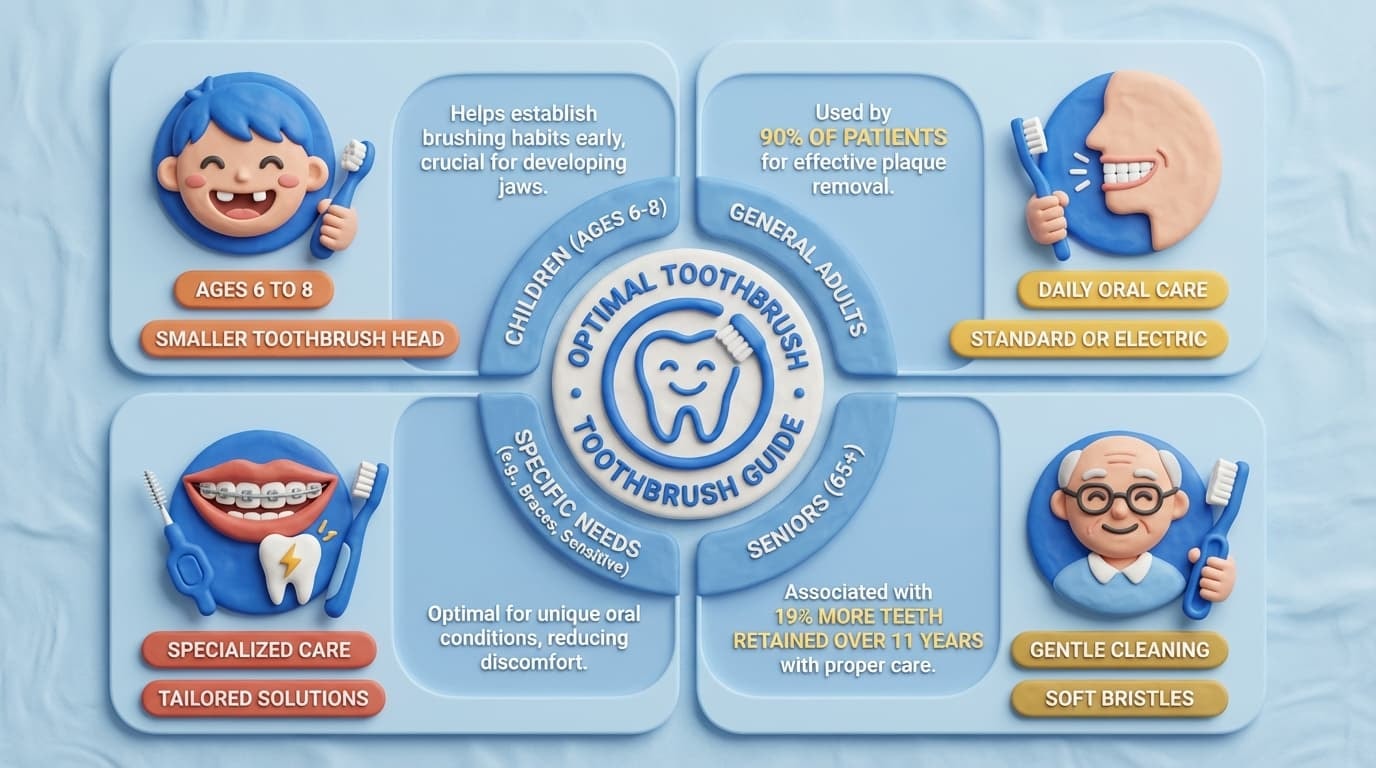
Choosing the best toothbrush for your needs means understanding how manual or electric options affect different users. Both can support good oral hygiene when used properly, but some populations benefit more from powered brushes.
Safe for Daily Use
Both electric and manual ones are safe for daily brushing as long as you use soft bristles and apply gentle pressure. Gum health issues like gum recession or enamel erosion usually come from pressing too hard or using hard bristles, not the toothbrush type itself. Many electric toothbrushes now include pressure sensors that prevent aggressive scrubbing, making them a better fit for users with sensitive gums or tooth sensitivity.
Who Benefits from Electric Brushes
Powered brushes are especially helpful for people who find it difficult to maintain good brushing technique:
-
Seniors or users with limited mobility (arthritis, stroke recovery, or developmental disabilities) can guide the handle without generating the brushing motion. In fact, seniors who used powered brushes retained 19% more teeth over 11 years than those who used manual brushes.
-
People with braces, implants, or orthodontic appliances often benefit from the smaller toothbrush head on many electric models, which helps clean between brackets and wires more effectively.
-
Children can start with manual ones to develop technique and later transition to electric models (usually around ages 6 to 8). Sonic toothbrushes and other powered styles with a built-in timer help make twice-daily brushing more consistent.
Safe Technique Matters Most
Regardless of whether you use a manual or electric toothbrush, using correct technique is key to reducing plaque, preventing gingival health issues, and supporting long-term oral hygiene.
Manual brushing tips:
-
Hold the brush at a 45-degree angle to the gumline.
-
Use small circular motions, not scrubbing back and forth.
-
Brush your teeth for 2 full minutes, covering all sides of every tooth.
-
Use fluoride toothpaste and soft bristles to clean teeth effectively.
Electric brushing tips:
-
Let the powered brush head do the work; do not scrub.
-
Move slowly from tooth to tooth, pausing briefly on each.
-
Follow the built-in timer, and pay attention to any pressure sensors that alert you to ease up.
Universal Oral Care Tips
No matter which brush you prefer, these habits matter:
-
Replace your new toothbrush or head every 3 to 4 months, or sooner if bristles are worn.
-
Don’t rely solely on brushing. Interdental tools like floss or water flossers are essential for cleaning teeth between tight spaces.
-
If brushing causes discomfort, gum inflammation, or persistent bleeding, consult a dentist to adjust your technique.
Whether you choose a powered brush like Oral-B, a simple manual model, or even advanced sonic toothbrushes, consistency, proper brushing technique, and gentle care make the biggest impact. With the right tools and habits, anyone can achieve and maintain good oral health.
Final Thoughts
Whether you use a manual or electric toothbrush, the key to good oral health is technique, consistency, and daily care. Brushing twice a day with fluoride toothpaste, cleaning between your teeth, and replacing your toothbrush or brush head every 3 to 4 months still matter more than the tool itself.
If you're consistent and confident in your brushing technique, a soft-bristle manual brush works just fine. But if you struggle to brush thoroughly or want built-in features like timers and pressure control, a smart electric brush can be a game-changer.
Looking for a clean upgrade? SNOW’s LED Electric Toothbrush offers sonic technology, soft bristles, and smart timers to help you brush better with less effort. It's designed to support healthier teeth and gums, no matter your routine.
Shop the SNOW LED Whitening Toothbrush
FAQs
Got questions about choosing the right toothbrush? These quick answers cover the essentials.
Do I need an electric toothbrush if I never get cavities?
Yes, you might still benefit from an electric toothbrush even without cavities. Many powered brushes help improve gum health, support proper toothbrushing technique, and are often recommended for preventing gum inflammation and supporting gingival health, especially if your dentist spots buildup.
Can an electric toothbrush damage my enamel or cause receding gums?
No, not when used correctly. Hard bristles, pressing too hard, or brushing aggressively are the real causes of gum recession, not the motor. Many electric toothbrushes now come with pressure sensors to prevent that damage.
How often should I replace my electric toothbrush head compared with a manual brush?
Both should be replaced every 3 to 4 months, or sooner if the bristles are fraying. A worn toothbrush or brush head won’t clean teeth effectively and can lead to plaque buildup or gum irritation.
Is a sonic toothbrush better than a rotating-oscillating one?
Both types of powered brushes work well in clinical studies. There’s no significant difference in results for most users, so choose based on personal preference, comfort, and how well it helps you maintain good oral health.
What if my gums bleed when I switch from manual to electric?
Mild bleeding often indicates that your gum health is improving as plaque is removed. Stick with a soft-bristled new toothbrush, brush twice a day, and ease into the switch. If bleeding continues after a week, check with your dentist.


