

You gave Boka a real shot. You brushed consistently, but the results just weren’t there. That’s not your fault.
We tested every major Boka alternative, checked their ingredient lists, and ranked them based on what actually works. No filler picks. No brand loyalty. Just the clearest answer to one question: what should you use instead?
At SNOW, we’ve shipped over 100 million treatments worldwide because we know what actually delivers results. This list reflects that.
Shop SNOW Whitening Toothpaste Now
Key Takeaways
-
We tested and ranked six alternatives, covering every whitening mechanism and every price point on the market.
-
Nano-hydroxyapatite toothpastes whiten gradually, expect subtle improvement over four to eight weeks, not a dramatic overnight shift.
-
PAP-based whitening delivers faster results with a lower sensitivity risk than peroxide, making it the best starting point for most switchers.
-
The reason you are leaving Boka should determine the product you pick next. Ingredient concerns, whitening performance, and sensitivity each point to a different answer.
-
Clean-label criteria matter. The best alternatives avoid SLS (Sodium Lauryl Sulfate), sodium benzoate, parabens, and artificial dyes.
-
No toothpaste, regardless of the brand, changes intrinsic tooth color. All whitening toothpastes work on surface stain removal only.
Why People Leave Boka (And Why That Makes Sense)
Boka is a solid brand. Their full fluoride-free lineup, from toothpaste to mouthwash, created a real following among ingredient-conscious shoppers. But a clean brand story doesn’t always mean visible results.
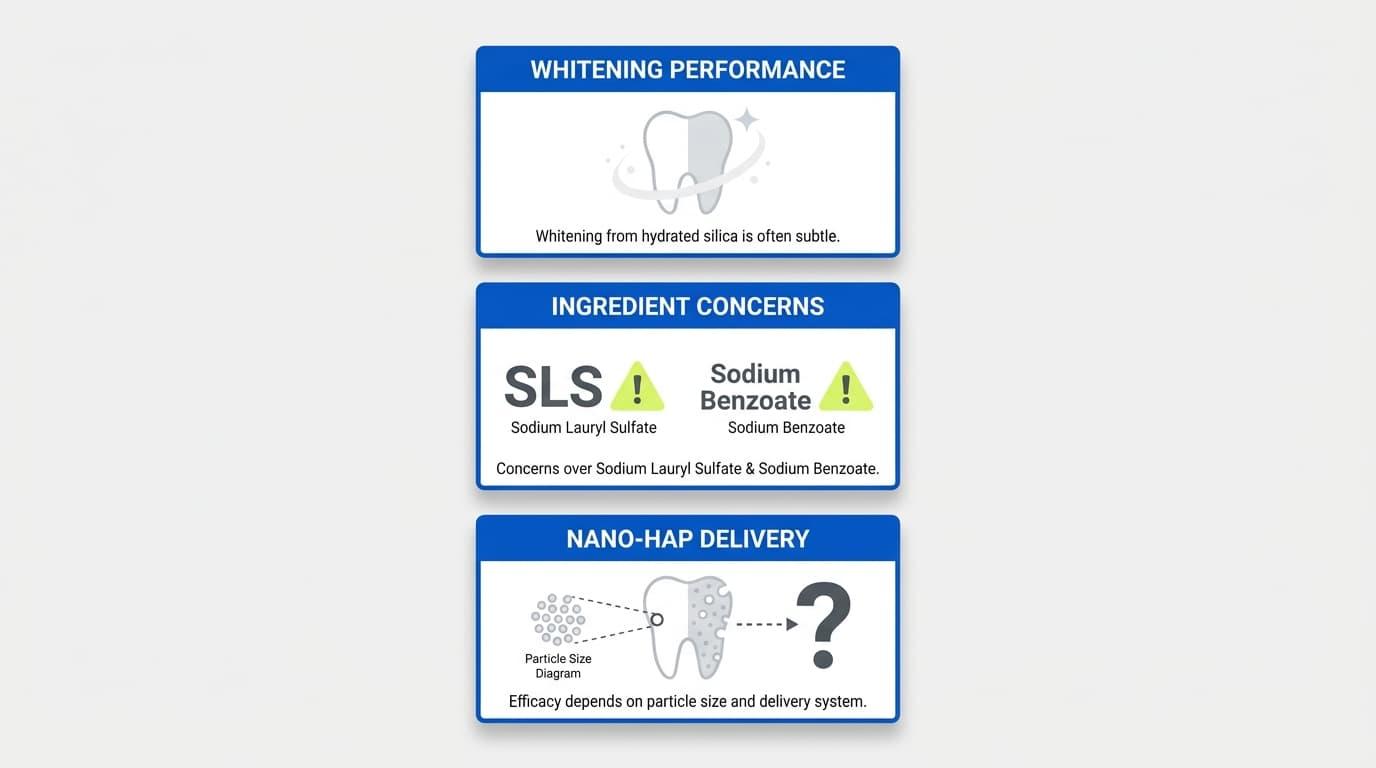
The biggest complaint across Boka's product range is whitening performance. Weeks of consistent use and the shade barely moves. That comes down to the abrasive. Hydrated silica is what does the whitening work in most of their formulas, and if the concentration or coarseness is not right, results stay flat regardless of how consistent you are.
Ingredient concerns are the second reason people leave. Sodium benzoate shows up across several Boka products, which is a red flag for label readers. SLS (Sodium Lauryl Sulfate) in a brand built around clean oral care is another friction point that is hard to ignore.
The third issue is the nano-hydroxyapatite claim itself. Boka leads with it across their entire lineup, but particle size and delivery system determine whether it actually works. Putting it on the label and engineering a product around it are two different things.
Every alternative below solves at least one of those problems. The best ones solve all three.
How Whitening Toothpastes Actually Work
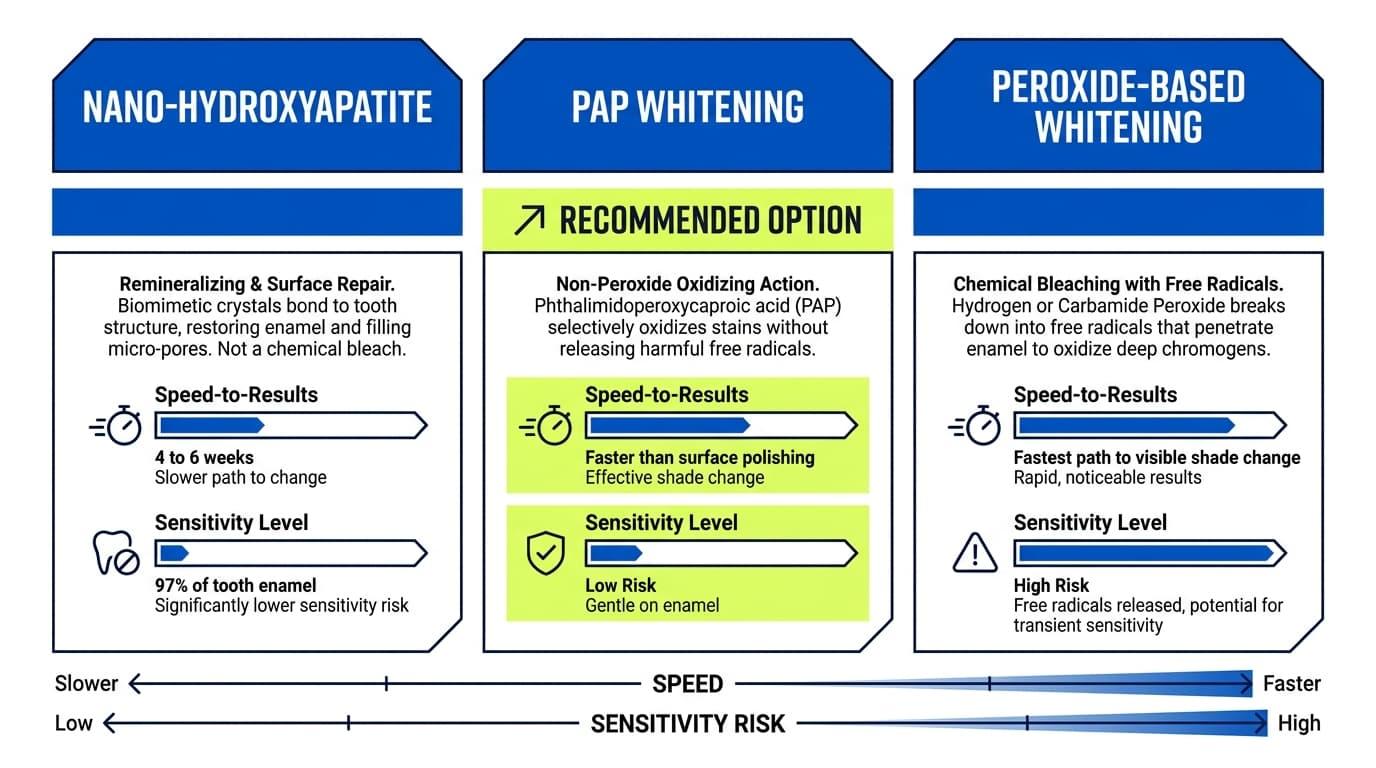
Three whitening approaches dominate the current market. Knowing which one powers your toothpaste changes everything. Supporting ingredients matter too: xylitol can help nourish beneficial oral bacteria and help prevent cavities, while silica is often used as a mild abrasive for polishing.
-
Nano-Hydroxyapatite: Nano-sized HAp particles interact with the enamel surface to polish away staining. The keyword here is “nano.” Particles that are too large do not interact the same way. Hydroxyapatite is a natural form of calcium that makes up about 97% of tooth enamel and helps remineralize while supporting cavity prevention. It can also fill microscopic fissures and grooves created by bacterial acids, which helps strengthen enamel defenses against cavities. Whitening is gradual, typically a subtle improvement over four to six weeks.
-
PAP Whitening: PAP oxidizes stain chromophores without releasing free radicals. That is why PAP has a significantly lower risk of false-positive results than peroxide. It moves faster than surface polishing and is gentler than peroxide. For most Boka switchers, it is the most logical next step.
-
Peroxide-Based Whitening: The fastest path to visible shade change. The trade-off is sensitivity. Free radical release during whitening is what causes discomfort, and peroxide is the primary source. Whitening toothpastes often use abrasives such as hydrated silica to remove surface stains, but overuse or overly aggressive formulas can contribute to enamel damage. Some sensitivity-focused formulas also use potassium nitrate to reduce sensitivity by calming nerve responses. Right for some, but not for everyone.
The Best Boka Toothpaste Alternatives for 2026
These six products were selected as the best Boka alternatives based don ingredient quality, whitening mechanism, real-world results, sensitivity profile, and value. Here’s every product, every spec, and exactly who each one is for.
1. SNOW Whitening Toothpaste: Best Overall for Visible Results Without Sensitivity
SNOW takes the number one spot because it delivers more than daily maintenance. It offers a complete oral care system for people who want visible whitening results without compromising comfort.
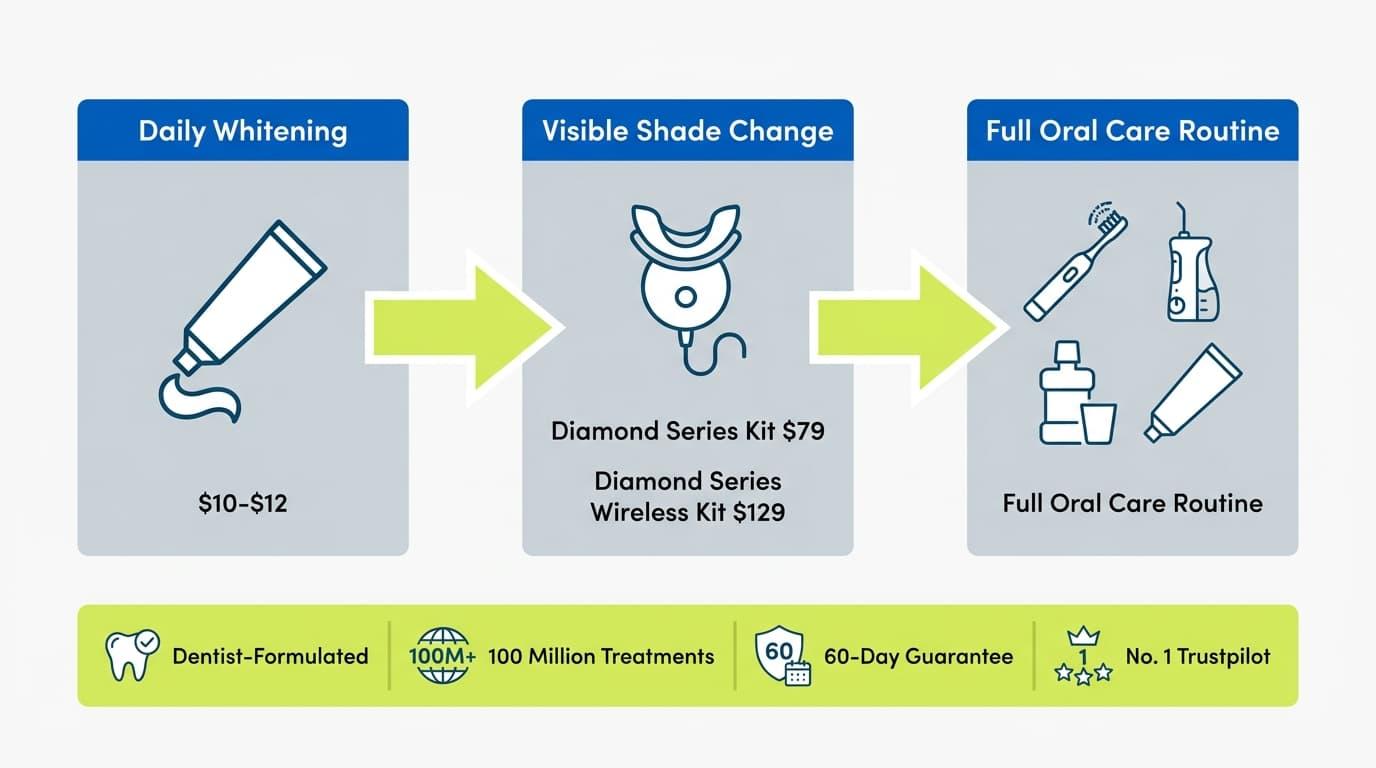
It is the only brand here that gives you a real upgrade path across your entire oral care routine. Start with the toothpaste for daily whitening, add the whitening kit when you want a visible shade change, and build out your full routine with SNOW's electric toothbrush, water flosser, and mouthwash.
That is the kind of complete ecosystem Boka promises but does not fully deliver on. A dentist-formulated formula at every step, clean ingredients throughout, and one brand covering everything from your morning brush to your whitening session.
What Makes It Stand Out
SNOW has been featured in Oprah’s Favorite Things, GQ, ELLE, Esquire, Marie Claire, and Cosmopolitan. But the press isn’t the point; the point is what 100 million treatments and a number one Trustpilot rating tell you: this brand delivers. Let’s take a look at the details:
-
Dentist-formulated by Dr. Brian Harris, DDS, professional-grade credibility is built into the formula
-
Free from SLS, alcohol, and parabens, a clean-label profile that holds up to the same scrutiny Boka users apply
-
Nano-Hydroxyapatite formula in the toothpaste for a brighter smile with every brush; regular use supports gentle whitening as part of a broader oral health routine
-
A full whitening ecosystem is available for when toothpaste alone is not enough, including the Diamond Series Kit at $79 and the Diamond Series Wireless Kit at $129. Unlike other toothpastes on this list, SNOW offers users one brand for daily brushing and a stronger whitening step for faster results.
-
Whitening kits use a PAP-based serum with LED light activation for faster shade lightening with a low sensitivity profile
-
Backed by a 60-day money-back guarantee, so there is no risk to trying it
-
Number one rated on Trustpilot and A-rated on BBB
-
Over 100 million treatments shipped worldwide
Price
Toothpaste starts at around $10 to $12. The Diamond Series Kit is $79, and the Diamond Series Wireless Kit is $129. Both are covered by the 60-day money-back guarantee, so neither carries any risk.
Pros and Cons
|
Pros |
Cons |
|---|---|
|
Dentist-formulated with Nano-Hydroxyapatite |
Kit formats are a higher upfront investment than toothpaste-only alternatives |
|
SLS-free, alcohol-free, and paraben-free |
Toothpaste whitening is gradual, best paired with a kit for faster visible results |
|
Full whitening ecosystem from toothpaste to LED kits |
Available primarily through DTC, though also sold at Costco and retail |
|
Featured by Oprah, GQ, ELLE, Esquire, and more |
|
|
60-day money-back guarantee on every purchase |
|
|
Number one rated on Trustpilot |
|
|
Over 100 million treatments shipped |
Best For
SNOW works for a wide range of Boka switchers, including:
-
Anyone who has tried gentler alternatives or experienced pain from harsher whitening products and wants a visible upgrade without trading in their sensitivity
-
Ingredient-conscious shoppers who want a clean-label formula with professional credentials behind every ingredient decision
-
People who want whitening built into their daily routine and a clear upgrade path when they are ready for faster results
-
Shoppers who trust what they can verify, including press coverage, Trustpilot ratings, and a satisfaction guarantee that removes the risk entirely
|
Whitening Mechanism |
Nano-Hydroxyapatite (toothpaste) plus PAP and LED (kits) |
|---|---|
|
Sensitivity Level |
Low to none |
|
Price Range |
$10 to $12 (toothpaste), $79 to $129 (kits) |
|
Timeline |
2 to 3 weeks with the kit, and then gradually with toothpaste |
|
Fluoride-Free |
Yes |
|
SLS-Free |
Yes |
|
Guarantee |
60-day money-back guarantee |
|
Key Credentials |
Number 1 Trustpilot, BBB A Rating, Oprah, GQ, ELLE, Esquire |
Try SNOW Whitening Toothpaste Today
2. RiseWell: Best Nano-HAp Toothpaste for Clean-Label Switchers
Leaving Boka because of the ingredient list? RiseWell is the most direct answer. Same category, same fluoride-free positioning, but with a cleaner formula. It earns the second spot because it solves the most common reason people move away from Boka without asking you to change what you care about.
What Makes It Stand Out
It takes what Boka does right and fixes what it gets wrong:
-
Uses non-nano hydroxyapatite as the same ingredient category competitors compare to Boka, and they often position it as a clean alternative that can strengthen enamel and reduce sensitivity
-
Avoids both SLS and synthetic preservatives, which addresses the two most common ingredient objections Boka users raise
-
Includes xylitol as a supporting ingredient for a cleaner oral environment
-
Fluoride-free formula that holds up to label scrutiny without compromise
-
Hydrated silica for daily surface stain polishing alongside the HAp
Price
Around $15 to $20 per tube. One of the most affordable nano-HAp options on the market, and slightly less than SNOW's toothpaste. Low risk, high value for ingredient-first switchers.
Pros and Cons
|
Pros |
Cons |
|---|---|
|
Cleaner preservative profile than Boka |
No PAP or peroxide, so whitening is gradual only |
|
SLS-free formula |
Expect four to six weeks for noticeable change |
|
Nano-hydroxyapatite as the primary active |
No full whitening system or kit upgrade path |
|
Budget-friendly price point |
No significant press endorsements or third-party credibility signals |
|
Xylitol is included as a supporting ingredient |
|
|
Fluoride-free with no synthetic preservatives |
Best For
This is your product if any of the following apply:
-
You want to stay in the nano-hydroxyapatite category but need a cleaner preservative profile than Boka offers, including if you have mild sensitivity
-
You are a label reader who has already eliminated SLS and synthetic preservatives from the rest of your routine
-
Gradual, subtle whitening over four to six weeks is sufficient for your goals
-
Budget is a priority, and you are not yet ready to invest in a full whitening kit
|
Whitening Mechanism |
Nano-hydroxyapatite plus hydrated silica |
|---|---|
|
Sensitivity Level |
Low |
|
Price Range |
$15 to $20 per tube |
|
Timeline |
4 to 6 weeks |
|
Fluoride-Free |
Yes |
|
SLS-Free |
Yes |
|
Guarantee |
Standard retail policy |
|
Key Credentials |
None listed |
3. Lumineux: Best Peroxide-Free Option for Sensitive Teeth
For shoppers who have reacted badly to whitening and are done pushing through, Lumineux is the most sensitivity-friendly option we found. Not the fastest path to a brighter smile. The most comfortable one.
What Makes It Stand Out
This isn’t a tweak to an existing formula; it’s an entirely different approach.
-
Certified non-toxic formula with clinical certification for its clean-label positioning
-
Plant-derived whitening using coconut oil and essential oils such as lemon peel oil and sage oil to address surface staining
-
No peroxide and no PAP, the most sensitivity-friendly whitening approach available in a toothpaste format, making Lumineux one of the gentlest options for users worried about gum recession or recurring sensitivity
-
Appeals to shoppers who have already eliminated synthetic actives from their skincare and want the same standard in their oral care
Price
Toothpaste runs $10 to $14. Whitening strips are $30 to $40 for shoppers who want a stronger whitening step while staying plant-derived.
Pros and Cons

Best For
Narrow use case, but an important one. Choose Lumineux if this sounds like you:
-
You have a documented history of sensitivity reactions to whitening products, including both PAP and peroxide, and you want whitening treatments to feel as low-irritation as possible
-
Your primary goal is a clean daily toothpaste with subtle surface stain reduction, not dramatic shade lightening
-
You want a certified non-toxic standard applied to your oral care routine
-
Budget is a priority, and you want the gentlest possible option without a premium price

4. Davids Natural Toothpaste: Best Clean-Label Whitening Toothpaste for Eco-Conscious Shoppers
Davids earns its consistent presence in roundups for one clear reason: Its ingredient list holds up to scrutiny. Clean formula, sustainable packaging. That combination is harder to find than it should be.
What Makes It Stand Out
Ingredient transparency plus packaging commitment. Here’s what that looks like in reality:
-
No SLS, no artificial preservatives, and no synthetic dyes, plus it avoids artificial flavors and artificial colors for a genuinely clean ingredient list that holds up to label scrutiny
-
Packaged in a recyclable metal tube, with much of its appeal coming from natural ingredients plus sustainability rather than a stronger whitening system
-
Hydrated silica as the primary whitening agent for daily surface stain polishing
-
Some formulations include nano-hydroxyapatite alongside the silica for additional enamel support
-
Xylitol is included as a supporting ingredient
Price
Around $12-$16 per tube. Slightly below SNOW's toothpaste, similar to RiseWell. A fair price for a clean formula in a genuinely different package.
Pros and Cons

Best For
Davids may be right for you if any of the following apply:
-
You’re switching for formulation or sustainability reasons rather than primarily for faster whitening
-
Eco-conscious packaging matters to you as much as the ingredient list
-
You want a clean daily whitening toothpaste without committing to a full whitening system
-
You’re a Boka user who wants a similar philosophy but a cleaner preservative profile and more transparent packaging

5. Hello Naturally Whitening Toothpaste: Best Budget-Friendly, Fluoride-Free Toothpaste Pick
Clean label, fluoride-free, drugstore price. Hello fills a gap most premium brands do not bother with. If you want to try this category without committing to a product that costs $20, this is where to start.
What Makes It Stand Out
Accessibility and value. It won’t blow you away with whitening effects, but it earns its spot on the basics:
-
One of the only fluoride-free whitening toothpastes available at a mainstream drugstore price
-
Cruelty-free and vegan, which resonates with the same values-driven audience that shops Boka
-
Free from SLS, artificial sweeteners, dyes, and artificial colors, and positioned as a cleaner pick than other toothpastes with harsher or more synthetic ingredient lists
-
Widely available in drugstores and online, so you can pick it up today without waiting for shipping
Price
$5 to $8 per tube. The most affordable option on this list is available at most drugstores today.
Pros and Cons

Best For
The right call if any of the following fit:
-
Budget is the primary decision driver, and you want a clean daily toothpaste under $10
-
You are exploring the fluoride-free clean-label category for the first time and want a low-risk entry point
-
Mild surface stain reduction is the goal, not a meaningful shade change
-
You need something you can pick up locally today without placing an online order

6. Crest 3D White: Best for Fast Proven Shade Lightening
Number six, because it fails at almost everything a Boka switcher cares about: No clean-label. Not fluoride-free. Highest sensitivity risk on the list. But if one to two weeks of visible shade change is the only thing that matters, it’s the most direct path.
What Makes It Stand Out
Decades of consumer data and the most clinically established whitening mechanism available.
-
Hydrogen peroxide, as the active ingredient, is the most proven mechanism for shade lightening
-
Fastest visible results of any option on this list, noticeable change within one to two weeks
-
Most accessible format, available everywhere at retail
-
Whitening strips available for users who want a stronger dose beyond daily toothpaste
Price
Toothpaste is $8 to $12. Strips run $30 to $55. The most affordable peroxide whitening option on the list.
Pros and Cons

Best For
Narrow circumstances only. Consider it if the following applies to you:
-
You have tried gentler alternatives without satisfying results and are ready to accept the sensitivity trade-off
-
Speed is the only priority, and you have an event within one to two weeks that requires visible results fast
-
Ingredient transparency and clean-label criteria are not primary concerns for your oral care routine
-
You want the most widely available and most affordable path to peroxide-level whitening

How to Choose the Right Format for Your Oral Health Goals
Two format categories, six products. The right one depends entirely on why you’re switching.
There are various types of teeth whitening product alternatives, but they still split into two practical paths. Daily brushing, lower cost, no change to your routine. If you’re looking for Boka alternatives because of ingredient or formulation reasons, a toothpaste is the right move. Expect subtle improvement over four to eight weeks.
Whitening kits are a different category. Higher-concentration active ingredients, faster results, and visible shade change within one to three weeks.
If Boka’s whitening performance disappointed you, no toothpaste will close that gap the way a kit will. After each session, rinse your mouth according to the product directions before returning to the rest of your routine.
The sensitivity question matters too. Peroxide works the fastest, but it also carries the highest risk. PAP moves at a similar pace with much less discomfort. If you have reacted to peroxide before, start with PAP.
In short:
-
Choose a toothpaste alternative if you are switching for ingredient reasons, want a low-cost daily driver, or your staining is mild
-
Choose a whitening kit if results disappointed you, you want a visible change within two weeks, or you are dealing with moderate to heavy extrinsic staining
-
Choose PAP-based products over peroxide if you have a history of sensitivity reactions, but still want meaningful shade improvement
One thing all six share: None of them can change intrinsic tooth color. All whitening products work on surface stains from coffee, tea, and other foods. If your staining is structural or deep, talk to dental professionals before spending another dollar on any over-the-counter product.
Final Verdict
We did the work so you don’t have to. Six products tested, ingredient lists checked, claims verified. The ranking is honest, and every product on it earns its spot.
Ingredient concerns point to RiseWell or Davids. Sensitivity concerns point to Lumineux. Budget concerns point to Hello. And if you want visible results with a clean formula and 100 million treatments of proof behind it, SNOW is where this list ends.
Dentist-formulated. Free from SLS, alcohol, and parabens. Featured by Oprah, GQ, and ELLE. Backed by a 60-day money-back guarantee. You’ve spent enough time wondering if your toothpaste is working. Now it’s time to know for sure.
Find Your Perfect SNOW Formula
Frequently Asked Questions
Choosing the right whitening toothpaste goes beyond flavor or branding. Here are quick answers to the most common questions about whitening ingredients, sensitivity, and clean-label oral care formulas.
Does Boka toothpaste actually whiten teeth?
It can. Boka toothpaste helps whiten teeth gradually by removing surface stains during brushing, so it mainly improves surface-level discoloration rather than changing intrinsic tooth color.
Its hydrated silica gently polishes the enamel while nano-hydroxyapatite helps improve overall tooth appearance. However, it doesn’t bleach teeth the way PAP or peroxide whitening products do. Most users notice subtle brightening over time rather than dramatic whitening results.
What is the difference between PAP and peroxide whitening?
The main difference between PAP and peroxide whitening is how they break down stains. Peroxide works by releasing free radicals, which is why it commonly causes tooth sensitivity. PAP whitens teeth through oxidation without releasing free radicals, making it a gentler option for sensitive teeth. Both can produce noticeable whitening results, but PAP is usually more comfortable for long-term use.
Why do some dentists still recommend fluoride over hydroxyapatite?
Some dentists recommend fluoride because it has a longer history in North American dental guidelines and cavity prevention research. Hydroxyapatite remains effective and is widely used in countries such as Japan and across Europe. Both ingredients support enamel health and remineralization in different ways. The better choice often depends on your dental needs, sensitivity level, and personal preference.
Is a whitening kit better than a whitening toothpaste?
Yes, a whitening kit is usually more effective if your goal is faster or more noticeable whitening results. Whitening toothpaste mainly works on surface stains through daily brushing, while whitening kits use stronger active ingredients that can visibly lighten tooth shade within a few weeks, which may appeal to people who want teeth professionally whitened-level results even though over-the-counter kits are not the same as having your teeth professionally whitened. Toothpaste works better for maintenance, while kits are better for more dramatic whitening.
What ingredients should I look for in a clean-label whitening toothpaste?
Look for whitening toothpaste formulas that avoid ingredients like SLS, parabens, artificial dyes, and unnecessary harsh additives, but also remember that a formula that tastes great is usually easier to stick with every day; for example, some shoppers prefer peppermint or a mild mint profile over stronger flavors. Nano-hydroxyapatite is a popular choice for enamel-friendly whitening and for supporting remineralization. PAP is another strong option if you want active whitening with a lower risk of sensitivity. Supporting ingredients like xylitol and calcium carbonate can also help maintain a healthier oral environment during daily use. The best clean-label choice is not the only toothpaste worth considering, since the right pick depends on whether you care more about cavity protection, sensitivity relief, or whitening.


