

Teeth whitening works. Many people buy a product, try it, and quit because they don’t see results. The reality is that the problem is almost never the product; it’s how people use it.
Enamel wear, tooth sensitivity, patchy results, months of effort and zero color change. All of it comes from specific, avoidable mistakes. And every single one on this list is fixable.
Ahead, we break down the biggest teeth whitening mistakes people make and how to avoid them so you can get safer, brighter, and more consistent results.
Key Takeaways
-
Whitening too often makes teeth look darker and grayer, not brighter. Overuse causes enamel to become translucent.
-
DIY methods like charcoal and lemon juice damage enamel more than regulated peroxide products do.
-
Between 30 and 78% of whitening users experience sensitivity, according to clinical trial data compiled by Loud Family Dentistry. Overuse and extended contact time are the main drivers.
-
Poor tray or strip fit sends gel to your gums, not your teeth. Irritation and uneven color follow.
-
Whitening over crowns, veneers, or bonding creates a visible color mismatch. These materials do not respond to peroxide.
-
The 48 hours after whitening is the easiest window to ruin your results. Watch what you eat.
-
Leaving strips on longer than directed does not improve shade. It just increases exposure and risk.
All 7 Mistakes at a Glance
Scan this table first to get the full picture, then use the sections below to find the ones that apply to you.
|
# |
Mistake |
The Damage |
The Fix |
|---|---|---|---|
|
1 |
Overusing whitening products |
Enamel turns translucent; teeth look darker |
Follow the cycle, then stop. Let enamel recover. |
|
2 |
DIY methods (charcoal, lemon juice, ACV) |
Acid erosion or abrasion damage |
Use regulated peroxide products with ADA Seal. |
|
3 |
Ill-fitting trays or generic strips |
Gum irritation, patchy uneven color |
Choose a system designed for your tooth shape. |
|
4 |
Whitening over restorations or damage |
Color mismatch, worsened existing damage |
Get a dentist to assess your baseline first. |
|
5 |
Skipping a pre-whitening cleaning |
Gel blocked from reaching enamel evenly |
Clean your teeth before starting your cycle. |
|
6 |
Eating staining foods right after |
Re-staining in the 48-hour open window |
Light foods and water only post-treatment. |
|
7 |
Ignoring product instructions |
Sensitivity, overexposure, poor shade result |
Follow the timing exactly. Longer is not better. |
Some of these feel obvious in hindsight. Others are easy to make even when you’re genuinely trying to do things right.
Mistake 1: Using Whitening Products Too Often
More doesn’t mean better. It often means darker.
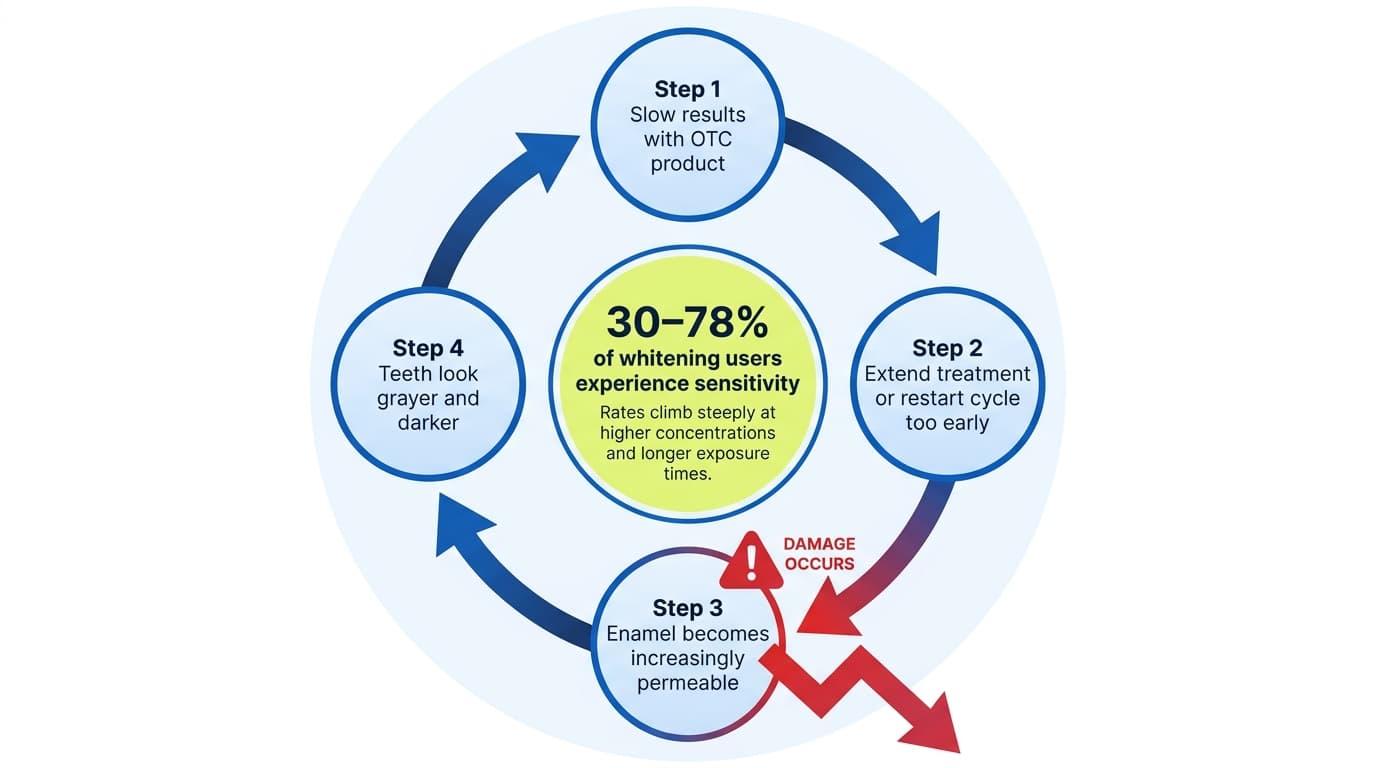
Most people link overuse to sensitivity. While sensitivity can be a real side effect, the bigger problem is enamel translucency.
When enamel gets hit with peroxide too often without enough recovery time, it becomes increasingly permeable. The yellow dentin layer underneath starts to show through, leaving you with teeth that look grayer and darker despite all the effort.
A 2022 study published in Applied Sciences (DOI: 10.3390/app12146930) confirmed that over-the-counter whitening products can cause significant enamel surface changes when overused. The American Dental Association flags frequent whitening as a real clinical concern for this exact reason.
There’s also a trap built into weaker OTC products. Because results come slowly, people extend treatments or restart cycles too early. The enamel absorbs repeated peroxide without enough time to recover in between.
According to clinical trial data compiled by Loud Family Dentistry, between 30 and 78% of whitening users experience sensitivity, with rates climbing steeply at higher concentrations and longer exposure times. Most cases are temporary, but they are almost always a sign that the enamel is being pushed past its recovery window.
The fix: Follow the recommended cycle, then stop. Give enamel time to recover before you go again.
Mistake 2: Trusting DIY Methods Over Regulated Products
"Natural" doesn’t mean gentle. For your enamel, it’s often the opposite.
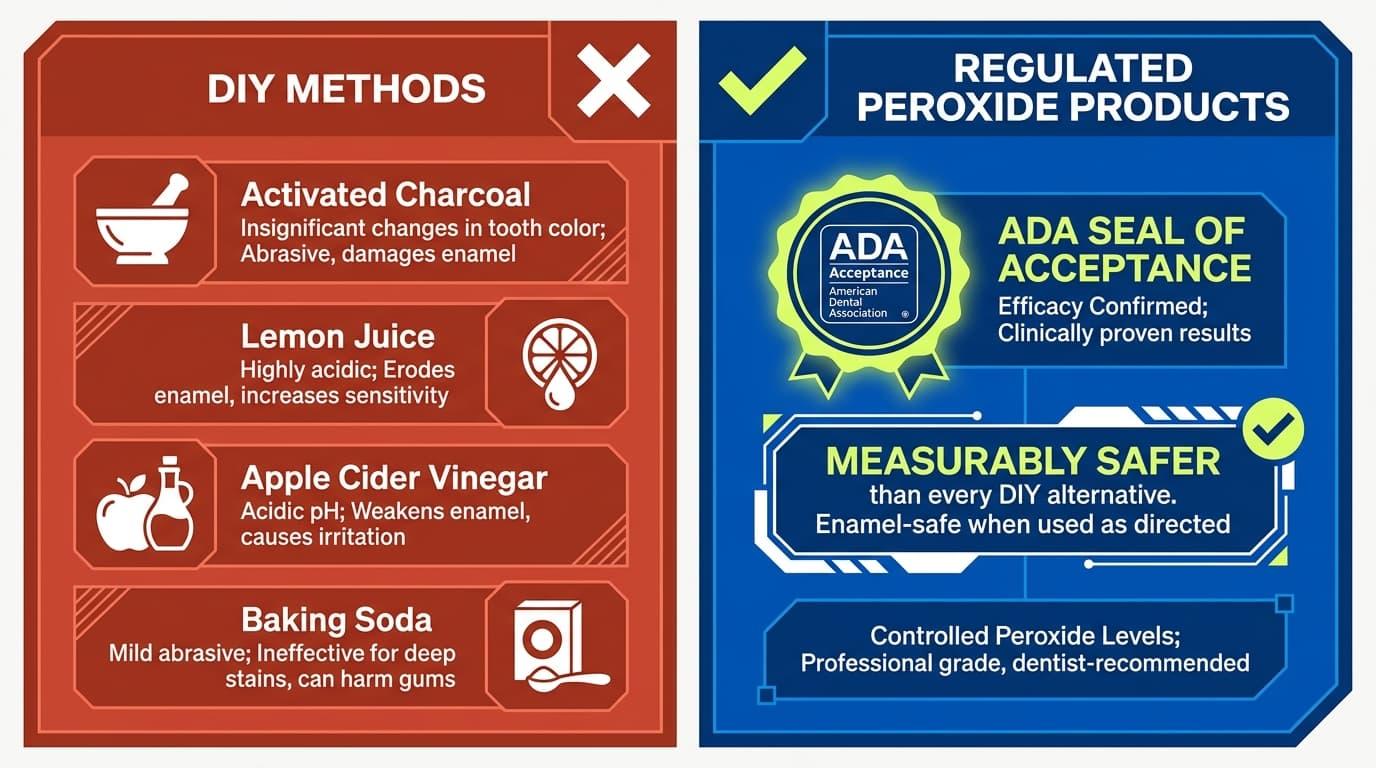
Activated charcoal, baking soda, lemon juice, and apple cider vinegar all have huge online followings as gentle, chemical-free alternatives to peroxide whitening. The research, however, doesn’t back that up.
Look at charcoal, for example. A systematic review published in 2022 analyzed a range of in vitro studies and found that activated charcoal toothpastes produced insignificant changes in tooth color while being the most abrasive option tested across the board.
A separate 2022 study in Biomedicines (DOI: 10.3390/biomedicines11010022) confirmed significantly higher enamel roughness and abrasion in groups using activated charcoal paste. None of the charcoal products tested hold the ADA Seal of Acceptance, and there’s no clinical evidence of whitening efficacy beyond physical abrasion.
Lemon juice is another one worth understanding. It feels mild, but it’s not.
A peer-reviewed study published in PMC (PMC4452714) measured enamel mineral loss across ten common beverages and found that lemon juice caused the highest enamel mineral loss of everything tested. That is direct demineralization from acid contact, not from peroxide chemistry.
Apple cider vinegar follows the same pattern. Its pH typically runs between 2.5 and 3.0, similar to lemon juice.
A study in PMC (PMC9683876) found that vinegar and apple cider produced the maximum demineralization effect across all substances tested on extracted human teeth.
Baking soda is the safest of the four, but it still carries moderate abrasion with daily use and limited whitening effect beyond surface stain removal.
Regulated hydrogen peroxide and carbamide peroxide products with the ADA Seal of Acceptance are independently tested for both safety and whitening efficacy. When used as directed, they’re measurably safer than every DIY alternative above.
An ADA spokesperson described charcoal toothpaste as something that "runs down surface tooth enamel," calling eroding enamel faster than normal "a procedure that is dangerous," according to ScienceInsights.org.
Enamel doesn’t grow back. Once it is worn thin, teeth become more sensitive to hot and cold, and the yellow dentin layer underneath starts showing through.
Mistake 3: Using Ill-Fitting Trays or Generic Strips
A bad fit doesn’t just deliver patchy results; it hurts your gums.
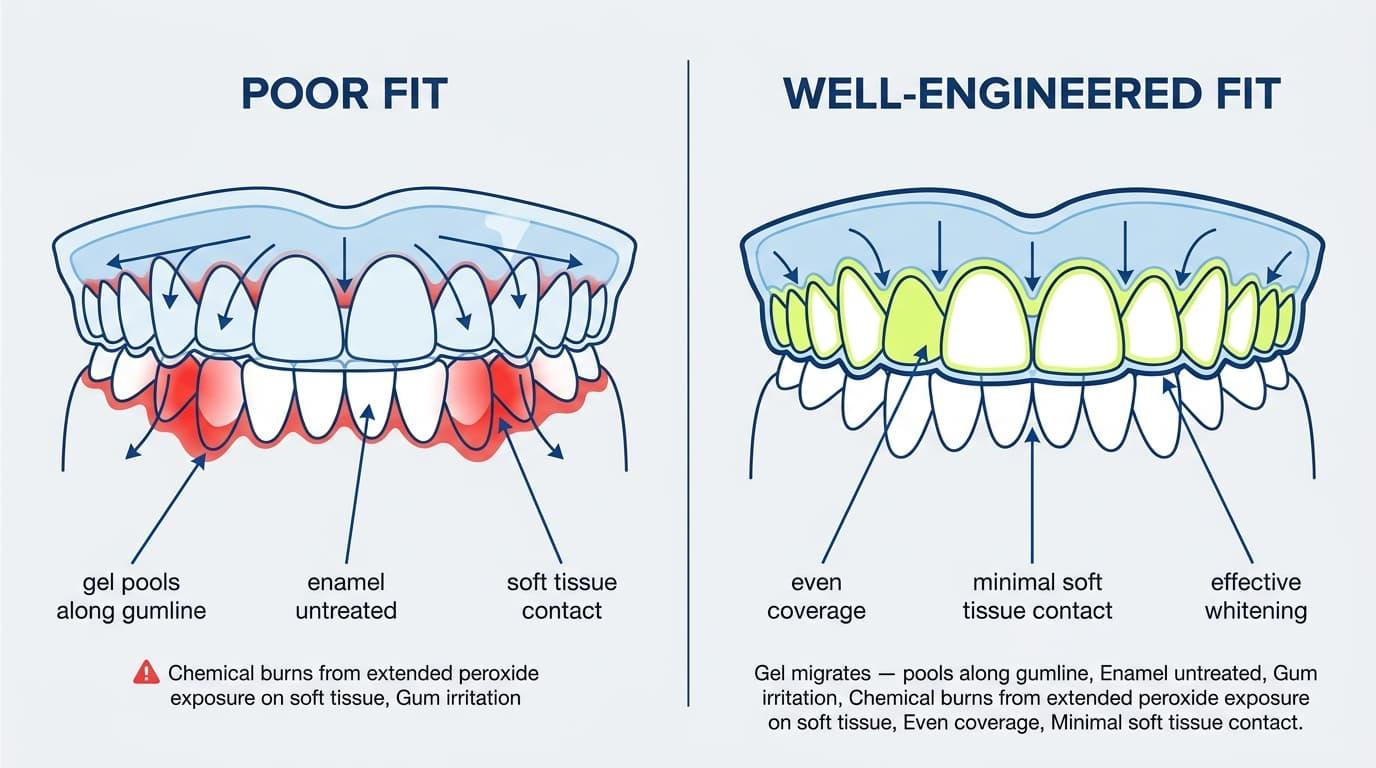
When a tray doesn’t match the shape of your teeth, the gel migrates. It pools along the gumline and contacts soft tissue directly.
The result is gum irritation, patchy whitening, and in some cases, chemical burns from extended peroxide exposure on soft tissue.
Generic strips have the same issue. They’re made for an average tooth shape. Curved teeth, gaps, and irregular edges all create spots where the strip lifts away or folds, leaving enamel untreated in some areas while other spots get too much contact time.
Well-engineered whitening systems are designed to keep gel on your teeth and away from your gums. Even coverage with minimal soft tissue contact is the goal, and product design is what makes that achievable. Fit matters as much as formula.
Mistake 4: Whitening Over Damaged Teeth or Dental Restorations
Peroxide only works on natural enamel. Everything else is unaffected.
Crowns, veneers, composite bonding, and porcelain bridges are made from ceramic or composite resin. None of these materials react to peroxide chemistry.
So when you whiten around restorations, your natural teeth brighten and the restorations stay the same shade. What used to blend in now stands out.
The same thinking applies to damaged enamel. Cracks, significant wear, and exposed dentin all make whitening less predictable and potentially more uncomfortable without a dentist looking at things first.
If you have restorations in your smile zone or any pre-existing damage, get a dental assessment before starting any whitening routine.
Mistakes 1 to 4 tend to get the most attention. The next three are quieter, easier to overlook, and often the reason people feel like whitening just stopped working for them.
Mistake 5: Skipping a Pre-Whitening Cleaning
Your gel can’t reach enamel it can’t touch.
Surface buildup from tartar and calculus sits on top of enamel. It acts as a physical barrier between the whitening formula and your tooth surface.
When that buildup is there, gel distributes unevenly. Some teeth lift noticeably. Others barely change at all.
A professional cleaning removes that barrier before treatment begins. Many dental providers require it before any whitening procedure for exactly this reason.
The fix is the simplest of all seven: Schedule a cleaning first, then start your cycle. A clean surface gives the formula the contact it needs to work properly.
Mistake 6: Eating Staining Foods Right After Whitening
The 48 hours after whitening is the easiest way to undo everything you just did.
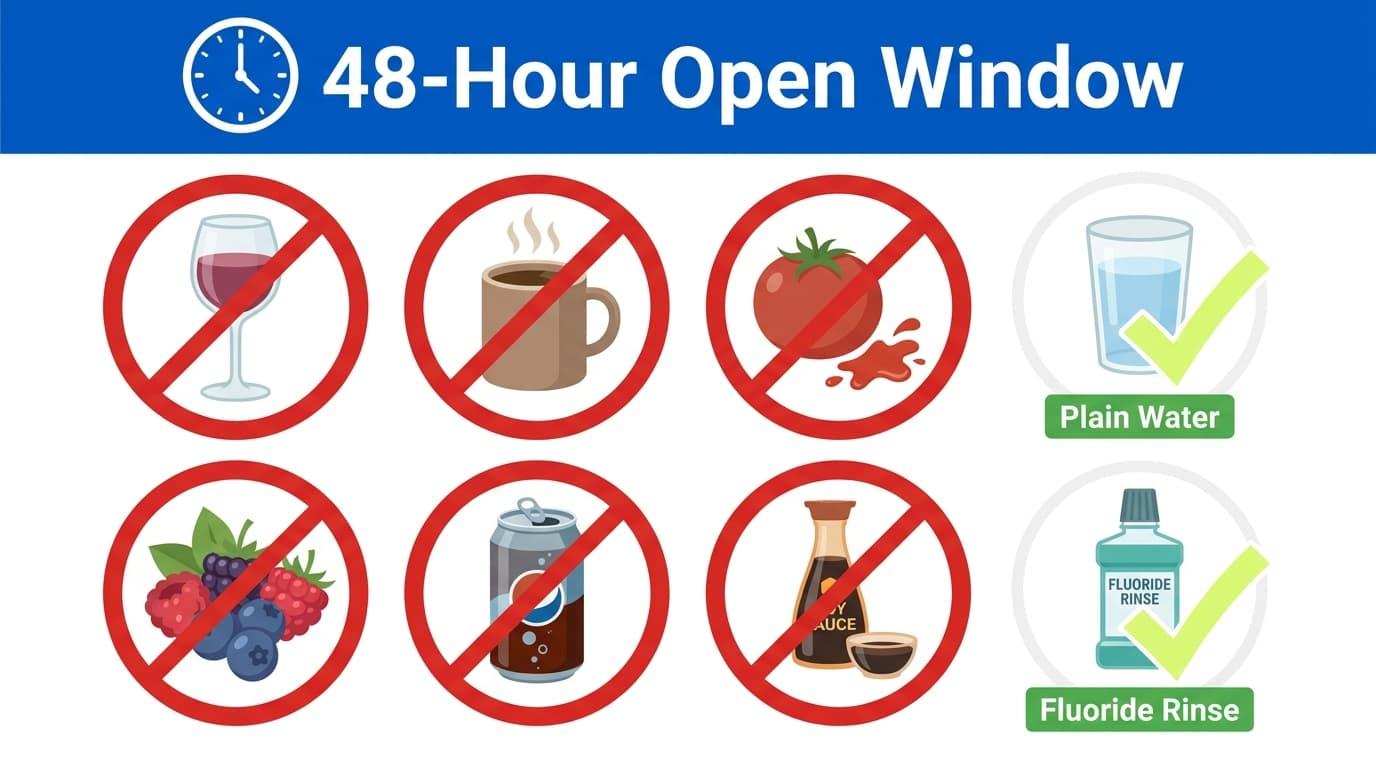
Whitening temporarily opens enamel tubules, the tiny channels running through tooth structure. For about 48 hours after treatment, those tubules stay more permeable than usual.
Pigment from food and drink enters faster and binds more readily during this window. Re-staining can partially reverse your results within days, not weeks.
The effort goes to waste because of what happens at dinner, not in the bathroom.
Here are the foods and drinks to skip completely for the first 48 hours after whitening:
-
Red wine
-
Coffee and tea
-
Tomato-based sauces
-
Berries and dark fruits
-
Dark sodas
-
Soy sauce and dark condiments
Stick to light-colored foods and plain water right after treatment. A fluoride rinse also helps support the surface during this window without introducing any pigment.
Mistake 7: Ignoring the Product Instructions
Longer isn’t better. It’s just more exposure with the same result and higher risk.
Leaving strips or trays past the recommended time doesn’t improve your shade.
Beyond the set contact time, peroxide keeps acting on the tooth surface without removing additional stain. What goes up is the likelihood of sensitivity and surface changes.
A 2018 Cochrane review on home whitening products found that sensitivity and oral irritation are more prevalent at higher concentrations and longer exposure times. It’s one of the most consistent findings across whitening research.
There’s also the OTC trap: Because results come slowly with lower-concentration products, people extend or restart cycles ahead of schedule. This creates the same overuse spiral as Mistake 1.
Following the instructions breaks that pattern. Timed correctly, whitening is safe, effective, and easy on your teeth.
Who Should Hold Off on Whitening Right Now
Not everyone is a good candidate today. Before starting any routine, check if any of these apply to you.
|
Who Should Wait |
Why It Matters |
|---|---|
|
Children and teens |
Thinner enamel and larger pulp chambers make them more sensitive to peroxide effects on tooth structure. |
|
Active gum disease |
Inflamed tissue lets peroxide reach sensitive root surfaces directly, making irritation worse. |
|
Heavy restorations in the smile zone |
Crowns, veneers, and bonding stay the same shade while natural teeth brighten, creating a visible mismatch. |
|
Significant enamel wear already present |
Thinned enamel is already more translucent. More whitening speeds that up and can make teeth look darker. |
|
Pregnant or nursing individuals |
Elective cosmetic treatment is not recommended during this period. Wait until the timing is right. |
If any of these apply, the answer isn’t "never." It’s "not yet, and not without professional input." A quick dental assessment before you start protects your results and keeps your tooth structure in good shape.
What Safe, Effective Whitening Actually Looks Like
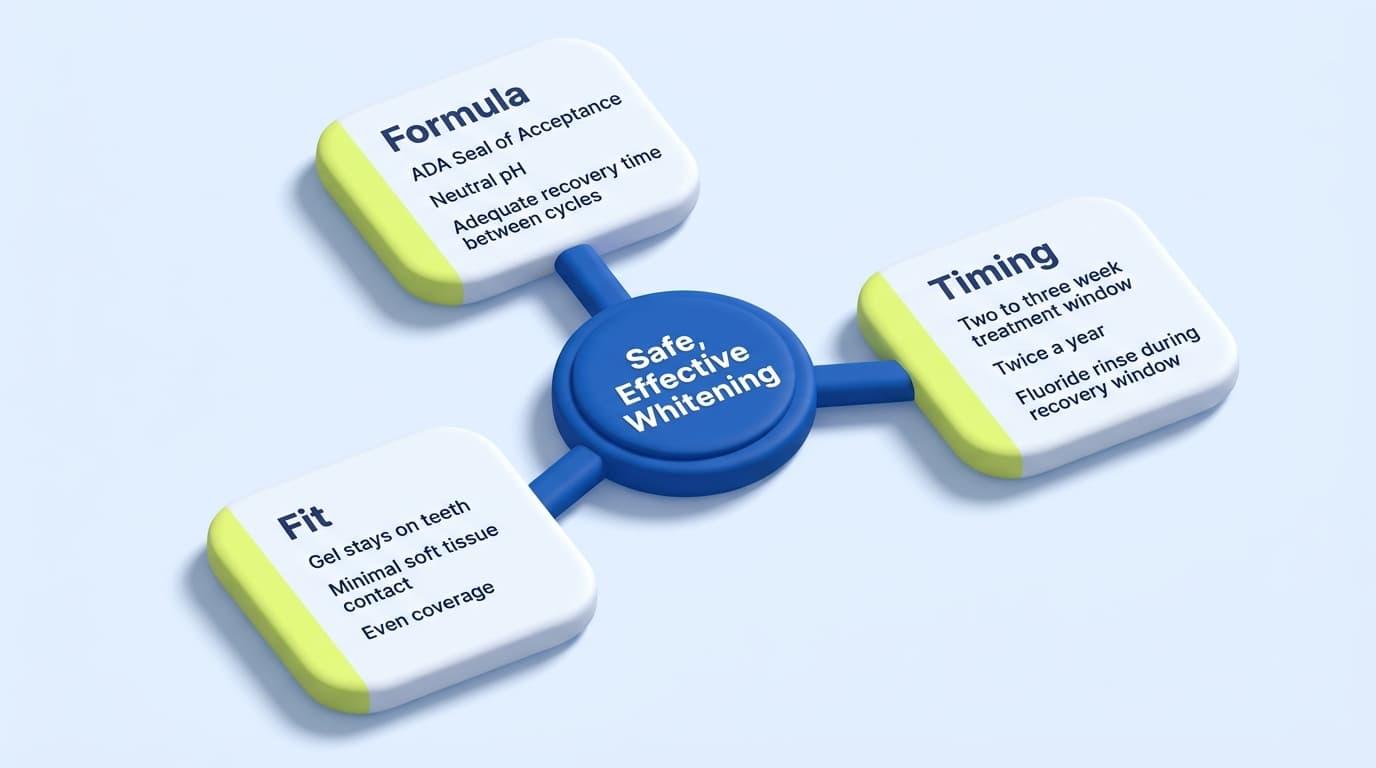
It comes down to three things: the right formula, the right fit, and the right timing.
Formula
Regulated products with the ADA Seal of Acceptance are independently tested for safety and efficacy. A dentist can offer professional advice on the most effective whitening method and recommend the best whitening products for your needs based on your enamel, sensitivity, and whitening goals.
A systematic review and meta-analysis by Zanolla et al., published in the Australian Dental Journal (2017), found that when whitening agents are used at neutral pH with adequate recovery time between cycles, there’s no meaningful reduction in enamel microhardness. Timed correctly, peroxide-based whitening doesn’t damage enamel.
Your routine matters, too.
Using whitening products from the same brand can make the process easier to manage because the formulas, timing, and aftercare steps are designed to work together.
This is the idea behind building a complete whitening stack, where each product supports the next instead of competing with it.
Fit
A well-engineered system keeps gel on your teeth and away from your gums. Tray design matters as much as what’s in the formula, because ill-fitting whitening trays can leak whitening gel onto the gums. Even coverage with minimal soft tissue contact is what separates a good result from one where poor fit can lead to ineffective results and gel contact can irritate gums, causing gum inflammation.
Timing
Most systems are built for a two to three week treatment window, and many are meant to be used only a few times a week during the whitening process, followed by maintenance intervals.
Teeth whitening isn’t a one-time fix, and results can fade without proper maintenance. Going past that window doesn’t give you better results. It just adds more exposure with no benefit.
After each session, a fluoride rinse supports the surface during the recovery window by helping close enamel tubules and reduce any residual sensitivity between rounds. Full whitening treatments are typically limited to about twice a year unless a dentist recommends otherwise, with touch-up treatments used in between as needed.
SNOW® uses dentist-formulated concentrations, sensitivity-conscious formulas, and systems designed for even coverage. With a 60-day money-back guarantee and over 100 million treatments shipped worldwide, it is whitening built around exactly this framework.
Final Words
Every mistake on this list is fixable. Sensitivity, patchy color, re-staining after a week, restorations that no longer match. All of it comes from frequency, method, fit, and timing.
Doing this right isn’t complicated. It just takes the right product, used correctly, at the right intervals.
SNOW® was built on that principle. Because brighter teeth should never come at the cost of your smile.
Frequently Asked Questions
Wondering why whitening sometimes doesn't go as planned? Here are quick answers to the most common questions about sensitivity, staining, and getting the best whitening results safely.
Can teeth look worse after whitening?
Yes, teeth can sometimes appear worse after excessive whitening. Overuse may make enamel more translucent, allowing the naturally darker dentin underneath to show through more clearly. This can create a grayish or darker appearance instead of a brighter smile. Following recommended treatment schedules helps avoid this issue.
How common is tooth sensitivity from whitening?
Tooth sensitivity is one of the most common side effects of whitening treatments. Many people experience temporary sensitivity during or shortly after a whitening cycle, especially if they already have sensitive teeth.
The likelihood often depends on the strength of the formula and how frequently it is used, since overusing whitening products can lead to tooth sensitivity and gum irritation.
Ignoring tooth sensitivity can make discomfort worse, so if symptoms persist, consult your dentist. Using gentler products, following directions carefully, and switching to desensitizing toothpaste during whitening can help reduce sensitivity risks.
Can I whiten my teeth with Invisalign?
Generally, it isn't recommended to whiten your teeth while actively wearing Invisalign aligners. Whitening products may not distribute evenly, and the trays can increase irritation to the gums. Many dentists suggest whitening before starting Invisalign or during specific treatment breaks. Your orthodontist can provide guidance based on your treatment plan.
What teeth cannot be whitened?
Dental restorations such as crowns, veneers, bridges, and composite bonding do not respond to whitening treatments. These materials do not absorb whitening agents the way natural enamel does. Some forms of deep internal discoloration may also be resistant to over-the-counter whitening products. In these cases, professional teeth whitening or other professional treatments may be necessary, and using unregulated whitening products can cause irreversible damage.
How long should I wait between whitening cycles?
Most people should wait at least four to six weeks between full whitening cycles. This allows the teeth time to recover and helps minimize sensitivity. Whitening too frequently can increase discomfort without significantly improving results. Always follow the recommendations provided with your whitening product.
How do I get rid of deep yellow stains?
Deep yellow stains are often caused by intrinsic discoloration inside the tooth rather than surface stains, while yellow teeth from external staining are more likely to respond to cleaning or whitening toothpaste. These types of stains usually do not respond well to repeated at-home whitening treatments, and foods and drinks can also cause stains to return after whitening. A dentist can determine whether professional whitening or another cosmetic procedure is more appropriate. Regular dental check-ups can remove surface stains and help maintain whitening results. Continuing to whiten without improvement may only increase sensitivity. Avoid staining foods for 24–48 hours after whitening to preserve results.


