
Coffee is doing a number on your teeth, and you already know it.
The honest truth is, 73% of Americans drink coffee every day, and the staining compounds in every cup quietly work against your smile with each sip, leading to coffee stained teeth that can dull your appearance over time.
The even better truth? You don’t have to choose between your morning cup and a brighter smile.
Coffee stains are extrinsic, meaning they sit on the surface of your enamel, and with the right approach, they are very much treatable.
At SNOW®, we’ve helped thousands of coffee lovers get noticeably brighter smiles without giving up a single cup. This guide covers everything you need to know to make that happen—including other whitening methods beyond the featured products. And if you’re ready to start right now, grab 20% off your first SNOW® order while the offer’s live.
Key Takeaways
-
Coffee stains are extrinsic stains, meaning they form on the outer surface of your enamel and respond well to whitening treatments.
-
Tannins act like a glue, helping color pigments called chromogens bind to dental enamel and build up over time.
-
Not all whitening methods work equally well for coffee drinkers, and the right choice depends on how fast you want results and how much sensitivity you can tolerate.
-
The 30-minute brushing rule and the two-hour coffee rule are two of the most effective habits you can build alongside any whitening routine.
-
Coffee during a whitening cycle is less of a problem than most people think. The real risk window is the 24 to 72 hours immediately after a session.
-
A strict white diet during whitening is not supported by current research. Timing matters far more than total elimination.
Why Coffee Stains Your Teeth
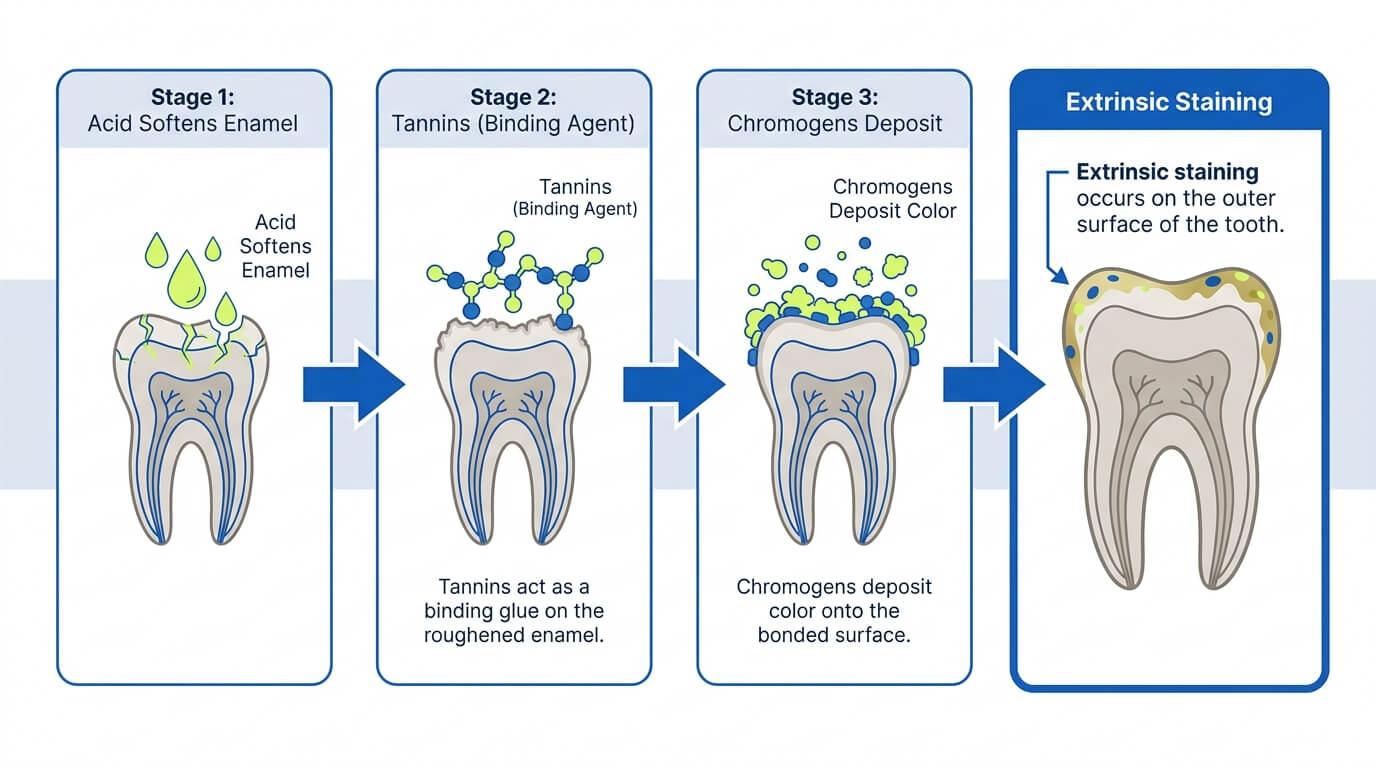
Understanding why coffee stains the way it does makes every other part of this guide click into place. This isn’t just background science. It’s the reason the habits and product choices covered later actually work, and why skipping them quietly costs you results.
Coffee contains tannins, a type of polyphenol, which break down and cause color compounds to adhere to the enamel. These color compounds are responsible for the yellow or brown discoloration that develops over time. Tannins act as a binding agent, making it easier for these color compounds to stick to the surface of your teeth and cause visible staining.
The cumulative effect of coffee’s acidity and staining agents doesn’t just sit on the surface. If not removed through regular cleaning, these stains can penetrate deeper into the tiny gaps and spaces within the tooth enamel, making them more stubborn and harder to treat. This is why consistent oral hygiene and the right whitening products are crucial for coffee drinkers.
Tannins, Chromogens, and Enamel Porosity
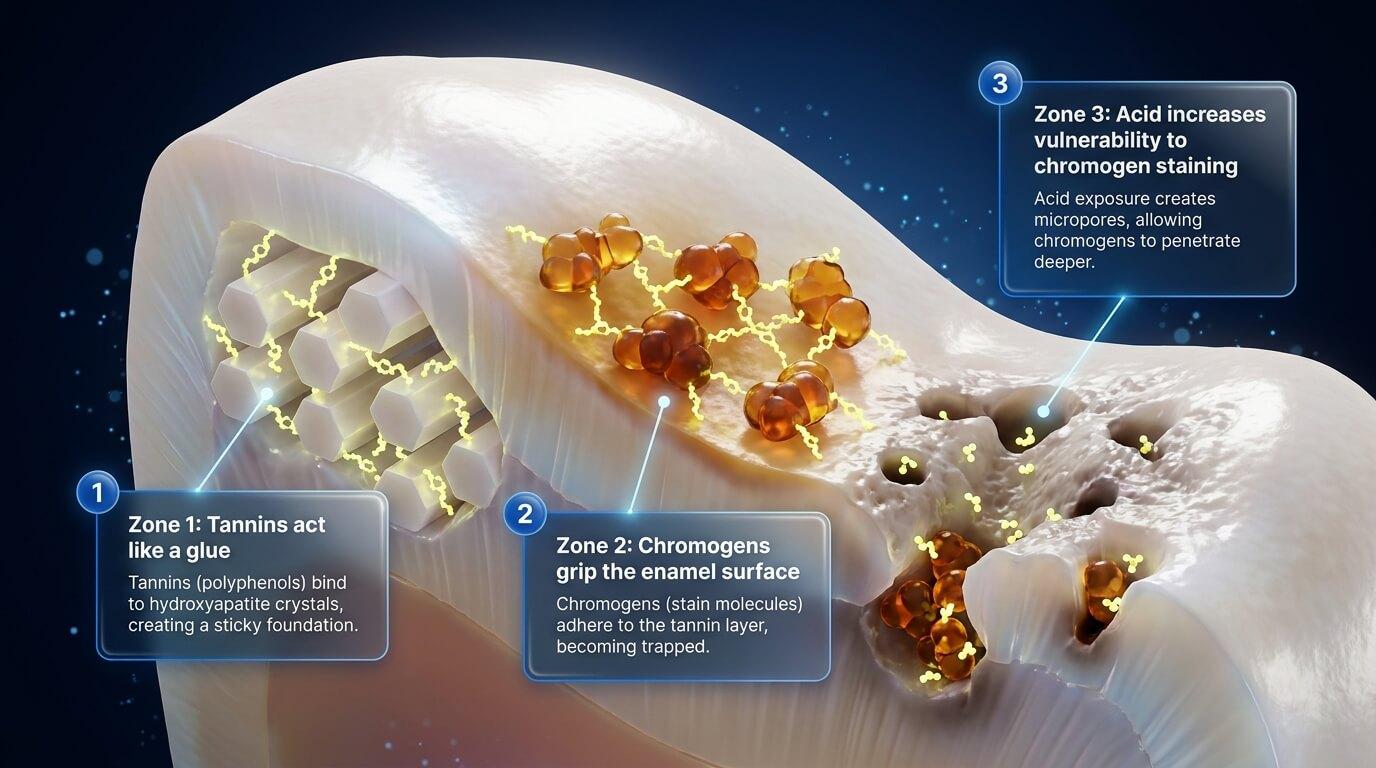
Coffee is one of the most stain-heavy beverages you can drink daily, and the chemistry behind it is genuinely fascinating. There are three things working together to produce those stubborn stains, and each one makes the others worse.
1. Tannins act as a binding agent that locks stains onto your enamel.
Tannins are a type of polyphenol found naturally in coffee, and research published in the Journal of Dentistry has documented that coffee tannins bind to hydroxyapatite, the main mineral that makes up your enamel, with significant chemical affinity. In practical terms, tannins essentially act like a glue. They make other compounds stick to tooth surfaces and hold them there, which is exactly why coffee stains feel so much more resistant than stains from other drinks.
2. Chromogens are the color pigments, and tannins make them far more effective at staining.
Those other compounds, tannins, help bind and are called chromogens. They’re the color pigment molecules in coffee that physically deposit onto dental enamel. On their own, chromogens would rinse away relatively easily. Paired with tannins, though, chromogens, tannic acids, and chlorogenic acids grip the enamel surface and create the kind of discoloration that builds up visibly over weeks of daily drinking.
3. Coffee’s natural acidity makes your enamel more receptive to staining right at the moment you drink it.
Acid temporarily softens enamel, and acidic environments erode the enamel surface, increasing its vulnerability to chromogen staining. That’s why even moderate daily coffee intake can accumulate into noticeable discoloration over time. It’s not just what’s in the coffee; it’s how the coffee prepares your enamel to absorb it.
The combined result of all three is called extrinsic staining.
It occurs on the outer surface of the tooth, which is actually good news. That’s because extrinsic stains respond well to whitening treatments designed to break down and lift these surface deposits.
Intrinsic staining, on the other hand, affects the inner structure of the tooth and can be caused by factors such as excessive fluoride exposure, which leads to internal discoloration that is more difficult to treat than coffee-related extrinsic stains.
Now that you understand why the stains form, let’s talk about what actually works to remove them.
What to Look for in a Whitening Product as a Coffee Drinker
Not every whitening product is designed for a daily coffee drinker.
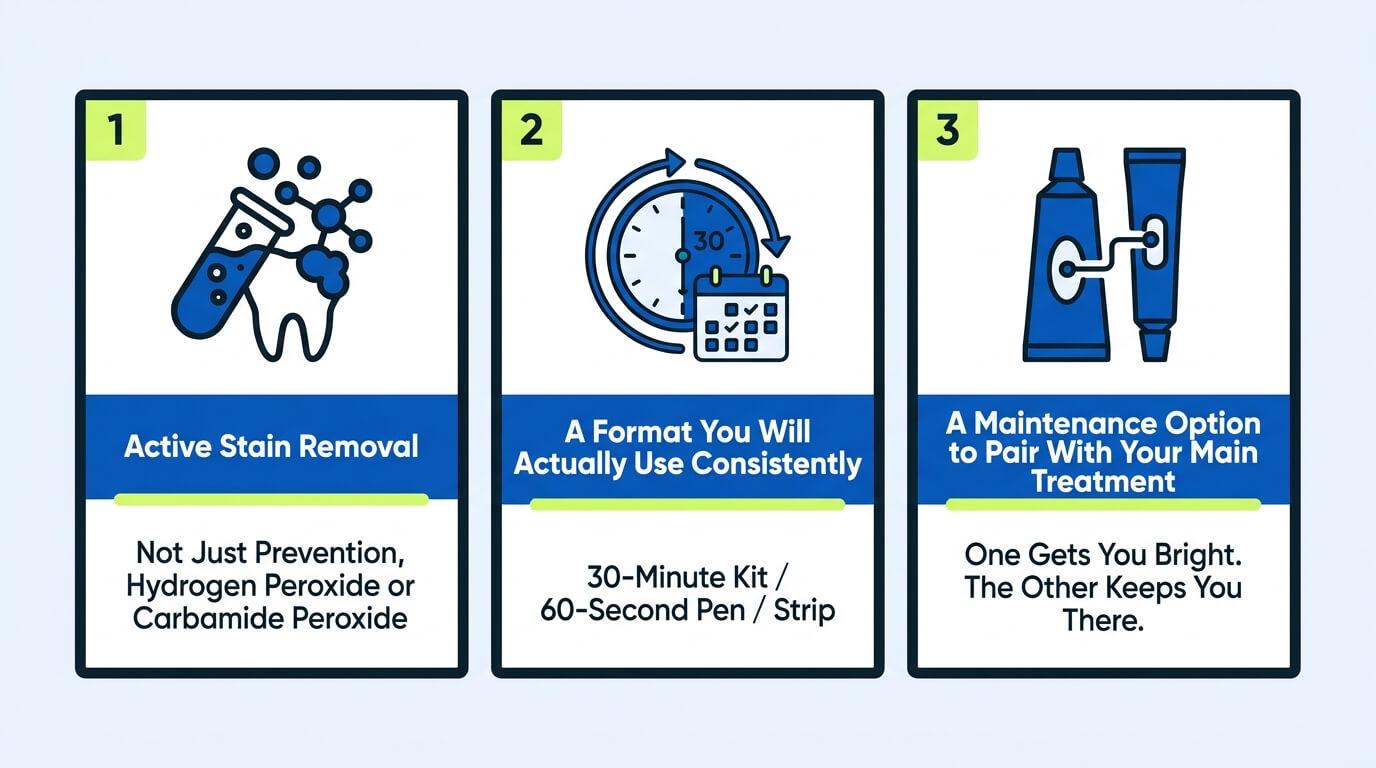
Before getting to the list, here are the three things that actually separate effective options from the ones that will leave you disappointed.
-
Active stain removal, not just prevention. Because coffee creates tannin-bonded staining, you need a product with an active whitening agent, typically hydrogen peroxide or carbamide peroxide, as the active ingredients in whitening products, that can actually break down existing deposits. Common whitening agents in toothpaste include hydrogen peroxide and carbamide peroxide, which help break down stains on the enamel surface. Products that only prevent new staining will not keep up with a daily coffee habit.
-
A format you will actually use consistently. Consistency is what produces results. The best product for a coffee drinker is one that fits realistically into their daily life, whether that is a 30-minute kit session at home, a 60-second pen application after lunch, or a strip while watching something in the evening.
-
A maintenance option to pair with your main treatment. Coffee drinkers need both a treatment product and a maintenance product. One gets you bright. The other keeps you there. The best routines combine both, and the products below are organized with that pairing in mind.
The 6 Best Teeth Whitening Products for Coffee Drinkers
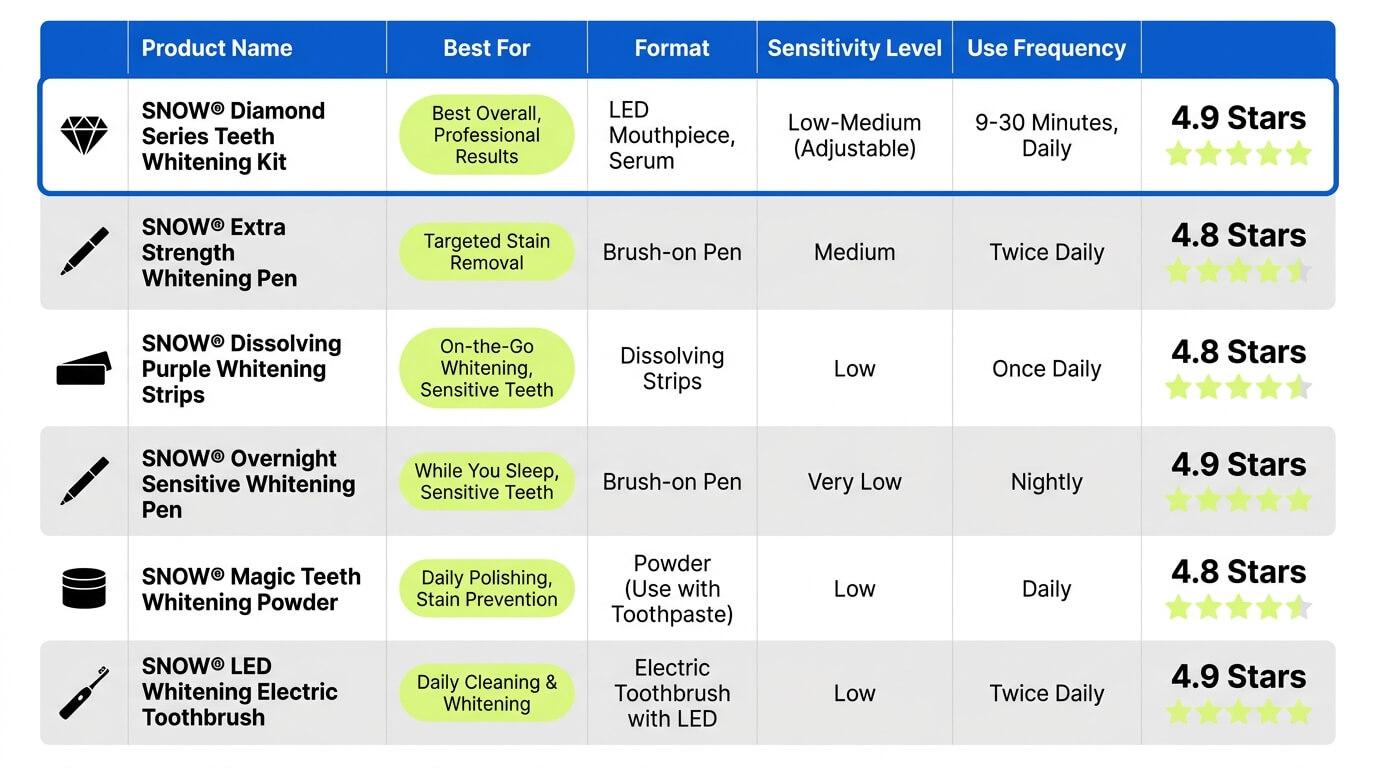
Each product on this list was chosen for a specific reason relevant to coffee drinkers: The kind of staining it addresses, the format it uses, the sensitivity level it suits, and where it fits in a full routine.
We’ve included a range of options, from at home kits and at home whitening kits—many of which feature custom trays and stronger bleaching solutions than typical over-the-counter products, offering a middle ground between professional treatments and store-bought options—to professional treatments and professional teeth whitening performed in-office by dental experts.
This ensures you can compare convenient at-home solutions with advanced, professionally supervised alternatives to find the best fit for your needs.
1. SNOW® Diamond Series Teeth Whitening Kit: Best Overall for Coffee Drinkers
If you are serious about reversing existing coffee staining, this is where to start. The SNOW® Diamond Series Teeth Whitening Kit is SNOW®’s most comprehensive at-home whitening system, comparable to what a dentist would use at a fraction of the cost.
Why it works for coffee drinkers specifically:
Coffee builds up tannin-bonded staining that requires an active, high-contact whitening agent to break down.
The Diamond Series uses a dentist-formulated hydrogen peroxide whitening gel, applied through a mouthpiece, to ensure even coverage across all tooth surfaces, including the edges and between teeth, where coffee staining tends to concentrate. Most people see noticeable results within 1 to 2 weeks of consistent use, and the risk of sensitivity is manageable compared to in-office treatments. Custom-molded trays paired with professional-strength carbamide or hydrogen peroxide gel provide a controlled whitening process for coffee drinkers.
What makes it stand out:
It is designed as a complete system, not just a one-step product. That means you get the initial treatment strength needed to address existing coffee stains, plus a routine that is sustainable enough to maintain long-term. Following the recommended steps ensures optimal results. SNOW® backs it with a 60-day money-back guarantee, so you can try it without the risk.
Best for: Coffee drinkers who want the most visible and noticeable results in the shortest timeframe and are ready to commit to a full treatment routine.
Shop The SNOW® Diamond Series Whitening Kit
2. SNOW® Extra Strength Whitening Pen: Best for On-the-Go Touch-Ups
The second cup of coffee at noon is where most people lose their results without even realizing it. The SNOW® Extra Strength Whitening Pen is the convenient solution that catches staining before it builds up, right in the moment it happens.
Why it works for coffee drinkers specifically:
Coffee stains accumulate gradually with each cup throughout the day. A whitening pen applied after a staining drink interrupts that accumulation at the source, before tannins and chromogens have time to bond deeply to enamel. It takes under a minute, fits in any bag or pocket, and requires no trays, lights, or prep.
What makes it stand out:
It is rated 4.9 out of 5 stars across over 1,200 reviews, and the most common feedback from coffee drinkers is that it is the habit that finally made their whitening results stick.
The extra-strength formula means it is actively working on staining, not just maintaining a baseline.
Research on coffee staining during at-home bleaching cycles found that consistent touch-up habits throughout the day have a meaningful impact on the amount of staining that accumulates between full treatment sessions.
Best for: Coffee drinkers who want a portable, daily-use option that prevents staining from building up between kit sessions. While the pen is effective for maintenance and touch-ups, those seeking more dramatic results for deeper stains may prefer a full whitening kit.
Get The SNOW® Extra Strength Whitening Pen
3. SNOW® Dissolving Purple Whitening Strips: Best Accessible Maintenance Option
Whitening strips are the most accessible format of at home kits, and SNOW®’s version removes the limitations of traditional strips.
The SNOW® Dissolving Purple Teeth Whitening Strips use color-correcting technology alongside their whitening formula, addressing both existing staining and the yellow undertones caused by coffee.
Over-the-counter whitening strips like these contain a peroxide-based bleaching agent that helps remove surface stains from teeth, making them effective for coffee drinkers.
Why they work for coffee drinkers specifically:
Traditional strips often miss the edges and between teeth, which is exactly where coffee staining tends to collect.
The dissolving format eliminates the coverage gaps that come with standard strip adhesion, and the purple color-correcting technology visually cancels out yellow tones while the whitening formula works to remove stains, including those caused by coffee, and remove surface stains for a brighter smile.
What makes them stand out:
They dissolve completely, which means no peeling, no repositioning, and no residue. They are rated 4.8 out of 5 stars and work well as a between-kit maintenance option used a few times per week. For coffee drinkers who want results without the commitment of a full kit session every time, these are the practical middle ground.
Best for: Coffee drinkers who want a flexible, no-fuss maintenance option that fits into their routine between full kit sessions.
Try The SNOW® Dissolving Purple Whitening Strips
4. SNOW® Overnight Sensitive Whitening Pen: Best for Coffee Drinkers with Sensitivity
Tooth sensitivity is the number one reason people abandon whitening routines, and for coffee drinkers who already deal with acid-related enamel wear, it is an even more relevant concern. Products designed for sensitive teeth, like the SNOW® Overnight Sensitive Whitening Pen, often contain lower concentrations of peroxide, which can help minimize discomfort while still providing effective whitening results.
The SNOW® Overnight Sensitive Whitening Pen is formulated specifically to address tooth sensitivity.
Why it works for coffee drinkers specifically:
Coffee’s acidity temporarily softens enamel, and repeated daily exposure can make standard whitening formulas feel too intense. The overnight formula uses a lower-contact approach that works gradually while you sleep, giving enamel time to settle rather than hitting it with a high-intensity treatment during the day.
What makes it stand out:
Clinical data show that about 77% of people who experience whitening sensitivity feel better within three days or less.
The Overnight Sensitive Pen is designed to help you stick to your routine on those days rather than stopping entirely.
It is also a practical secondary tool for anyone who uses the Extra Strength Pen on regular days and wants a gentler option on days their teeth feel more reactive.
Best for: Coffee drinkers with existing sensitivity who want to whiten consistently without discomfort.
Get The SNOW® Overnight Sensitive Whitening Pen
5. SNOW® Magic Teeth Whitening Powder: Best Booster Between Full Sessions
Once you have hit your brightness goal with the Diamond Kit, the challenge is staying there without running a full whitening session every few weeks. That is where the SNOW® Magic Teeth Whitening Powder earns its place in the routine.
Why it works for coffee drinkers specifically:
Coffee staining is cumulative. Even with good daily habits, surface staining builds up between full whitening sessions, and by the time it is visible, it has already been accumulating for weeks.
A booster treatment used every four to six weeks intercepts that buildup before it deepens. Research shows that at-home whitening results typically last 3 to 6 months with consistent maintenance, and regular booster use is a major factor in that.
What makes it stand out:
It is rated 4.8 out of 5 stars and is specifically formulated for maintenance, not for a fresh start. That means it is gentler on enamel than a full-strength treatment while still being active enough to address the light surface staining that coffee accumulates between sessions. The powder includes baking soda, a popular ingredient in whitening toothpaste known for its mild abrasive properties, aiding in the removal of surface stains without damaging the enamel.
Best for: Coffee drinkers who have completed an initial treatment and want to extend their results as long as possible without repeating a full kit cycle.
Try The SNOW® Magic Teeth Whitening Powder
6. SNOW® LED Whitening Electric Toothbrush: Best Daily Foundation Tool
Every product above works better when paired with a good daily brushing tool. The SNOW® LED Whitening Electric Toothbrush is the daily foundation that makes every other step in this list more effective. For optimal cleaning and to maintain oral hygiene, it's important to replace the brush head every three to four months.
Why it works for coffee drinkers specifically:
Coffee staining is a daily event, and daily mechanical removal of surface deposits prevents light staining from progressing to deeper discoloration over time. Practicing good oral hygiene by brushing twice a day and flossing regularly is essential for keeping your teeth healthy and stain-free.
The sonic technology removes surface staining left by a manual brush, and the built-in LED light provides an extra whitening boost during your regular brushing routine. This helps keep your teeth healthy and supports a bright smile, which is especially important for coffee drinkers concerned about staining.
The ADA recommends professional dental cleanings every six months alongside good daily brushing habits, and research shows that regular oral hygiene visits can reduce the risk of buildup by up to 50%. This brush is the daily layer that supports it all.
What makes it stand out:
It is rated 4.9 out of 5 stars and was designed specifically to complement SNOW®’s whitening ecosystem. Using it twice daily with a whitening toothpaste establishes a daily maintenance baseline that meaningfully slows the rate of coffee-staining accumulation between kit sessions.
Best for: Coffee drinkers who want to build the strongest possible daily routine as a foundation for their whitening results and maintain a bright smile.
Get The SNOW® LED Whitening Electric Toothbrush
The Two Habits That Make Every Product Work Better
The products above do the heavy lifting, but two simple timing habits make them significantly more effective for coffee drinkers. Think of these as the rules that protect your investment.
In addition to at-home care, scheduling regular cleanings and professional cleanings with your dentist is essential for maintaining whitening results.
Regular dental cleanings help remove surface stains and prevent the buildup of plaque, which can worsen staining and diminish the effects of whitening treatments.
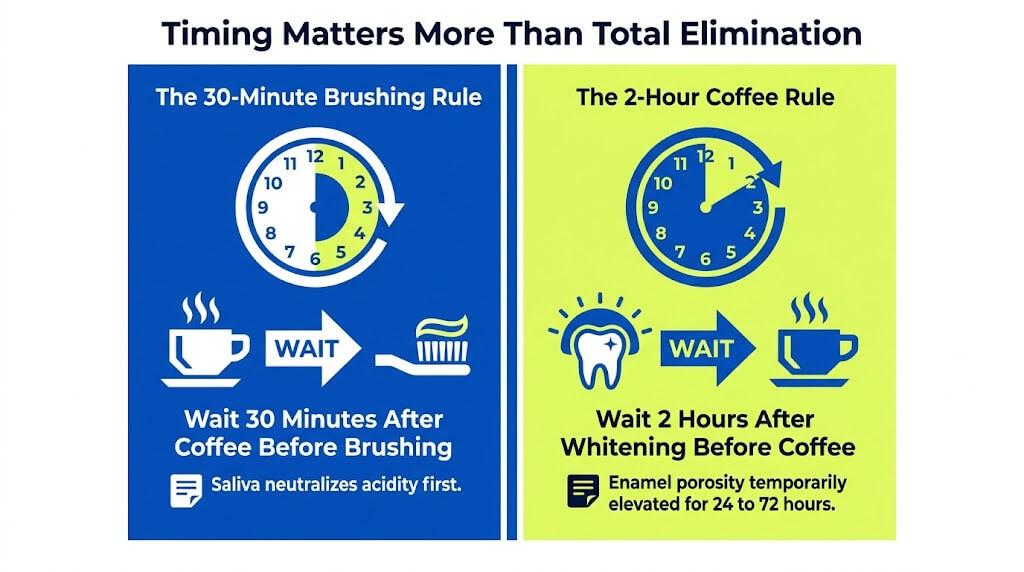
The 30-Minute Brushing Rule.
Coffee is acidic, and that acidity temporarily softens tooth enamel right after you drink. Brushing during that window increases surface wear on already-softened enamel, which can lead to enamel erosion and make teeth more susceptible to staining.
Waiting 30 minutes gives your saliva time to neutralize the acidity before you introduce any abrasion. It is one of the simplest shifts you can make, and it makes a meaningful long-term difference.
Additionally, some toothpastes contain natural enzymes like papain and bromelain, which help break down the protein layers where coffee stains bind, offering an effective way to address stains without harming enamel.
The 2-Hour Coffee Rule.
After any whitening session, your enamel porosity is temporarily elevated for roughly 24 to 72 hours. Drinking coffee during that window means tannins and chromogens can bind faster and more deeply than usual, increasing the risk of enamel damage if you don't follow post-whitening guidelines or seek professional advice.
Research on the effect of different drinks on tooth color after bleaching confirms that timing matters more than total elimination. Waiting two hours after a session is one of the most protective habits a coffee drinker can build, and it costs nothing to implement. Additionally, in-office whitening treatments often use hydrogen peroxide gel activated by UV or laser light to effectively lift coffee stains, making it even more important to protect your enamel immediately after these procedures.
Final Thoughts
Coffee stains are real, but they don’t have to be permanent. You can enjoy coffee and still maintain your pearly whites by choosing the right whitening products and adopting daily habits that help remove discoloration for a brighter smile.
Since new stains are continuously introduced, especially for coffee drinkers, professional treatment combined with consistent daily care is necessary to maintain whitening results over time. That’s the part nobody wants to negotiate on, and honestly, you shouldn’t have to.
At SNOW®, our dentist-formulated system is built around this reality. We back every product with a 60-day money-back guarantee so you can try it without the risk. Coffee lover or not, a brighter smile is absolutely within reach.
Start With SNOW® And Get 20% Off Today
Frequently Asked Questions
These are the questions coffee drinkers ask us most often about whitening, including natural remedies like coconut oil for oil pulling, and ingredients such as silica, activated charcoal, and sodium hexametaphosphate (SHMP) found in whitening toothpaste.
What Is the Best Whitening Toothpaste for Coffee Drinkers?
The best whitening toothpaste for coffee drinkers balances mild abrasives with a low RDA score to avoid unnecessary enamel wear over time. Look for formulas that address extrinsic tannin staining without relying on high-abrasive agents. Whitening toothpaste works best as a daily maintenance tool alongside a more complete whitening system, not as a standalone treatment for coffee staining.
What Is the 2-Hour Coffee Rule?
The 2-hour coffee rule means waiting at least 2 hours after a whitening session before drinking coffee. Right after whitening, enamel porosity temporarily increases, making teeth more receptive to new staining from tannins and chromogens. Respecting that window protects your results during the period when re-staining risk is at its highest.
How Do You Drink Coffee Without Getting Your Teeth Yellow?
The most effective habits for enjoying your daily cup of coffee while minimizing staining include rinsing with plain water right after coffee, drinking through a straw to limit direct contact with tooth surfaces, and finishing your cup in a shorter window rather than sipping over several hours. These steps reduce the time tannins remain in contact with dental enamel. Pairing them with a regular whitening routine makes a noticeable and lasting difference over time.
How Do I Keep My Teeth White as a Coffee Drinker?
Keeping teeth white as a coffee drinker does, in fact, come down to consistent maintenance. Stick to a regular whitening routine, which can include at home treatments—though it's wise to seek professional advice before trying DIY remedies. Rinse after every cup, and follow the 30-minute brushing rule to avoid brushing on acid-softened enamel. Small daily habits compound quickly and meaningfully extend the results of any whitening treatment you use. The most effective teeth whitening options for coffee drinkers combine peroxide-based chemical bleaching with polishing agents to remove stains.
Will My Teeth Get Whiter If I Stop Drinking Coffee?
Coffee is a common cause of stained teeth due to the tannins it contains, which can lead to noticeable discoloration over time. Stopping coffee can slow the rate of new extrinsic staining, but it will not remove the stains already present on your teeth. The American Dental Association recognizes that existing stains require active whitening treatment to lift. Quitting coffee helps maintain results over time, but a proper whitening routine is still the most direct path to a visibly brighter smile.