
You have seen it all over TikTok: purple toothpaste promising an instant, dramatic whiter smile in 2 minutes. So does purple toothpaste actually work?
The short answer? Yes, but only for a quick, temporary brightening effect, not permanent whitening. It is a clever optical illusion using color theory, not a substitute for real teeth whitening.
If you want to know whether this new whitening trend is worth trying, whether it is just a gimmick, and how it compares to actual whitening treatments, this article covers everything you need to know.
Explore the SNOW Whitening Collection
Key Takeaways
-
Purple toothpaste works through color theory, using purple dye to temporarily neutralize yellow tones on teeth and create an instant but short-lived brightening effect
-
Unlike real whitening treatments, purple toothpaste does not remove surface stains or change the intrinsic shade of teeth. Its whitening effect typically lasts only a few hours
-
Many purple toothpaste products lack fluoride and the cleaning agents found in traditional toothpaste, so they should never replace your regular oral care routine
-
The best use of purple toothpaste is as an event-ready cosmetic boost, not as a substitute for professional teeth whitening or whitening strips
Quick Answer: Does Purple Toothpaste Actually Work?
Yes and no. Purple toothpaste does work for instant, temporary brightening. It does not permanently whiten teeth or replace real whitening treatments.
Here is how the color theory works in practice:
-
Purple sits opposite yellow on the color wheel
-
When a sheer purple layer coats yellowish tooth enamel, the combination appears closer to neutral white
-
This optical illusion typically lasts a few hours before fading with eating, drinking, or your next brush
A randomized crossover study published in PubMed confirmed that toothpastes containing blue covarine, the same color-correcting mechanism used in purple toothpaste, produced a measurable reduction in tooth yellowness immediately after 1 brushing. The keyword: immediately. The effect is real, but it is optical, not structural, and it does not last.
As of 2026, no purple toothpaste has earned an American Dental Association Seal of Acceptance. No large, long-term clinical trials prove lasting whitening effects. The mechanism is real, but the results are extremely temporary.
The real question is not whether purple toothpaste works. It is whether the specific product you are considering is honest about what it does. The problem is not color-correcting technology itself. It is brands claiming professional-level whitening while delivering what amounts to an Instagram filter for your teeth.
What Is Purple Toothpaste, Really?
Purple toothpaste is any paste, serum, or tablet that uses violet dyes to neutralize yellow tones on teeth. The active colorants are typically CI 17200 (D&C Red No. 33) combined with CI 42090 (FD&C Blue No. 1), water-soluble dyes that produce the purple color.
Viral products like HiSmile V34 are technically serums, not traditional toothpaste. They are designed as cosmetic brighteners, not cavity-fighting dental products. Common ingredients include:
-
Glycerin, Water, Sorbitol, Hydrated Silica, and Xylitol as base ingredients
-
Phthalimidoperoxycaproic Acid (PAP) in some formulations, a non-abrasive whitening agent formulated to remove surface stains without bleaching agents
-
Purple colorants (D&C Red No. 33 + FD&C Blue No. 1) for the color-correcting effect
Traditional toothpaste looks very different. It typically contains:
-
Stannous fluoride or fluoride ion for daily oral health support
-
Sodium bicarbonate and hydrated silica as cleaning agents
-
Calcium carbonate to help remove bacterial plaque
Many purple formulas on social media omit fluoride entirely. Some brands, like Colgate Optic White Purple, include micro-polishers to physically remove daily surface stains while also correcting color. But many products are just pigment in a gel. Knowing which category a product falls into before using it matters.
How Does Purple Toothpaste Work? (The Color Theory Explained)
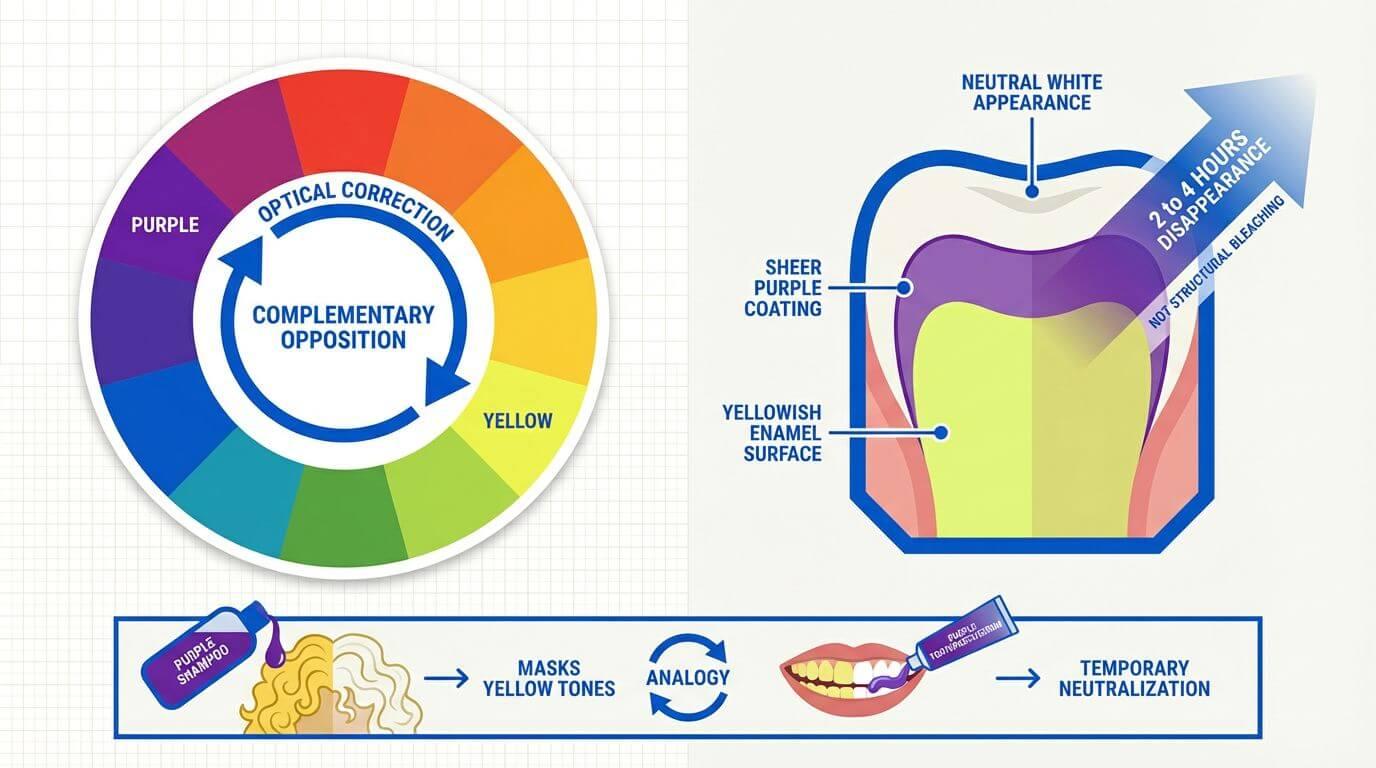
The science is straightforward.
Purple is opposite yellow on the color wheel. These complementary colors cancel each other out when layered together. When a sheer purple coating sits on yellowish enamel, the combination appears closer to neutral white.
Think of it like purple shampoo for blonde hair. The purple micro particles do not remove yellow. They mask it with the opposite color. This is optical correction, not structural bleaching.
The purple dye coats the surface of your tooth enamel without penetrating it. It does not lift, break down, or remove surface stains embedded in the enamel.
A 2021 randomized controlled trial published in the Journal of Dentistry found that after a single brushing with blue covarine toothpaste, there was no clinically relevant increase in tooth whiteness. Study participants could not observe any difference between the color-correcting toothpaste and a standard control.
Once the pigment washes away, typically within 2 to 4 hours, the effect disappears completely.
What the Science Actually Says
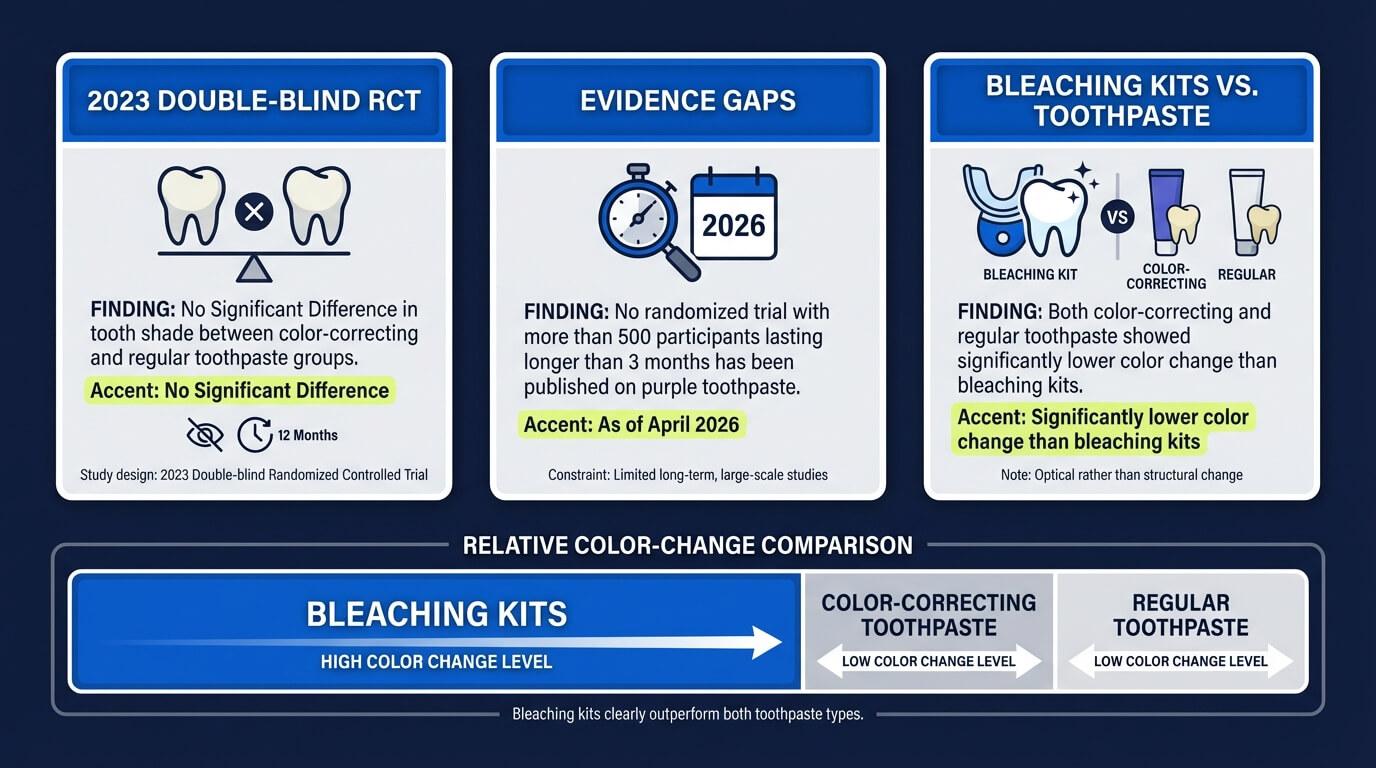
A 2023 double-blind randomized controlled trial compared blue covarine toothpaste against at-home bleaching and conventional whitening toothpaste over 2 weeks. The results, published in PubMed, showed no significant difference in tooth shade between the color-correcting group and the regular toothpaste group. Both showed significantly lower color change than bleaching kits.
The researchers classified the whitening effect as optical rather than structural. 3 key findings from the current evidence:
-
No randomized trial with more than 500 participants lasting longer than 3 months has been published on purple toothpaste specifically (as of April 2026)
-
The whitening effect is temporary and does not change the internal color of teeth or structurally remove surface stains
-
Effectiveness varies greatly based on the product's ingredients and the type of stains being treated
Does Purple Toothpaste Actually Whiten Teeth Long-Term?
"Whitening" means 2 different things:
-
Instant brightening (optical): A surface-level color correction that lasts hours
-
Long-term lightening (structural): Bleaching with hydrogen peroxide or similar agents that change the actual tooth shade
Purple products only provide instant brightening. They do not change the intrinsic shade of teeth or remove deep yellow stains from inside enamel or dentin. Most users report brighter teeth for a few hours after brushing, with the effect largely gone by the end of the day.
Repeated use does not build up a whiter color the way whitening strips or professional teeth whitening can over weeks of treatment. Think Instagram filter, not Photoshop retouch.
What Purple Toothpaste Can and Cannot Do
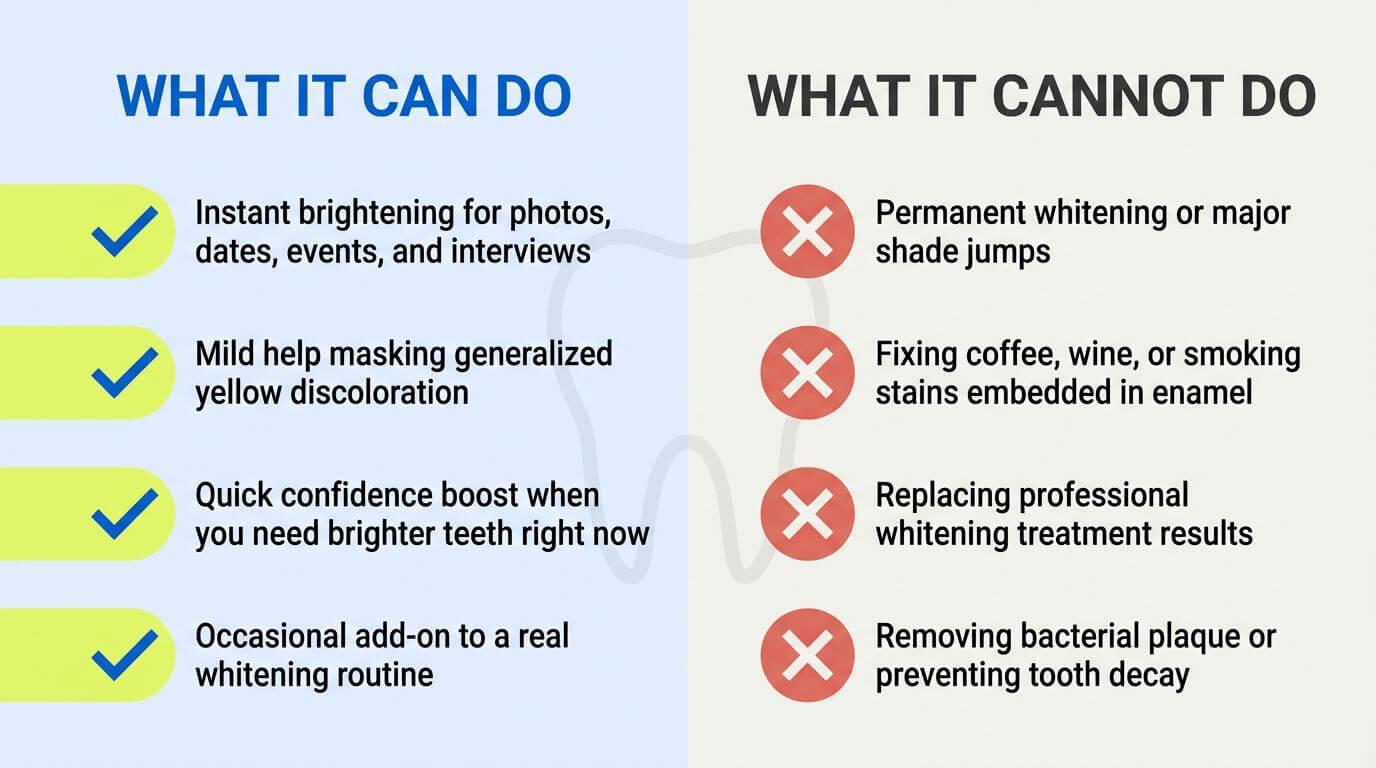
Purple toothpaste is a cosmetic tool, not a whitening treatment. Here is exactly what you can and cannot expect from it.

Some users report that surface stains appear darker after use. This happens when purple dye clings differently to plaque or rough enamel, creating a mottled appearance. If your enamel has rough patches or calculus buildup, purple toothpaste may highlight rather than hide them.
Dental professionals consistently caution that purple toothpaste should not replace traditional toothpaste. It does not remove bacterial plaque or prevent tooth decay.
Is Purple Toothpaste Safe? Side Effects and What to Know
Short-term use appears generally low-risk for most healthy adults. But there are important caveats worth knowing before you add it to your oral care routine.
Common short-term side effects include:
-
Mild tooth sensitivity
-
Gum irritation, especially in those with pre-existing sensitivity
-
Temporary purple stains on gums or tongue from the dyes
-
In rare cases, surface stains appear darker due to pigment clinging to rough enamel
-
Allergic reactions to the dyes, according to dental professionals
The bigger concern is long-term. Because many purple products skip fluoride and the plaque-removing agents found in traditional toothpaste, relying on them as your only toothpaste can lead to:
-
Increased plaque accumulation over months
-
Higher risk of tooth decay without fluoride protection
-
Weaker oral health baseline if the product fully replaces a proper toothpaste
There is currently no published data on the effects of daily ingestion of these dyes from brushing over 12+ months. Long-term safety remains an open question, not a proven fact.
Who Should Avoid or Be Cautious With Purple Toothpaste?
Avoid use entirely if you have:
-
Known dye allergies
-
Active gum disease
-
Uncontrolled tooth decay
-
Severe enamel erosion
All of the above require clearance from a dental professional first. Additionally:
-
Children, pregnant people, and anyone under active dental treatment should consult a dentist before adding purple products to their routine
-
No purple toothpaste carries the ADA Seal of Acceptance. Absence of FDA warnings does not equal proven safety
-
Purple toothpaste should be an add-on or occasional boost, never a permanent replacement for other toothpastes
Purple Toothpaste vs. Real Whitening: How Does It Compare?
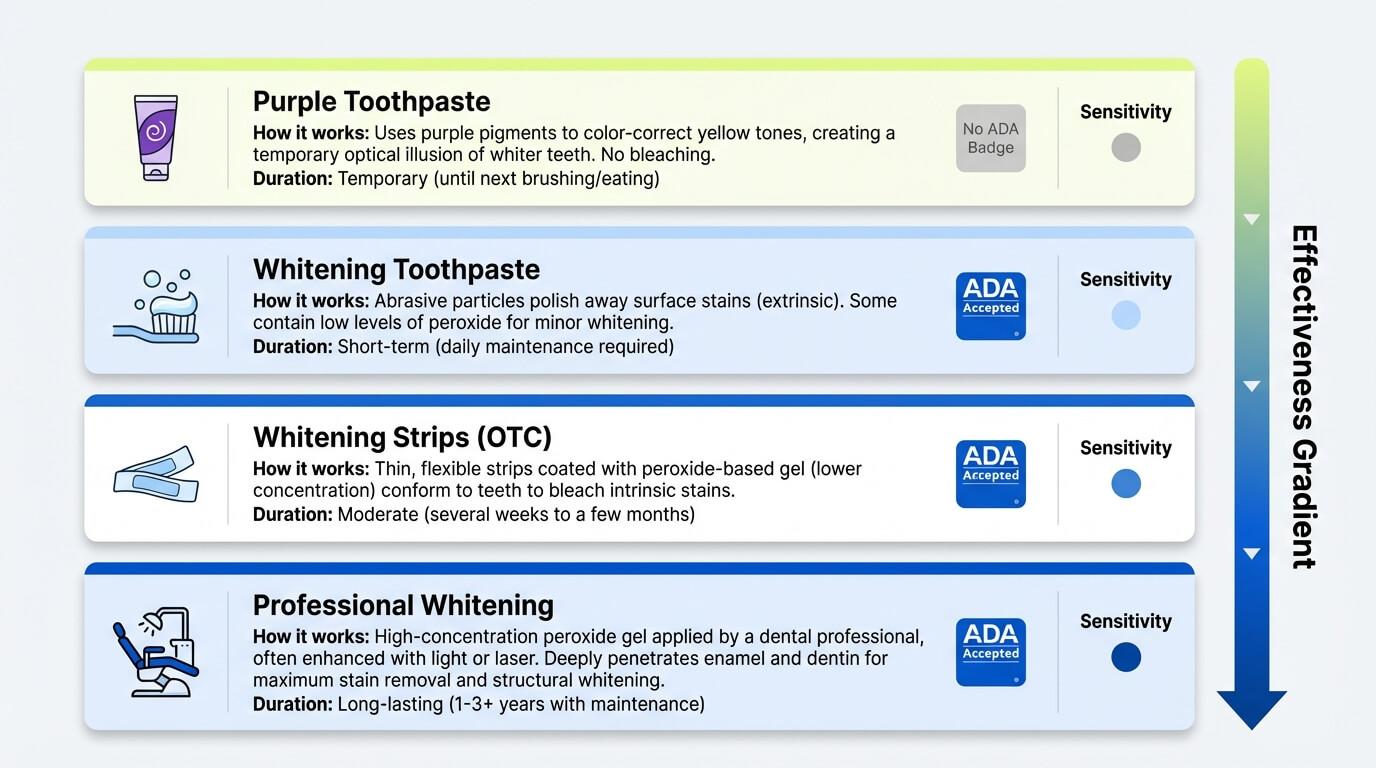
Purple toothpaste uses color-correcting pigments that coat the surface and wash away within hours. According to the American Dental Association, whitening toothpastes primarily rely on abrasives for mechanical removal of extrinsic surface stains, with some containing low-dose hydrogen peroxide for gradual color change over weeks.
Over-the-counter whitening strips use higher-concentration hydrogen peroxide (10 to 15%) that penetrates enamel and works on stains deeper in the tooth structure.
A clinical trial published in PubMed found that 7-day use of 10% hydrogen peroxide whitening strips produced significant, measurable tooth color improvement, while a 2% hydrogen peroxide pre-rinse produced no significant change. Results appear within 1 to 2 weeks and last weeks to months.
Professional whitening uses 35%+ peroxide under clinical supervision. Results are the most dramatic and longest-lasting because the bleaching agents reach deeper into the tooth. Sensitivity risk follows the same gradient:
-
Lowest: Purple toothpaste (no bleaching agents)
-
Moderate: Whitening toothpaste and strips
-
Highest: In-office treatments, but always with the dentist's supervision
A 2021 Frontiers in Dental Medicine review confirmed that whitening strips are the most effective over-the-counter whitening option across the majority of studies, outperforming dentifrices, rinses, and paint-on gels.

Where Purple Toothpaste Fits into a Whitening Routine
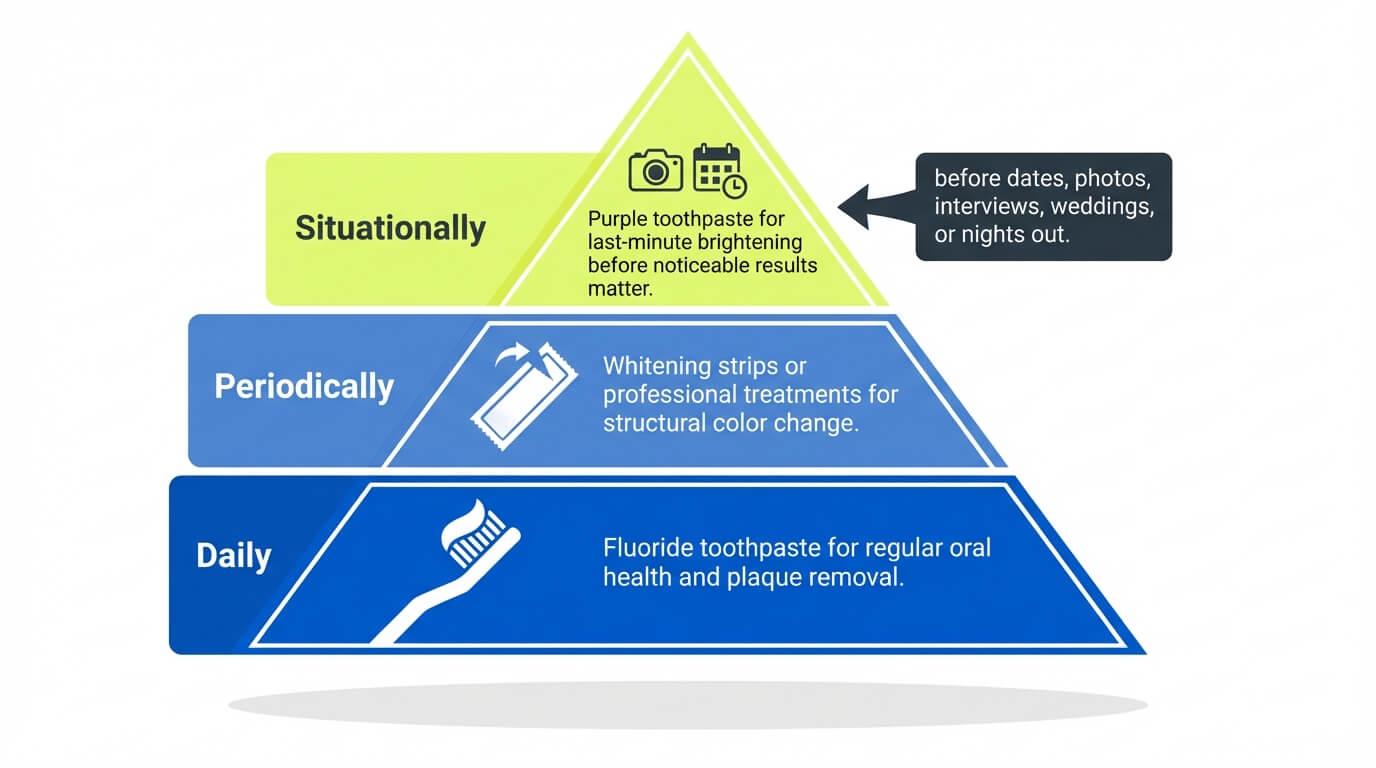
Position purple products as an event tool, not a core whitening strategy. Use them before dates, photos, interviews, weddings, or nights out for instant teeth whitening.
A realistic daily routine looks like this:
-
Daily: Fluoride toothpaste for regular oral health and plaque removal
-
Periodically: Whitening strips or professional treatments for structural color change
-
Situationally: Purple toothpaste for last-minute brightening before noticeable results matter
This is exactly what dentists recommend: do not rely solely on color correction when you actually need to remove plaque or permanently change your tooth shade. The SNOW Dissolving Whitening Strips with Hydroxyapatite are designed for people who want real, measurable whitening results.
They use a gentle hydrogen peroxide formula to work on stains at the surface and below, not just mask them. If purple toothpaste has given you a taste for a brighter smile, SNOW Whitening Strips are the next step toward making that brightness last.
How to Use Purple Toothpaste the Right Way
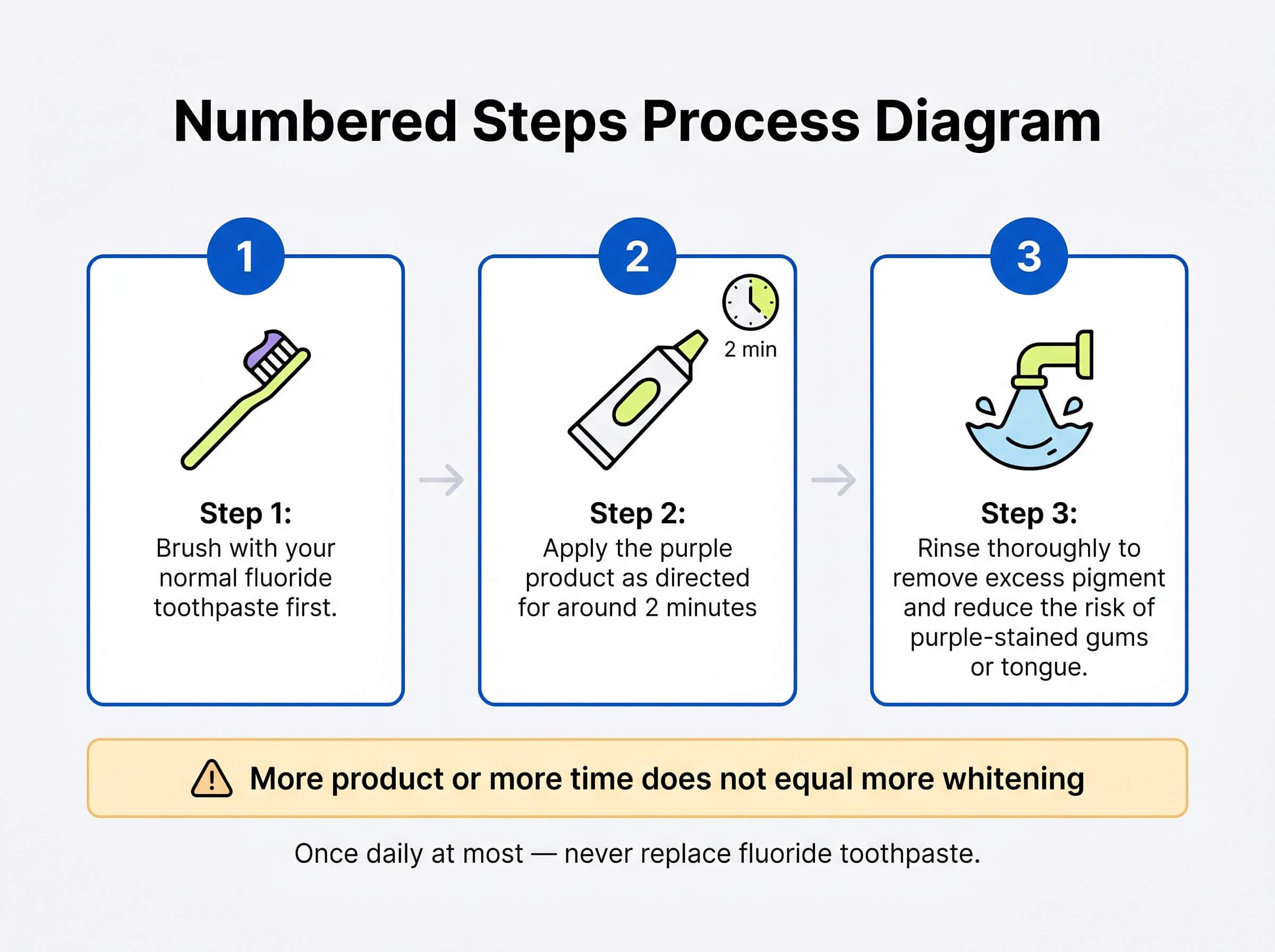
Follow these steps for the best results:
-
Step 1: Brush with your normal fluoride toothpaste first
-
Step 2: Apply the purple product as directed, whether paste, serum, or tablet, for around 2 minutes
-
Step 3: Rinse thoroughly to remove excess pigment and reduce the risk of purple-stained gums or tongue
More product or more time does not equal more whitening. Going longer will not change the underlying tooth color because the mechanism is surface-level pigment, not a penetrating treatment.
Use purple products occasionally or situationally: once daily at most, or just on days when you want extra brightness. Never use them as a permanent replacement for other toothpastes with fluoride and cleaning agents.
Signs You Are Overusing or Misusing Purple Toothpaste
Watch for these warning signs:
-
Persistent gum irritation that does not resolve after stopping use
-
Unusual teeth staining patterns or uneven color
-
Teeth look more yellow once the effect wears off than before you started
-
Darker-looking stains, which can indicate plaque buildup or rough enamel catching more pigment
If you notice any of these, stop use and consult a dental professional. They can assess whether the issue is cosmetic or a sign of a need for professional cleaning and evaluation.
How to Choose a Purple Toothpaste (Without Getting Scammed)
Before you buy, run through these 3 checks:
-
Check the claims: Be cautious of phrases like "professional-level whitening," "permanent results," or "replaces dentist whitening." These overpromise what color correction can do
-
Scan the ingredients: Look for real cleaning agents, such as sodium bicarbonate, hydrated silica, or calcium carbonate, alongside the pigments. Not just a gimmick of dyes in a gel
-
Verify transparency: Brands should clearly state that the effect is instant and temporary. Look for realistic before-and-after photos without heavy social media filters
Some products mix mechanisms, adding activated charcoal or low-dose peroxide alongside color agents. When brands claim whitening without specifying whether it is optical or chemical, that is a transparency problem.
Red Flags and Green Flags in Purple Toothpaste Marketing
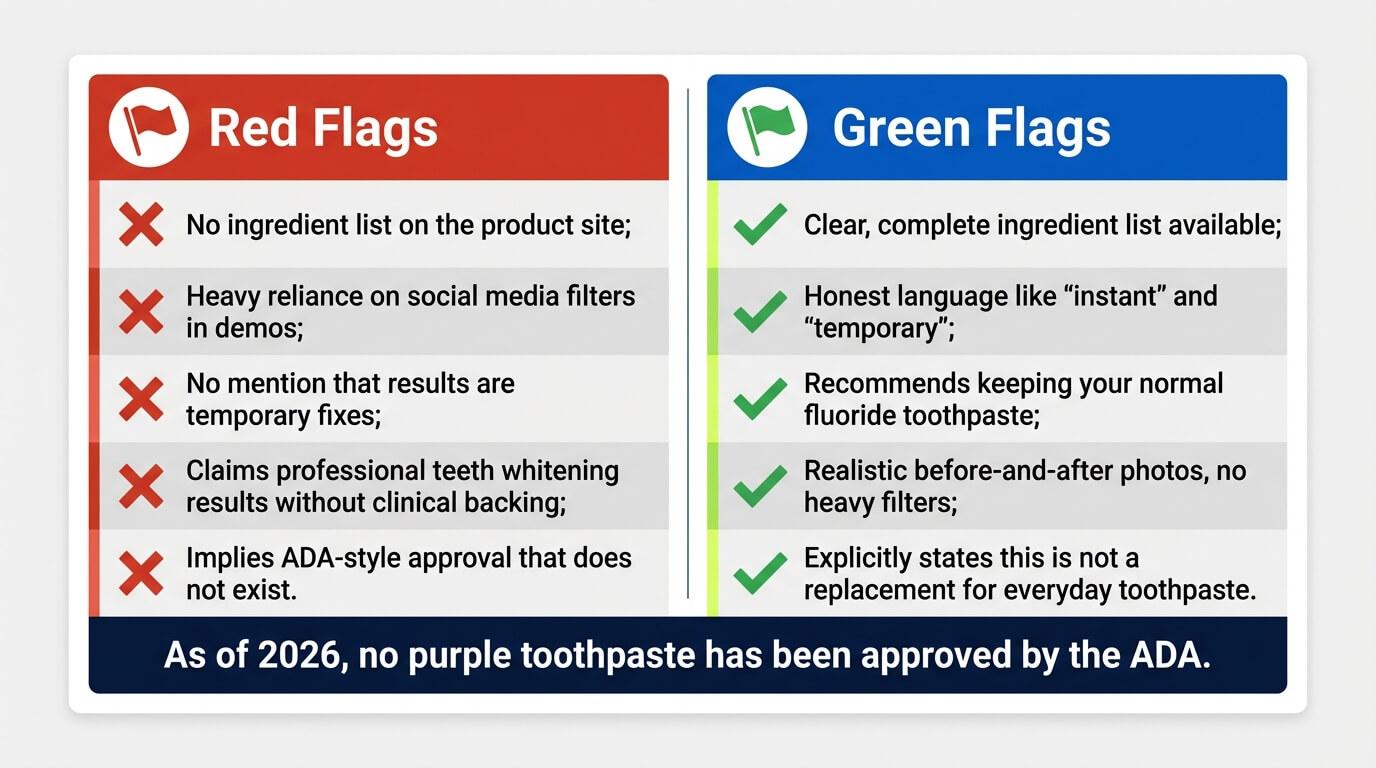
Not all purple toothpaste brands are created equal. Use this checklist before you buy.

As of 2026, no purple toothpaste has been approved by the ADA. If a product implies otherwise, that is a major red flag.
Final Take
Purple toothpaste works as advertised when it is sold honestly as an instant, temporary brightener. It fails to meet expectations when marketed as a long-term whitening cure or a gimmick-free alternative to professional treatments.
Stop asking "Does purple toothpaste work?" Start asking, "Does this specific dental product do exactly what it claims, and is it honest about being temporary?"
Here is the honest bottom line:
-
Pair any purple product with proven oral hygiene basics: fluoride toothpaste, flossing, and regular cleanings
-
When you need a lasting shade change, use real whitening methods with bleaching agents
-
Use purple for last-minute boosts before big moments, not as your long-term whitening strategy
For real whitening results that hold, SNOW Whitening Strips with Hydroxyapatite deliver measurable color change over time, not just for the next few hours.
Frequently Asked Questions About Purple Toothpaste
Have more questions? Here is what people ask most about purple toothpaste and how it actually works.
Does purple toothpaste permanently whiten teeth?
No, purple toothpaste does not permanently whiten teeth. It creates a temporary optical illusion, based on color theory, that makes teeth appear whiter for a few hours. It does not structurally change tooth color or remove surface stains.
Is purple toothpaste safe to use daily?
Short-term use is generally low-risk for most adults, but many purple toothpastes lack fluoride and the cavity-fighting ingredients found in traditional toothpaste. They should never replace regular brushing with fluoride toothpaste. Long-term safety data are limited.
How does purple toothpaste work to whiten teeth?
Purple toothpaste uses purple dye, typically a combination of D&C Red No. 33 and FD&C Blue No. 1, to neutralize yellow tooth tones through color theory. This creates an instant, temporary brightening effect without altering the tooth color.
Can purple toothpaste replace professional whitening treatments?
No, purple toothpaste cannot replace professional whitening treatments. It is best used as a quick cosmetic boost before events. Professional whitening treatments provide longer-lasting, more significant results by actually altering tooth color through chemical processes.
Are there any side effects of using purple toothpaste?
Some users experience mild tooth sensitivity, gum irritation, or temporary purple staining on the gums or tongue. In rare cases, surface stains may appear darker because the purple dye clings to rough enamel or plaque buildup. Allergic reactions to the dyes are also possible.
What should I look for when choosing a purple toothpaste?
Choose products that are transparent about their temporary whitening effect, contain real cleaning ingredients like sodium bicarbonate or hydrated silica, and do not overpromise permanent whitening results. Avoid any product that implies ADA approval it does not have.