
Let's be real: Crest 3D Whitestrips is not a bad product. It just isn't the right product for everyone. Maybe the strips slip the second you open your mouth. Maybe your teeth feel like they've been through a pressure washer every time you finish a cycle. Or maybe you've started reading ingredient labels a little more carefully, and you're not loving what you see.
Whatever the reason, you're here, and the good news is that 2026 has genuinely strong alternatives across every format, ingredient approach, and price point. This list cuts through the noise and tells you exactly which one fits your situation.
At SNOW, we’ve shipped over 100 million teeth whitening treatments to people who were done wasting money on routines that didn't deliver. Our dentist-formulated, sensitivity-conscious whitening strips were built for the buyer that standard options leave behind. If harsh strips have burned you before (sometimes literally), we're pretty confident you'll feel the difference after switching to SNOW.
Shop SNOW's Full Whitening Range
Key Takeaways
-
Hydrogen peroxide, carbamide peroxide, and peroxide-free formulas are not the same thing. They work differently on staining, sensitivity, and timing.
-
Sensitivity is the number one reason people quit whitening routines halfway through, and the formula you pick directly affects your odds of finishing.
-
Whitening strips cannot change the color of crowns, veneers, or fillings; only your natural enamel plays along.
-
Realistic shade improvement is 2 to 6 shades with consistent use; results typically show up between days 7 and 14.
-
The ADA Seal of Acceptance and dentist-formulated credentials are worth caring about - they are not just marketing noise.
-
Format matters more than most people think. The strip you'll actually wear every day beats the "best" strip you abandon after three uses.
The 7 Best Crest 3D Whitestrips Alternatives in 2026
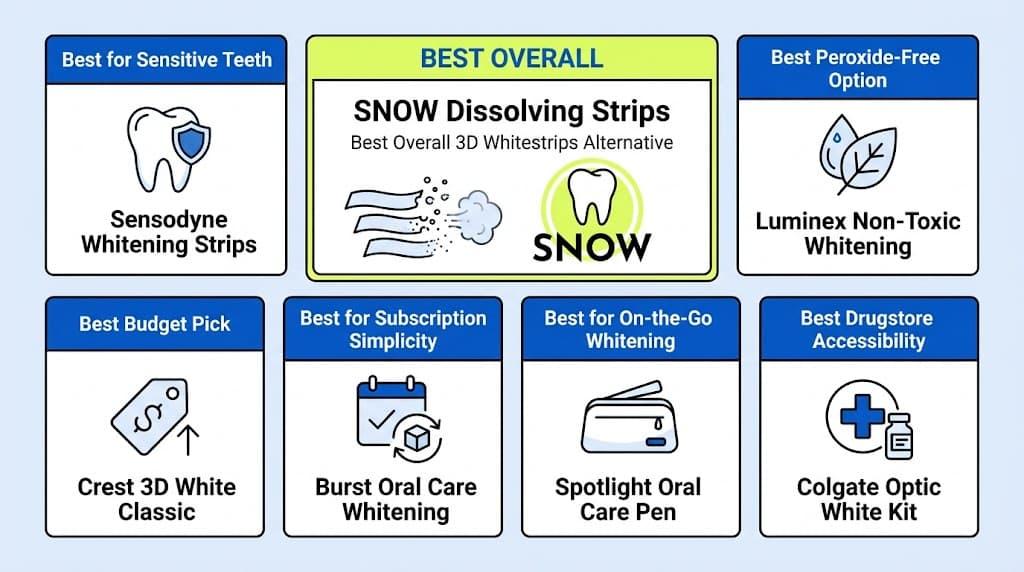
Every product on this list earned its spot based on whitening performance, sensitivity handling, ingredient quality, format convenience, and overall value. No filler picks.
Here’s how they stack up.
1. Opalescence Go: Best for Sensitive Teeth
If your teeth have ever sent you a very clear message mid-whitening session in the form of sharp, sudden, absolutely unwelcome pain or sensitivity, Opalescence Go was designed for you. It takes a fundamentally different approach to active ingredients, swapping hydrogen peroxide for carbamide peroxide, which releases far more slowly in contact with enamel. Less peroxide hitting your nerves at once means a noticeably more comfortable experience for people with a history of sensitivity.
The format is a step up, too. Instead of strips that fight gravity every time you speak, Opalescence Go uses pre-filled trays that actually conform to your tooth surfaces. No slipping, no gel migrating to your gums, no adjusting in the bathroom mirror every few minutes.
What Makes It Stand Out
Opalescence Go pairs a gentler peroxide type with a sensitivity-supporting ingredient and a format that outperforms standard strips. Here’s the full picture:
-
Carbamide peroxide releases more gradually than hydrogen peroxide, which means lower peak peroxide exposure per session and less chance of that sharp mid-treatment sting
-
Potassium nitrate is included in the formula. A clinical trial found that a carbamide peroxide gel containing potassium nitrate produced measurably less tooth sensitivity than a control bleaching gel over a two-week treatment period, without sacrificing whitening results (Tam L, J Can Dent Assoc, 2001); if you still get sensitivity, you can also support treatment by brushing with sensitivity toothpaste containing potassium nitrate, fluoride, or strontium chloride
-
Pre-filled trays give you better surface contact than strips and cut out the slipping problem entirely
-
Available through dental offices and online retailers, which gives it a professional-grade credibility that most drugstore alternatives lack
-
Multiple concentration levels are available, so you can dial up or down depending on how your teeth respond
Price
Opalescence Go typically runs $40 to $60 for a standard treatment pack. That is mid-to-premium territory, but the price reflects genuine formulation and format differences - not just a fancy box.
Pros and Cons

Best For
This one has a clear audience. Opalescence Go is the right call if you:
-
Have tried hydrogen peroxide strips before and ended up white-knuckling through the sensitivity
-
Prefer a tray format that actually stays put rather than strips that need constant babysitting
-
Are willing to trade speed for a considerably more comfortable daily experience
-
Want a clinically-backed formula rather than something that just looks good on a shelf
2. SNOW Dissolving Strips: Best Overall 3D Whitestrips Alternative
Here’s the thing about most whitening strips: They ask a lot of you. Wear them for 30 to 60 minutes. Peel them off without making a mess. Try not to trigger your gag reflex in the process. Hope they haven’t slipped onto your gums while you were making coffee.
SNOW’s Dissolving Strips opt out of all of that entirely. They dissolve completely on your teeth in 15 minutes, making the application process more convenient for busy schedules, with no removal step, nothing to rinse, and no strip waste left behind.
That alone makes them stand out, but the dentist-formulated, sensitivity-conscious formula is what makes them the best overall Crest 3D Whitestrips alternative on this list.
What Makes It Stand Out
The format gets SNOW in the conversation. The formula keeps it at the top. Here’s what separates these from everything else:
-
Dentist-formulated by Dr. Brian Harris, DDS, with sensitivity handled as a design requirement rather than an afterthought
-
Dissolving format means no slipping, no gagging, and no awkward removal - you apply them and get on with your morning
-
Hydrogen peroxide delivers real, visible whitening results with consistent use
-
Nano-Hydroxyapatite is included to support enamel appearance - a cleaner approach for buyers who want whitening without ingredients they'd rather avoid
-
SLS-free, alcohol-free, paraben-free, vegan, and cruelty-free - the kind of formula that ingredient-label readers actually appreciate
-
15-minute wear time fits into the kinds of schedules where most whitening routines quietly go to die
-
Over 100 million treatments shipped, #1 rated on Trustpilot, BBB A rating, and featured by Oprah, ELLE, GQ, Esquire, and Marie Claire
-
Every purchase comes with a 60-day money-back guarantee - so trying it costs you nothing but a little optimism
Price
SNOW Dissolving Strips are priced at $44. Above drugstore, below professional treatment, and honestly competitive for what you're actually getting in the box. Each kit comes with 42 dissolving strips, giving shoppers a longer treatment window than many standard over-the-counter strip kits.
Pros and Cons

Best For
SNOW Dissolving Strips hit the sweet spot for a wide range of buyers. They’re worth considering if you:
-
Have quit whitening strips before because of sensitivity, slipping, or sheer inconvenience
-
Apply a clean-ingredient filter to your oral care routine the same way you do with skincare
-
Need a fast, no-fuss format that actually fits into a packed morning
-
Are trying whitening strips for the first time and want something low-risk and high-quality
-
Have ever looked in the mirror mid-strip and thought "there has to be a better way"
Try SNOW Dissolving Strips Today
3. Lumineux Whitening Strips: Best Peroxide-Free Option
Not everyone wants peroxide near their teeth, and that’s a perfectly valid position. Lumineux is one of the very few whitening strips on the market that holds the ADA Seal of Acceptance while being entirely peroxide-free. That combination is rare, and it’s basically the whole reason Lumineux exists on this list.
This formula uses lemon peel oil and coconut oil as part of its peroxide-free whitening approach, rather than a conventional bleach system, which makes it a gentler option for sensitive teeth.
No harsh chemistry. No aggressive oxidation. Just a gentler approach that takes its time getting there.
One thing to be clear-eyed about: this isn’t the strip you buy when you want dramatic whitening in three days.
It works more gradually, and that slower pace is part of the tradeoff. Plant-based alternatives like this are often chosen because they can cause virtually zero gum irritation or tooth sensitivity, even if the results take longer.
What Makes It Stand Out
For a specific buyer, Lumineux checks boxes nothing else on this list can. Here’s the full case for it:
-
ADA Seal of Acceptance means an independent body looked at the safety and efficacy claims and signed off on them
-
Peroxide-free formula is the real differentiator - no bleaching agents, full stop
-
Certified non-toxic with a natural ingredient profile built on plant-based oils rather than chemical whitening agents
-
A 2023 randomized controlled trial published in the American Journal of Dentistry compared a peroxide-free regimen built around plant-based oils against a hydrogen peroxide whitening strip. The hydrogen peroxide group achieved greater overall color change, but the plant-oil group showed favorable tolerability, which is the whole point for the buyer who chooses Lumineux
-
NBC News Select included Lumineux in its best OTC teeth whitening products roundup for 2026
One thing to be clear-eyed about: Without peroxide, whitening is slower and less dramatic. This isn’t the product for someone who wants a noticeable difference in two weeks. It’s the product for someone who wants a gentler approach and is okay with being patient.
Price
Lumineux typically lands in the $30 to $40 range per treatment pack. For a certified non-toxic, ADA-approved, peroxide-free strip, that’s a solid value, especially compared to professional-grade sensitivity treatments.
Pros and Cons

Best For
Lumineux is a niche pick, but it’s worth considering if you:
-
Are avoiding peroxide for personal, medical, or sensitivity-related reasons and are not interested in negotiating on that
-
Read ingredient labels and will not put anything on your teeth that you would not recognize in a skincare product
-
Have a history of sensitivity and want whitening you can actually finish without discomfort
-
Prioritize long, gradual brightening over fast, high-contrast results
4. Zimba Teeth Whitening Strips: Best Budget Pick
Zimba is the answer to a question a lot of first-time whitening strip buyers are quietly asking: Can I get real hydrogen peroxide whitening without paying premium prices? The answer is yes. Zimba uses the same active ingredient class as many of the more expensive options on this list, and it delivers meaningful results; just without the bells, whistles, or clinical depth of its pricier competitors.
The flavor variety is another key differentiator. Buyers can choose from flavors like watermelon, coconut, mint, and more. It sounds like a gimmick until you realize how many people have quietly abandoned their whitening routine because they couldn’t stand putting the strips in their mouth every morning. Taste is a compliance issue, and Zimba takes that seriously.
What Makes It Stand Out
At this price, Zimba performs well above expectations. Here’s why it made the list:
-
Hydrogen peroxide formula delivers actual whitening results at a price that does not require a second thought
-
Wide flavor range meaningfully improves daily compliance, as a routine you’ll actually stick to beats a superior product you stop using after day four
-
An accessible entry point for first-time users who want to test at-home whitening before investing in something premium
-
Results typically land in the 2 to 4 shade range with consistent use, which is a real, visible improvement for most users
-
Good Housekeeping's top-rated whitening strips roundup lists Zimba as a recommended budget option
One transparency note worth knowing upfront: Zimba has fewer large-scale peer-reviewed clinical trials behind it than more established brands. That doesn’t make it ineffective, but it’s worth knowing before you compare it to products with deeper clinical backing.
Price
Typically in the $20 to $25 range. The price gap relative to premium alternatives is real, and it reflects a considerable trade-off in clinical depth and formula sophistication. For casual whitening at a low barrier to entry, however, the value is hard to argue with.
Pros and Cons

Best For
Zimba has a clear and well-defined lane. It’s the right pick if you:
-
Are brand new to whitening strips and want to trial the format before spending more
-
Have given up on other strips because of the taste, and finally want a flavor you can tolerate
-
Need a hydrogen peroxide product that does not come with a premium price tag
-
Whiten casually and want a meaningful improvement without a serious investment
5. Moon Dissolving White Strips: Best for On-the-Go Whitening
The dissolving strip format is one of those things that makes you wonder why traditional strips stuck around as long as they did. Moon's version dissolves completely on your teeth in around 15 minutes, with zero removal, zero rinsing, and zero of the usual strip-related frustrations. No slipping. No gag response. No standing over the sink at 7 am trying to peel a film off your teeth without drooling.
It’s a convenience play, and for certain buyers, convenience is the whole game.
What Makes It Stand Out
Moon earns its place on this list based almost entirely on format. Here’s what matters:
-
Fully dissolvable with no removal step, no rinsing, and no cleanup - just apply and move on
-
15-minute wear window, which is the shortest on this list for a hydrogen peroxide-based format
-
Hydrogen peroxide formula delivers real whitening results with consistent use
-
No slipping mid-wear - the dissolving mechanism solves the strip's biggest everyday frustration
-
No gag reflex issues that thicker traditional strips can cause in people with a sensitive response
-
Travel-friendly and usable anywhere without needing a mirror, a sink, or much planning
The honest trade-off: Results are more gradual than traditional strips running a higher hydrogen peroxide concentration. This format is optimized for convenience, not speed.
Price
Typically $25 to $35. A reasonable step up from drugstore strip pricing that reflects the format upgrade.
Pros and Cons

Best For
Moon is a strong match for a specific kind of buyer. Consider it if you:
-
Have a schedule where anything requiring more than 15 minutes of setup just doesn't happen consistently
-
Have ditched other strips because they slipped, caused gagging, or were just too much work to bother with
-
Travel regularly and want a portable, mess-free whitening option
-
Want real hydrogen peroxide whitening in a format that actually gets used
6. Burst Teeth Whitening Strips: Best for Subscription Simplicity
There’s a certain kind of buyer who doesn’t want to think about reordering anything. Burst was built for that person. It is a direct-to-consumer subscription brand with a dentist-backed angle, charcoal-infused strip options, and a pricing model that rewards consistency over one-off purchasing.
It’s not trying to be the most innovative formula on the market. It is trying to be the whitening strip that shows up at your door before you run out, backed by dentists, and priced fairly on a recurring basis.
What Makes It Stand Out
Burst wins on logistics as much as formula. Here is the case for it:
-
Subscription model handles restocking automatically - no remembering, no reordering, no running out mid-routine
-
Coconut oil is included as a natural cleansing ingredient alongside the whitening formula
-
Dentist-network marketing adds a layer of professional credibility that holds up to scrutiny
-
Charcoal-infused strip option available for buyers who want that format
-
Competitive per-pack pricing, especially on subscription
Worth noting for thorough buyers: Burst does not have the same depth of large-scale peer-reviewed clinical trials as more established brands in this category. The dentist marketing is credible, but the independent clinical record is thinner.
Price
Typically $20 to $30 per pack, with subscription pricing bringing the cost down further. The value case is strongest for buyers who commit to a consistent whitening schedule rather than occasional touch-ups.
Pros and Cons

Best For
Burst works best for a routine-focused buyer who values simplicity. Consider it if you:
-
Want a whitening routine that essentially runs itself once you set it up
-
Like the credibility of a dentist-backed brand without paying professional-tier prices
-
Are comfortable with a subscription model and whiten often enough to make it worthwhile
-
Want a lower-cost entry point to a dentist-associated brand with ongoing support
7. Colgate Optic White Strips: Best Drugstore Accessibility
Colgate Optic White isn’t going to blow you away with innovation. What it will do though is be on the shelf at the pharmacy down the street, cost less than most alternatives, and actually whiten your teeth. Sometimes that’s the whole brief.
It uses hydrogen peroxide as the active ingredient, requires no prescription or subscription, and carries decades of brand familiarity behind it. For buyers who want the lowest possible barrier to entry, this is it.
What Makes It Stand Out
Colgate Optic White's strongest card is accessibility. Let’s take a look at the full picture:
-
Hydrogen peroxide formula delivers real, visible whitening with consistent use - the same active ingredient class as many premium alternatives
-
Available at virtually every major pharmacy, which means you can pick it up same-day without any planning
-
Familiar brand with the kind of consumer trust that comes from actually being around for a long time
-
No subscription, no commitment, no shipping wait - just grab it and go
Price
Typically $20 to $35, depending on the specific product tier and retailer. Simple value for a proven whitening ingredient at the lowest barrier to access on this list.
Pros and Cons

Best For
Colgate Optic White is the practical, no-friction pick. It makes sense if you:
-
Need a same-day purchase without ordering online or waiting for shipping
-
Want a recognizable brand with decades of real-world use behind it
-
Are looking for the absolute lowest barrier to hydrogen peroxide whitening
-
Whiten occasionally and do not want to commit to a subscription or premium product
How Teeth Whitening Strips Actually Work (And What the Research Says)
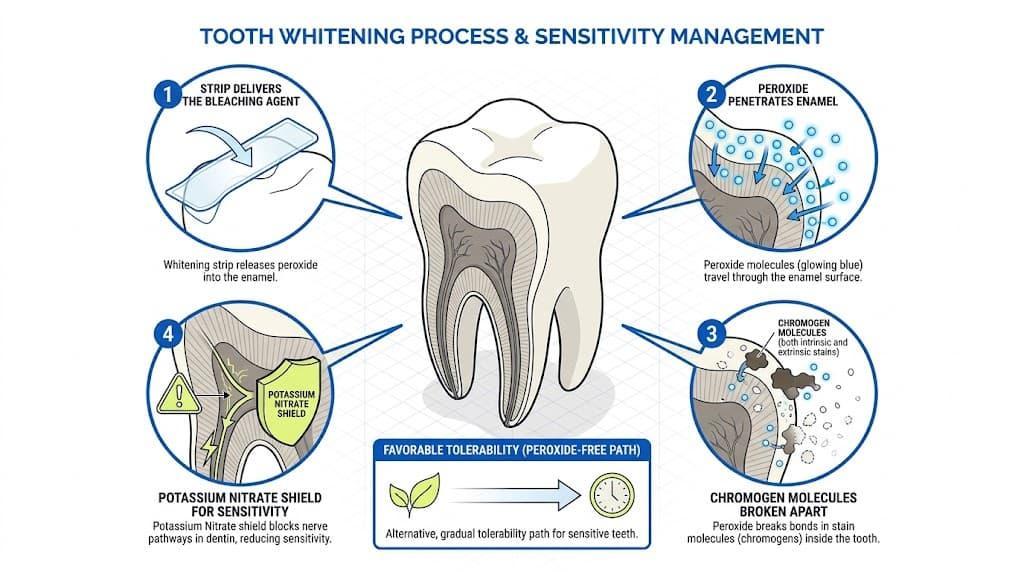
You're about to put a peroxide-based product on your teeth for up to 60 minutes. Worth knowing what's actually happening in there.
The Strip Delivers the Bleaching Agent
Whitening strips work by pressing hydrogen peroxide or carbamide peroxide directly against your enamel. These peroxides are the most effective whitening ingredients because they penetrate the enamel as the active whitening agent and reverse both intrinsic and extrinsic stains by breaking down chromogen molecules, the compounds responsible for visible staining from years of coffee, tea, and red wine. Your tooth doesn’t get scrubbed. The staining gets chemically dismantled from the inside out.
The Research Backs It Up
This isn’t just marketing. A randomized controlled trial published in Frontiers in Oral Health in 2026 evaluated low-concentration whitening strips with 3% hydrogen peroxide on extrinsic tooth discoloration and confirmed statistically significant whitening improvements alongside a favorable safety profile. Translation: lower-concentration peroxide, when used consistently, really works.
Then Sensitivity Shows Up (For Some People)
This is where things get complicated.
Peroxide doesn’t always stop at the enamel. It can push through into the dentin layer underneath and temporarily spike nerve sensitivity, that sharp, uninvited jolt that makes people throw their strips in the trash before results ever show up.
This isn’t a rare reaction. It’s the single most common reason people quit whitening mid-course.
Potassium Nitrate Is the Fix With Real Evidence Behind It
Products that include potassium nitrate aren’t just slapping the word “sensitive” on the box. Carbamide peroxide gel containing potassium nitrate produced measurably less tooth sensitivity than a control bleaching gel over a two-week treatment period, with no loss in whitening performance. Sensitivity can also be managed by brushing with toothpaste containing potassium nitrate, fluoride, or strontium chloride. If sensitivity has stopped you before, this ingredient is worth looking for specifically.
Peroxide-Free Works Too, Just Slower
If you want to skip peroxide entirely, the trade-off is real but manageable. A 2023 randomized controlled trial compared a plant-oil-based formula against a standard hydrogen peroxide whitening strip. The peroxide-free group achieved less overall color change but showed favorable tolerability throughout the treatment. Gentler means slower. For the right buyer, that is not a downside. It’s the whole reason to choose it.
What to Actually Look for in a Crest 3D Alternative
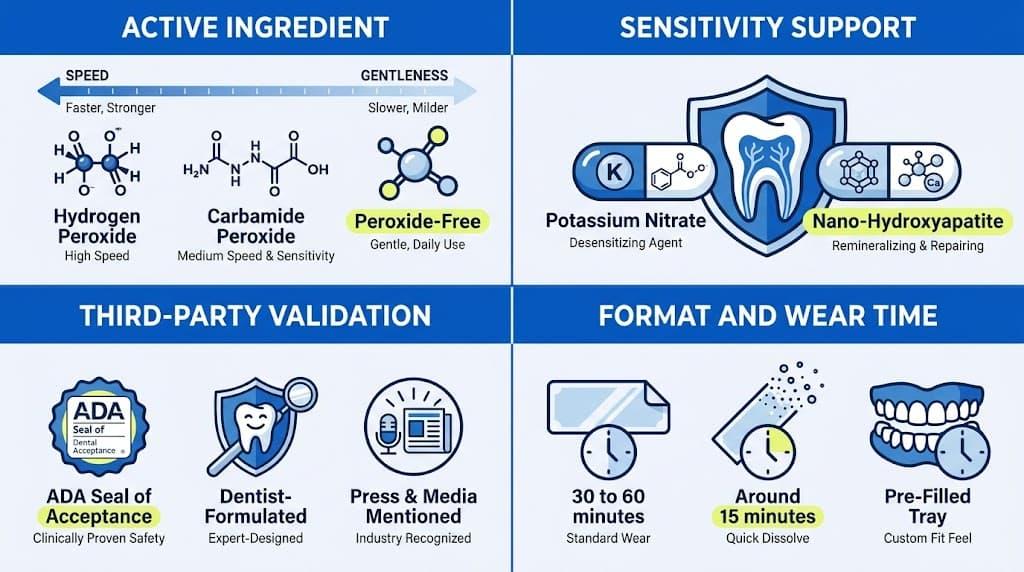
Not all alternatives are worth the switch. Here are the four things that separate the strong options from the disappointing ones.
Active ingredient. Hydrogen peroxide moves fastest but increases the risk of sensitivity with repeated use. Carbamide peroxide is gentler because it releases hydrogen peroxide more slowly, meaning less shock to the system per session. Peroxide-free formulas using plant oils or color-correcting technology are the gentlest option, though they produce the most gradual whitening. Know what you’re prioritizing before you choose.
Sensitivity support. If sensitivity has ended a whitening routine for you before, this is not a nice-to-have - it is the deciding factor. Look specifically for potassium nitrate and Nano-Hydroxyapatite in the ingredient list. Both have clinical research supporting their role in making whitening more tolerable without undermining results.
Third-party validation. The ADA Seal of Acceptance means an independent body evaluated the product’s safety and efficacy claims and confirmed them. Not every product on this list carries it, and that gap matters for ingredient-conscious buyers. Dentist-formulated credentials and press editorial coverage serve a similar function when the Seal is absent.
Format and wear time. Traditional strips require 30 to 60 minutes per session and are prone to slipping. Dissolving strips cut that to around 15 minutes with no removal step. Pre-filled trays offer better surface contact, and molded trays or an LED light system can match or outperform strips depending on whether you need better stability or a gentler formula. Pick the format you will actually use consistently - that matters more than any single ingredient advantage, and the strongest over-the-counter teeth whitening kits are not limited to strips but also include professional-grade prefilled trays, LED-assisted options, and peroxide-free natural strips.
A Quick Note on Dental Restorations and Realistic Results
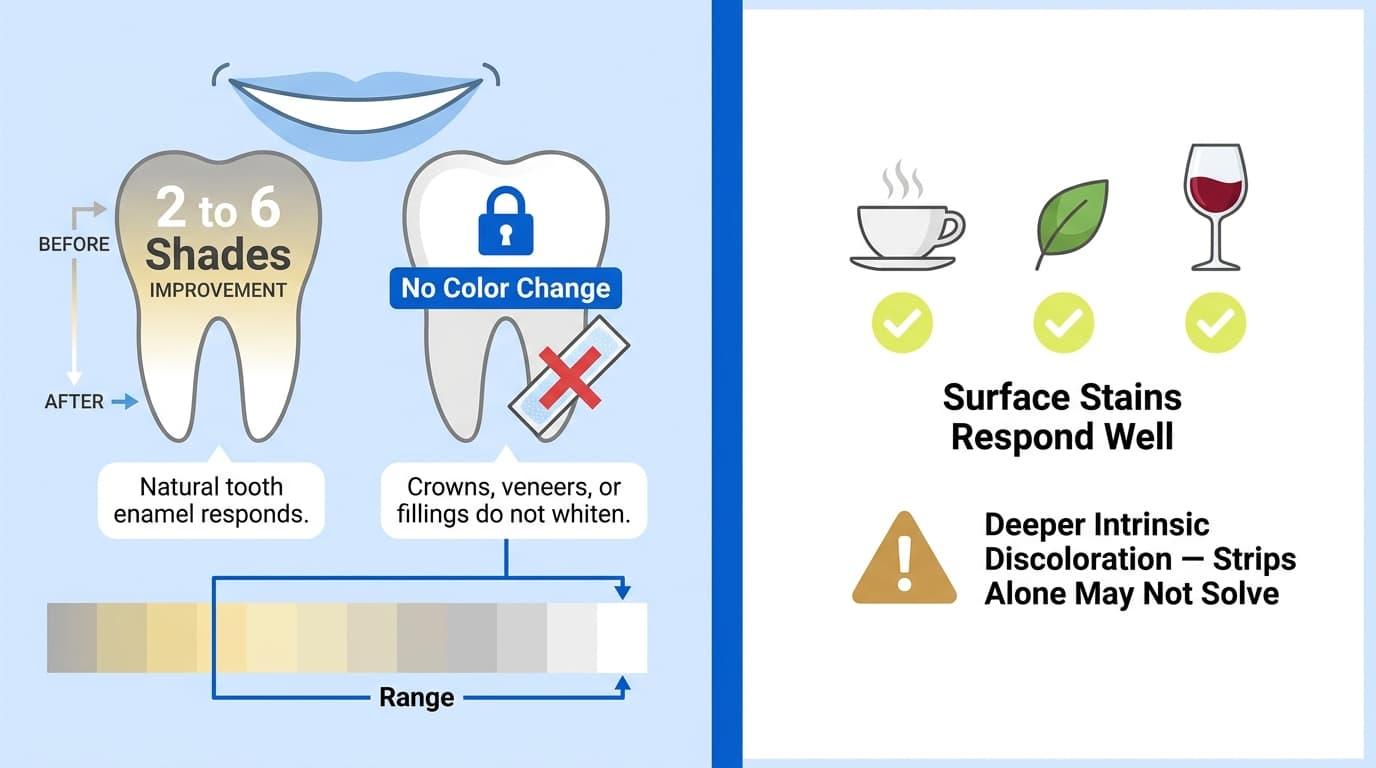
One thing that almost no product pages bother to mention? Whitening strips don’t change the color of crowns, veneers, or fillings. None of them. Only natural tooth enamel responds to peroxide or enzyme-based whitening agents.
If you have visible dental restorations in your smile zone and you whiten your surrounding natural teeth, the contrast can actually become more obvious, not less. To avoid any issues, it’s worth a conversation with your dentist before you start.
As for realistic expectations, most over-the-counter strips deliver somewhere between 2 and 6 shades of improvement with consistent use. That’s a visible, meaningful change, but it’s not the dramatic transformation that heavily filtered before-and-after content sometimes implies. Surface stains from coffee, tea, and wine respond well. Deeper intrinsic discoloration is a different problem that strips alone may not solve.
Final Words
There’s no single best Crest 3D Whitestrips alternative. There’s only the best one for your teeth, your routine, your budget, and your patience for ingredient labels. Sensitivity, format preference, and how fast you want results will all point somewhere different on this list.
That said, if you want our honest recommendation for most people? SNOW Dissolving Strips cover the most ground. They’re dentist-formulated, sensitivity-conscious, contain clean ingredients, and come in a format that removes the parts of whitening that cause people to quit. Try them with the 60-day money-back guarantee and let your teeth make the final call.
Start Your SNOW Whitening Routine Today
Frequently Asked Questions
Looking for a Crest Whitestrips alternative? Here are quick answers about whitening strips, sensitivity, and the difference between peroxide and cleaner-label whitening options.
How long does it take to see results from whitening strips?
Most whitening strips show visible results within 7 to 14 days when used consistently. Stronger peroxide formulas like Crest usually work faster, while peroxide-free or PAP-based alternatives brighten teeth more gradually. Surface stains from coffee, tea, and wine typically respond the quickest. Some products also include color-correcting ingredients for an instant brightness effect.
Are whitening strips safe if I have sensitive teeth?
Yes, some whitening strips are designed specifically for sensitive teeth. Lower-peroxide formulas, carbamide peroxide, and peroxide-free PAP strips are usually gentler than standard whitening strips. Products like Lumineux and Hismile are commonly recommended for minimizing discomfort, and the Snow Diamond Wireless Teeth Whitening Kit uses LED tech with a wireless device and light to deliver immediate whitening results while helping minimize sensitivity. If you already deal with strong tooth sensitivity or dental work, checking with your dentist first is still a good idea.
What is the difference between carbamide peroxide and hydrogen peroxide?
Hydrogen peroxide works faster because it directly whitens the enamel surface, but it can also increase sensitivity more quickly. Carbamide peroxide breaks down into hydrogen peroxide more gradually, creating a slower and gentler whitening process. Both ingredients can whiten teeth effectively with consistent use. The main difference is speed versus sensitivity management.
Do whitening strips work on crowns, veneers, or fillings?
No, whitening strips only work on natural tooth enamel. Crowns, veneers, and fillings will not change color regardless of the whitening formula used. This can sometimes create uneven coloring if the surrounding natural teeth become whiter. It’s best to discuss whitening plans with your dentist if you have visible dental restorations.
How many shades whiter can I realistically expect?
Most over-the-counter whitening strips can improve tooth shade by around 2 to 6 shades with proper use. Results depend on the severity of staining, product strength, and how consistently the strips are used. Surface stains respond well to at-home whitening products, while deeper discoloration may require professional treatment. Dramatic overnight whitening results are usually unrealistic.